

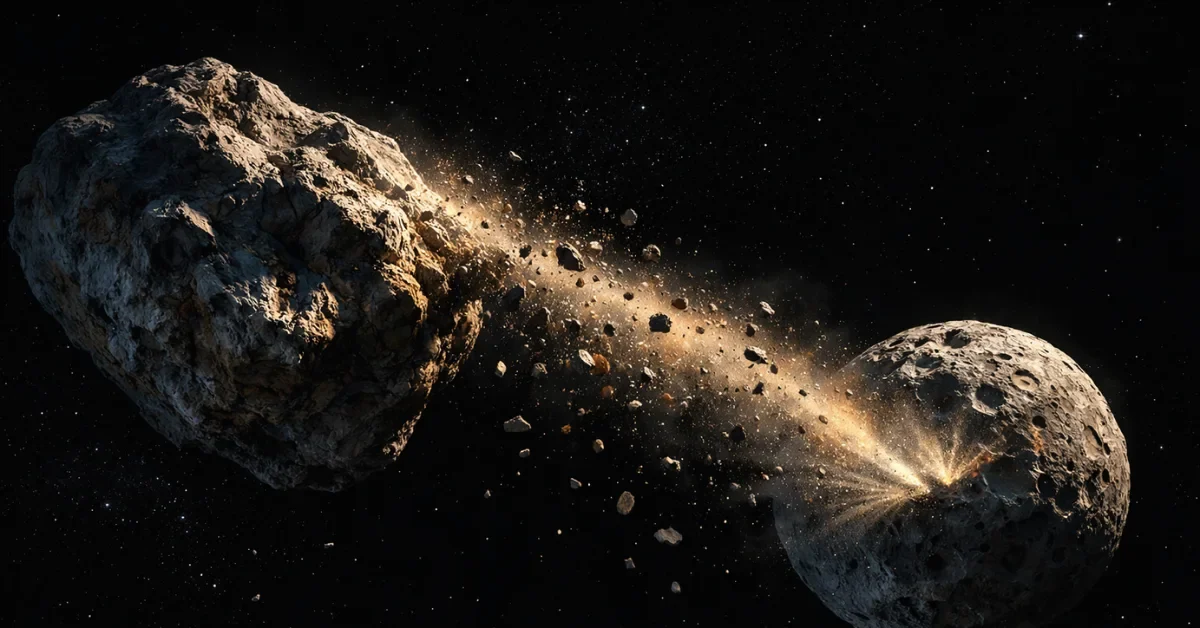
The NASA DART mission spacecraft’s 2022 collision with an asteroid continues to yield astonishing discoveries. New analysis of images captured right before the historic crash reveals that paired asteroids constantly reshape each other by exchanging rocks and dust in gentle, slow-motion collisions.
Astronomers led by the University of Maryland uncovered the first direct visual evidence of material traveling naturally between space rocks. Published in The Planetary Science Journal on March 6, 2026, the findings offer vital clues about how near-Earth asteroids behave, providing crucial insights to improve future planetary defense strategies.
Unseen Dynamics in Binary Asteroid Systems
Roughly 15 percent of known near-Earth asteroids exist in binary systems, meaning a larger asteroid is orbited by a smaller moon. Until now, scientists did not realize how active these cosmic neighborhoods could be.
The new research centers on Dimorphos, the small asteroid moon orbiting a larger primary asteroid named Didymos. As the NASA Double Asteroid Redirection Test (DART) spacecraft hurtled toward Dimorphos for its deliberate collision in 2022, it snapped detailed pictures of the moon’s surface.
Analyzing these final images, researchers spotted bright, fan-shaped streaks stretching across Dimorphos. These distinctive rays serve as the first visual proof that material naturally migrates from a primary asteroid to its moon.
According to Jessica Sunshine, the paper’s lead author and a professor at the University of Maryland, the discovery initially seemed like a technical glitch. The team suspected an image processing error. However, further analysis confirmed the patterns were caused by low-velocity impacts, a process researchers compare to tossing “cosmic snowballs.”
Discovering the Hidden Streaks
Finding these delicate streaks required extensive detective work. In the raw images transmitted by the DART spacecraft, the fan-shaped rays were completely invisible.
The mission’s trajectory created a unique optical challenge. The spacecraft approached Dimorphos head-on, meaning the lighting and perspective barely changed. This made it difficult for scientists to distinguish between physical features and visual artifacts caused by the sun’s glare.
To solve this problem, University of Maryland astronomy research scientist Tony Farnham and former postdoctoral researcher Juan Rizos developed advanced image-processing techniques. They stripped away shadows cast by surface boulders and corrected lighting effects. Once the visual noise was cleared, the subtle streaks emerged.
To ensure the streaks were real, the team mapped the rays back to their origin near the edge of Dimorphos. Because this point was offset from where the sun was directly overhead, they concluded the marks were left by incoming cosmic snowballs.
The YORP Effect in Action
The discovery provides the first visual confirmation of the Yarkovsky-O’Keefe-Radzievskii-Paddak (YORP) effect. This occurs when sunlight heats a small asteroid, causing it to spin faster. Eventually, the rapid rotation forces rocks and dust to fly off the surface, sometimes coalescing into a moon.
The bright streaks on Dimorphos show exactly where the shed material from Didymos landed. Calculations revealed that the dust and rocks left the larger asteroid at a sluggish speed of just 30.7 centimeters per second, slower than an average human’s walking pace.
Because the material traveled so slowly, the impacts created smooth deposits rather than violent craters. As the material spun off Didymos, it landed centered around the equator of Dimorphos, matching what mathematical models predicted.
Simulating the Cosmic Impacts
To prove their theory, the research team conducted laboratory experiments. They simulated the rocky surface of Dimorphos by scattering painted gravel over sand, then dropped marbles to represent the incoming cosmic snowballs.
High-speed cameras recorded the results. The footage showed that surface boulders blocked some incoming material while allowing other particles to stream through gaps. This interaction naturally sculpted the debris into the exact fan-like rays seen in the DART images.
Computer simulations performed at the Lawrence Livermore National Laboratory backed up the physical experiments. Whether the incoming material was solid rock or loose dust, the boulders on the asteroid’s surface consistently funneled the debris into those distinctive ray patterns.
Preparing for the Hera Mission
Understanding how near-Earth asteroids evolve and interact is a critical step in refining planetary defense measures to protect our planet from potential impacts.
Scientists will soon have another opportunity to study this dynamic environment. The European Space Agency’s Hera mission is scheduled to arrive at the Didymos system in December 2026.
Researchers hope the Hera spacecraft will reveal whether the delicate fan rays survived the DART spacecraft’s explosive collision. There is also a possibility that Hera will discover new streaks created by the debris that DART knocked loose, unveiling the hidden lives of these dynamic space rocks.
