

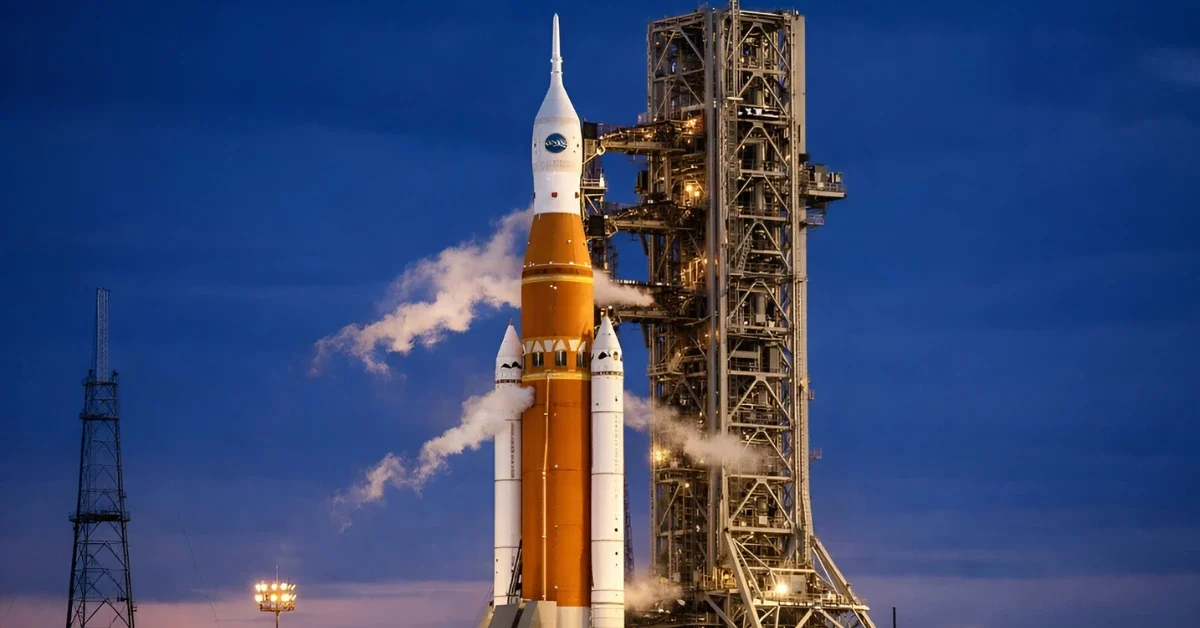
NASA has pushed back the launch of its Artemis II mission to March following technical issues during a critical fueling test conducted earlier this week. The delay marks another setback for the agency’s ambitious plan to return astronauts to the moon for the first time in over five decades.
The space agency completed a wet dress rehearsal for the Artemis II test flight early Tuesday morning, which involved loading cryogenic propellant into the Space Launch System tanks. While the test successfully filled all tanks in both the core stage and interim cryogenic propulsion stage, engineers encountered multiple challenges that prevented a planned February launch.
Hydrogen Leak Forces Countdown Stop
The most significant problem arose during tanking operations when engineers detected a liquid hydrogen leak in an interface used to route the cryogenic propellant into the rocket’s core stage. Teams spent several hours attempting to fix the issue by stopping the flow of liquid hydrogen into the core stage, allowing the interface to warm up for the seals to reseat, and adjusting the flow of the propellant.
Despite these efforts, the ground launch sequencer automatically halted the countdown at approximately five minutes remaining due to a spike in the liquid hydrogen leak rate. This occurred after engineers had conducted a first run at terminal countdown operations during the test.
Cold Weather Compounds Testing Challenges
Unusually cold temperatures at Kennedy Space Center in Florida created additional complications throughout the approximately 49-hour countdown, which began on January 31. The frigid conditions caused a late start to tanking operations, as teams needed extra time to bring some interfaces to acceptable temperatures before propellant loading could begin.
Cold weather also affected several cameras and other equipment during the test. While these issues did not prevent the wet dress rehearsal from proceeding, they would have required additional attention on an actual launch day.
Additional Technical Problems Identified
Beyond the hydrogen leak, engineers identified several other concerns during the test. A valve associated with the Orion crew module hatch pressurization, which had recently been replaced, required retorquing. Closeout operations also took longer than anticipated when a team of five was sent to the launch pad to finish Orion closeout tasks.
Communication problems emerged as another area of concern. Engineers have been troubleshooting dropouts of audio communication channels across ground teams in recent weeks, and several dropouts reoccurred during the wet dress rehearsal.
Astronaut Quarantine Temporarily Lifted
The four-person crew entered quarantine in Houston on January 21 in preparation for the mission. With the shift to a March launch window, NASA astronauts Reid Wiseman, Victor Glover, and Christina Koch, along with Canadian Space Agency astronaut Jeremy Hansen, will be released from quarantine. They will not travel to Kennedy Space Center as tentatively planned for Tuesday and will enter quarantine again approximately two weeks before the next targeted launch opportunity.
Next Steps for Mission Preparation
Teams will now fully review data from the wet dress rehearsal and work to mitigate each identified issue before conducting a second wet dress rehearsal. NASA has not yet announced an official target launch date within the March timeframe.
The team also carried out updated procedures during the test to purge the Orion service module’s cavities with breathing air during closeout crew operations rather than gaseous nitrogen. This ensures that the team assisting the crew into their seats and closing Orion’s hatches can safely operate in the White Room.
NASA has emphasized that crew safety remains the highest priority as the agency works toward sending the four astronauts on a journey around the moon and back. The wet dress rehearsal was designed as a prelaunch test to identify any issues and resolve them before attempting a launch, fulfilling its intended purpose despite the resulting delay.
