

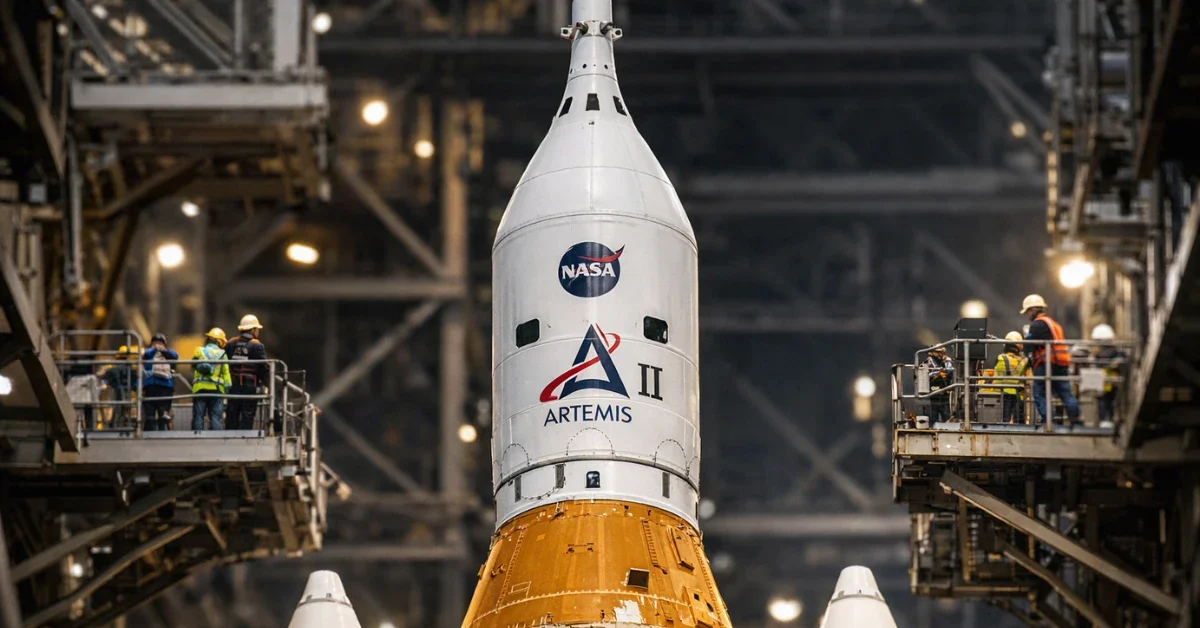
NASA has successfully resolved a critical equipment issue on its massive moon rocket, keeping the agency securely on track for an upcoming Artemis II launch. The vital repair comes after the towering Space Launch System and its attached Orion crew spacecraft were forced to roll back from the launch pad to the Vehicle Assembly Building late last month to address the malfunction.
With the necessary fixes now complete, the space agency is officially eyeing a potential liftoff in April. This highly anticipated mission will mark the first time human explorers have traveled beyond low-Earth orbit in more than half a century.
Resolving the Helium Flow Blockage
The frustrating setback originally emerged shortly after the rocket completed a successful wet dress rehearsal—a critical two-day practice run of fueling and pre-launch procedures—on February 21. While preparing for an early March liftoff from Kennedy Space Center’s Launch Pad 39B, engineers noticed a sudden interruption in the flow of helium gas directed into the rocket’s upper stage.
This upper section, officially known as the interim cryogenic propulsion stage, relies entirely on helium to purge cryogenic fuel and carefully maintain proper pressure within the propellant tanks for its single RL-10 engine. Because the affected hardware was inaccessible while the rocket stood at the launch pad, NASA had no other option but to move the massive vehicle back to the Vehicle Assembly Building on February 25.
Lori Glaze, NASA’s acting associate administrator for the Exploration Systems Development Mission Directorate, noted that the decision to delay was difficult but entirely necessary. According to Glaze, the preliminary data clearly indicated a “no-go” situation, and the launch team allowed those operational findings to directly guide their safety-first response.
Engineers eventually traced the gas flow blockage to a dislodged seal inside the quick disconnect, an important interface designed to safely break away from the rocket during liftoff. Technicians carefully removed the affected component, reassembled the internal system, and successfully validated the repair by running a deliberately reduced flow of helium through the mechanism. The agency is still actively investigating exactly what caused the seal to shift out of its proper place.
Additional Rocket Maintenance
While the giant rocket remains safely parked in the hangar, ground crews are taking full advantage of the opportunity to complete other essential maintenance tasks. This includes installing and activating brand-new batteries for the rocket’s flight termination system. Once installed, this critical safety system will undergo extensive end-to-end retesting to fully satisfy the stringent safety requirements of the Space Force’s Eastern Range.
Teams are also busy replacing various flight batteries on the core stage, the upper stage, and the twin solid rocket boosters. At the exact same time, workers are continuously charging the emergency-abort batteries located on the Orion capsule. Furthermore, technicians have begun the complex process of replacing a seal on the core stage’s liquid oxygen line feed system, a delicate task that will conclude with intensive integrity tests to ensure the new seal is completely tight and ready for flight.
Targeting an April Artemis II Launch
The unexpected helium flow issue effectively eliminated the previously established target launch date of March 6. Now, NASA is officially targeting its next available launch window, which opens on April 1. If the rocket is simply not ready to fly on that specific day, backup opportunities are available between April 3 and April 6, with another launch window opening on April 30.
Glaze clearly explained that once the rocket rolls back out to the launch pad, launch teams will still need approximately a week and a half to finish their final preparations before any launch attempt can actually occur.
When it does finally fly, the 10-day Artemis II mission will confidently send four astronauts on an ambitious journey around the moon and back. The historic crew features NASA astronauts Reid Wiseman, Victor Glover, and Christina Koch, along with Canadian Space Agency astronaut Jeremy Hansen. This monumental flight will be the very first crewed mission to the lunar neighborhood since the Apollo 17 landing in 1972.
NASA Restructures Future Artemis Missions
Alongside the positive Artemis II launch updates, NASA recently announced significant and sweeping changes to the broader lunar exploration program. NASA Administrator Jared Isaacman publicly revealed that the subsequent Artemis III mission will no longer serve as the program’s first crewed lunar landing.
Instead, Artemis III is now slated as a mid-2027 crewed test mission that will remain relatively close to Earth. During this revised flight, the Orion spacecraft will actively practice rendezvousing and docking with human landing systems that are currently being developed by private aerospace companies like SpaceX and Blue Origin.
Isaacman emphasized that these strategic changes are specifically designed to accelerate manufacturing, dramatically increase launch rates, and build vital operational muscle memory for future crews. Moving forward, the timeline for an actual lunar landing remains firmly focused on 2028. However, reports differ slightly on the exact sequence of those future missions. Some agency announcements indicate that the Artemis III test flight will establish the groundwork for two potential moon landing missions in 2028, while other program updates specifically identify Artemis IV as the singular mission that will return astronauts to the lunar surface that year.
