

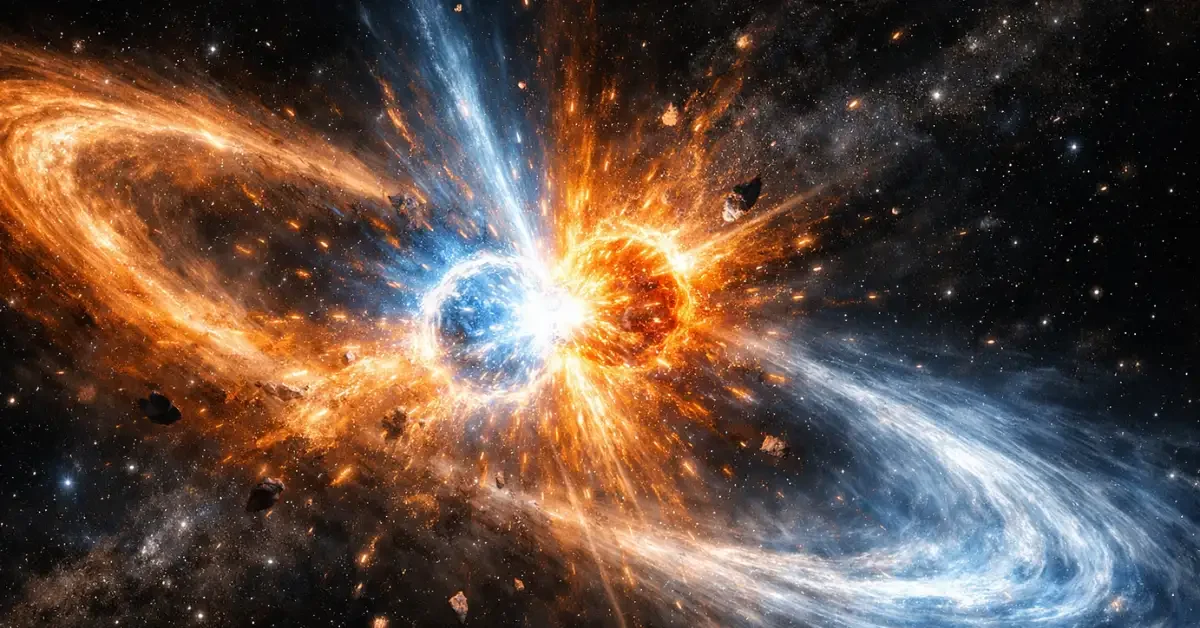
Astronomers using a network of space telescopes have uncovered a groundbreaking event in deep space. For the first time, researchers have traced a massive cosmic explosion back to a neutron star collision in an unexpectedly tiny and faint galaxy. This remarkable discovery, involving extreme stellar remnants crashing into each other, is challenging previous assumptions about where these intense events can occur.
The historic neutron star collision was detected billions of light-years away, buried within a massive stream of gas. This rare celestial event is providing experts with critical clues needed to solve long-standing mysteries about the universe, including the origins of heavy elements like gold and platinum.
The extraordinary outburst of radiation, known as a gamma-ray burst, has been designated as GRB 230906A. There is a slight disagreement in the timing of the discovery among reporting organizations. According to NASA, the explosive event occurred on September 6, 2023. Meanwhile, Space.com reports that the burst was detected on September 23, 2023. Despite this discrepancy, the scientific consensus on the event’s significance remains unified.
The discovery was made possible through the combined efforts of major observatories. The Fermi Gamma-ray Space Telescope initially picked up the distinctive explosion signal. Afterward, researchers utilized the Neil Gehrels Swift Observatory, Chandra X-ray Observatory, and Hubble Space Telescope to pinpoint the exact location.
An Unprecedented Cosmic Location
Previous observations of merging neutron stars always pointed to medium or large galaxies. Neutron stars are the incredibly dense, collapsed cores left behind after massive stars exhaust their nuclear fuel and explode in supernovas. Measuring only about a dozen miles across, they hold more mass than our Sun, making them some of the most extreme objects in the universe.
This newly discovered neutron star collision broke the mold by taking place in a tiny galaxy approximately 4.7 billion light-years away. This faint galaxy sits embedded within an enormous gas and dust stream stretching roughly 600,000 light-years long. For comparison, this massive stream is about six times the diameter of our entire Milky Way galaxy.
Solving Two Major Space Mysteries
The research team, whose findings were published in The Astrophysical Journal Letters, believes this unusual environment holds the answers to major astrophysical puzzles. Simone Dichiara from Penn State University, who led the discovery team, stated, “Finding a neutron star collision where we did is game changing. It may be the key to unlocking not one, but two important questions in astrophysics.”
The Mystery of Hostless Gamma-Ray Bursts
The first puzzle involves gamma-ray bursts that appear to occur in the middle of nowhere. Astronomers frequently trace these intense radiation bursts back to origins far from dense galactic cores. Sometimes they seem to originate entirely outside of any galaxy. This latest discovery implies that many of these seemingly “hostless” explosions actually happen inside tiny, extremely faint galaxies that are simply too dim to be seen in standard optical images from ground-based telescopes.
The Origin of Heavy Elements
The second enigma involves the distribution of precious metals. Scientists know that the turbulent environments created by colliding neutron stars synthesize heavy elements like silver, gold, and platinum. However, astronomers have often found these elements in older stars located far from galactic centers, where such materials should not logically exist. Explosions like GRB 230906A demonstrate that neutron star mergers in galactic outskirts can generate these heavy elements and spread them far and wide.
A Collision Within a Collision
The massive gas stream hosting this tiny galaxy has a violent history. Astronomers believe the stream formed hundreds of millions of years ago when a larger group of galaxies collided. This crash stripped away gas and dust, casting it out into intergalactic space.
Eleonora Troja from the University of Rome described the phenomenon perfectly, stating, “We found a collision within a collision. The galaxy collision triggered a wave of star formation that, over hundreds of millions of years, led to the birth and eventual collision of these neutron stars.”
How Telescopes Tracked the Explosion
Pinpointing this faint celestial event required a masterclass in astronomical teamwork. After Fermi detected the initial gamma-ray burst and the InterPlanetary Network provided a preliminary location, X-ray data became crucial.
Brendan O’Connor from Carnegie Mellon University emphasized this point, stating, “Chandra’s pinpoint X-ray localization made this study possible. Without it, we couldn’t have tied the burst to any specific source. And once Chandra told us exactly where to look, Hubble’s extraordinary sensitivity revealed the tiny, extremely faint galaxy at that position. We were only able to make this discovery after we put all the pieces together.”
While the research team is confident in their findings, they acknowledge one alternative explanation. The explosion could potentially be located in a much more distant galaxy sitting behind the identified galaxy group. However, researchers consider this scenario much less likely than the tiny galaxy explanation.
