

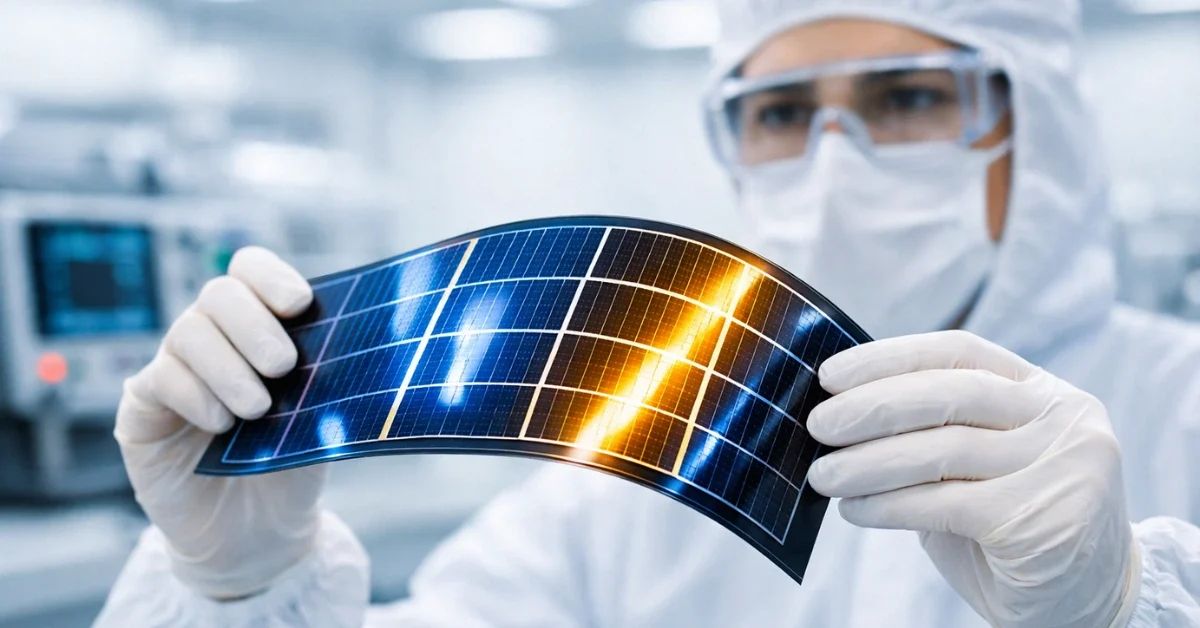
The global market for next-generation solar cell technology is rapidly expanding. Valued at $2.6 billion in 2022, the market is projected to reach $17.5 billion by 2032, growing at a 21.4% compound annual growth rate. Conventional silicon photovoltaic panels currently dominate the industry, but emerging technologies promise higher efficiencies, lower production costs, and entirely new applications. Breakthroughs in perovskite, quantum dot, and transparent solar modules are transforming the future of clean energy. Organic solar cells and multi-junction concentrator photovoltaics, which can exceed 45% efficiency for space and concentrated solar applications, are also pushing the boundaries of what is possible. As governments enforce strict net-zero policies, these high-efficiency solar panel technology trends are critical to meeting global energy demands.
Efficiency Milestones in Perovskite and Silicon Cells
Perovskite solar cells are emerging as the fastest-growing segment in the renewable energy sector due to their simple manufacturing process and low production costs. Unlike silicon, which requires energy-intensive purification, perovskites can be produced using simple solution-based coating methods. According to Acumen Research and Consulting, the perovskite solar cell market was valued at $353.9 million in 2025 and is projected to exceed $7.58 billion by 2035.
Recent developments highlight the massive potential of these materials. In early 2025, Trina Solar achieved a 25.44% conversion efficiency record for its n-type fully passivated heterojunction modules. Meanwhile, LONGi Solar reached a 26.81% efficiency milestone in late 2023 for its perovskite-silicon tandem solar cells. This tandem design layers perovskite over conventional silicon, allowing the module to capture a broader spectrum of sunlight. Acumen Research and Consulting notes that laboratory efficiencies for these tandem cells have even surpassed 33%. To help commercialize ultra-thin, flexible perovskite solar cells, Japan announced a $1.5 billion national investment in 2025.
Quantum Dot and Indium-Free Innovations
Quantum dot solar cells represent another high-growth technology segment. By using nanoscale semiconductor crystals with precisely tunable properties, quantum dot modules enable multi-spectral light absorption. The market for this technology was valued at roughly $1.48 billion in 2025 and is expected to reach $7 billion by 2035.
Researchers are also exploring alternative materials to improve performance and sustainability. Scientists at Japan’s National Institute of Advanced Industrial Science and Technology recently recorded a 12.28% power conversion efficiency in a solar cell utilizing a copper gallium selenide absorber. This is the highest recorded efficiency for an indium-free wide-bandgap chalcogenide solar cell in its specific energy range. Upgrading a cell design from 2024, the researchers added aluminum to the backside region of the absorber films to improve voltage and carrier collection. While this fundamental technology requires further development before mass production or cost analysis, it shows significant promise for future tandem cell structures.
Flexible, Transparent, and Smart Integrations
Ongoing research is making solar modules lighter and more adaptable for everyday use. Researchers at the Massachusetts Institute of Technology recently introduced ultralight fabric solar cells. These cells are thinner than a human hair and weigh just one-hundredth of traditional glass-encased panels, yet they generate 18 times more power per kilogram. Consumer electronics are also integrating these advances; in 2025, Lenovo unveiled the Yoga Solar PC, a concept laptop featuring 84 ultra-efficient solar cells built directly into the device.
In the architecture sector, transparent solar panels are turning windows and building facades into energy-harvesting devices. Using transparent luminescent solar concentrators, these panels selectively absorb ultraviolet and near-infrared light while letting visible light pass through. Additionally, bifacial solar panels are gaining market share by capturing sunlight from both the front and back of the module, utilizing reflected light from the ground or water.
Smart solar panel technologies now incorporate sensors, artificial intelligence, and the Internet of Things. These integrated systems use data analytics to track sunlight, detect potential issues, and proactively optimize overall electricity production alongside advanced energy storage systems like lithium-ion and flow batteries.
Overcoming Manufacturing Challenges and Managing Waste
Despite these technological leaps, the next-generation solar cell technology market faces several hurdles. Perovskite materials struggle with long-term stability because they can degrade when exposed to heat, moisture, and ultraviolet light. Furthermore, the highest-performing perovskites contain lead, which raises environmental and regulatory concerns as lead-free alternatives currently lag in efficiency. Scaling these highly efficient laboratory cells into consistent, high-yield commercial manufacturing remains a complex technical challenge.
As these advanced technologies deploy globally, managing end-of-life modules is becoming a major priority. In 2025, Varanashi Farms in India partnered with the Indian Institute of Science and Imperial College London to pilot the Surya Arka project. This recycling initiative successfully repurposes used solar panels into energy-efficient tools for agriculture, establishing a sustainable, circular blueprint for the renewable energy industry from manufacturing to end-of-life management.
