

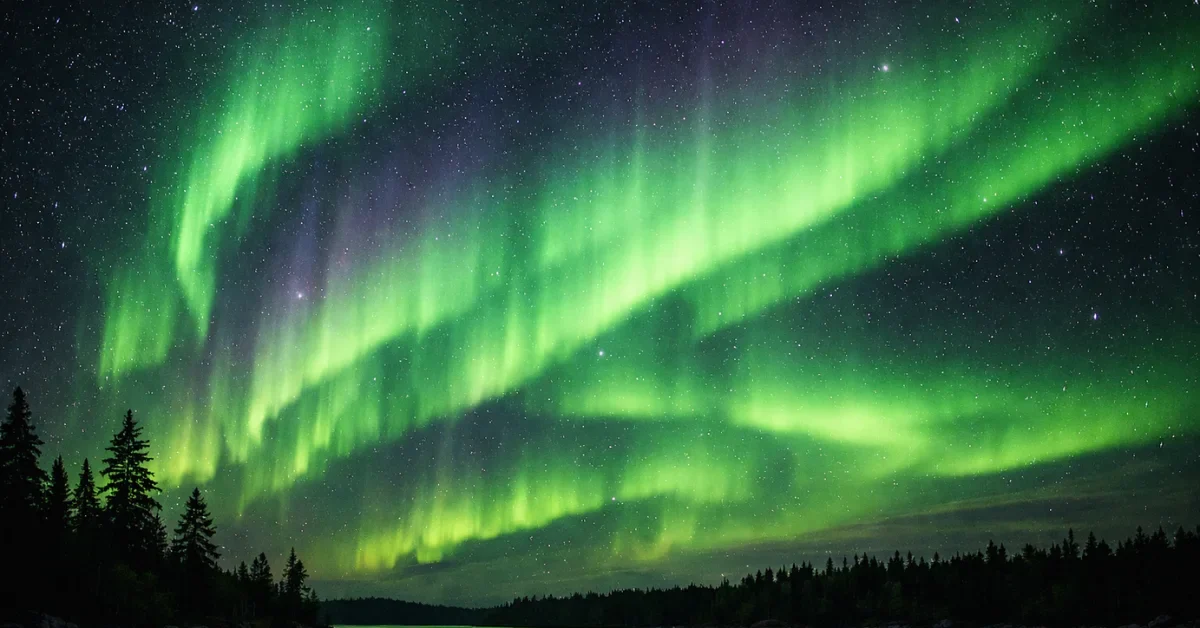
Skywatchers and space weather enthusiasts have another reason to look up, as incoming solar winds and recent solar eruptions could trigger widespread auroras. Following a relatively quiet period for the sun, forecasters are tracking fast solar winds approaching Earth that are expected to generate ideal viewing conditions for the northern lights this Sunday night. A recurrent coronal hole high-speed stream is slated to arrive, opening the door for minor to moderate geomagnetic storming across the northern hemisphere.
While recent solar activity has remained at low-to-moderate levels, the upcoming event is driven by a combination of complex space weather factors. Forecasters anticipate a G1-class minor geomagnetic storm, with the potential for brief G2-class moderate intervals if specific magnetic conditions align favorably. This incoming solar activity is projected to push the northern lights further south, potentially creating visibility across several northern states and international locations where skies are clear.
The Drivers Behind the Upcoming Aurora
Over the past twenty-four hours, the sun took a brief breather, with overall flare production dropping after an earlier energetic event. However, the solar disk remains highly active, currently displaying ten numbered sunspot regions. Among these, sunspot regions AR4401 and AR4405 maintain the most complex magnetic configurations, indicating a high potential for renewed moderate flaring in the coming days. Specifically, the sprawling beta-class region AR4405 recently fired an M1.3-class solar flare that triggered a minor radio blackout over Malaysia. Prior to that, the same region produced a long-duration C5.4 flare that released energy comparable to a stronger M-class event.
Despite the recent dip in major flare activity, the primary catalyst for Sunday night’s anticipated northern lights display is a recurrent coronal hole high-speed stream. As this stream impacts Earth’s magnetic field, solar wind speeds are forecast to climb above 500 kilometers per second. Adding a wild card to the geomagnetic forecast, two older coronal mass ejections that erupted on March 25 and March 26 also have modeled Earth-arrival windows coinciding with the high-speed stream.
Where and When to Spot the Northern Lights
As the influence of the coronal hole high-speed stream peaks, the resulting geomagnetic storming is expected to enhance aurora visibility significantly. The most intense activity is forecast for late Sunday into Monday. If the interplanetary magnetic field shifts and sustains a southward orientation, the coupling between the solar wind and Earth’s magnetosphere will strengthen, potentially elevating the storm to G2-class moderate levels.
Under these favorable conditions, the northern lights may become visible to observers located in appropriate geomagnetic latitudes. Forecasters have specifically noted that aurora watchers in cities such as Seattle and Minneapolis should stay alert for possible displays. Internationally, the auroras could reach Edinburgh and the broader Scottish Highlands, provided the local skies remain clear and free of significant light pollution.
A Continuation of Active Space Weather
This upcoming event follows closely on the heels of a highly active period of space weather earlier in the week. Just days prior, Earth’s magnetic field endured G3-class strong geomagnetic storming, which fueled gorgeous auroras that danced across northern skies. That previous storm was driven by a potent one-two punch of multiple coronal mass ejection arrivals and the onset of a fast solar wind stream pouring in from a large coronal hole.
During the peak of that earlier storm, the influx of charged particles into Earth’s upper atmosphere pushed vivid auroral displays to mid-latitude locations as far south as New York, London, and northern France. Forecasters noted that the Russell-McPherron effect, which often enhances geomagnetic activity near the equinoxes, likely played a role in strengthening those specific displays. Additional strong activity occurred when sunspot region AR4403 announced its arrival with a powerful M3.9 flare, triggering a minor radio blackout over the Indian Ocean.
Looking Ahead to Next Week
As the effects of the current high-speed stream gradually wane by Monday and Tuesday, space weather conditions are expected to transition from unsettled to active before trending back toward quiet levels. Consequently, aurora visibility will likely retreat to higher, more typical latitudes, such as northern Canada, Iceland, and northern Scandinavia.
In the meantime, scientists and forecasters continue to monitor the sun’s eastern horizon, where new active regions are rotating into Earth’s view. A recent massive blast of solar material on the northeast horizon suggests another large sunspot region is lurking just out of sight. With several complex sunspot groups already crowding the visible solar disk, the potential for further solar flares and subsequent northern lights displays remains high in the weeks ahead.
