

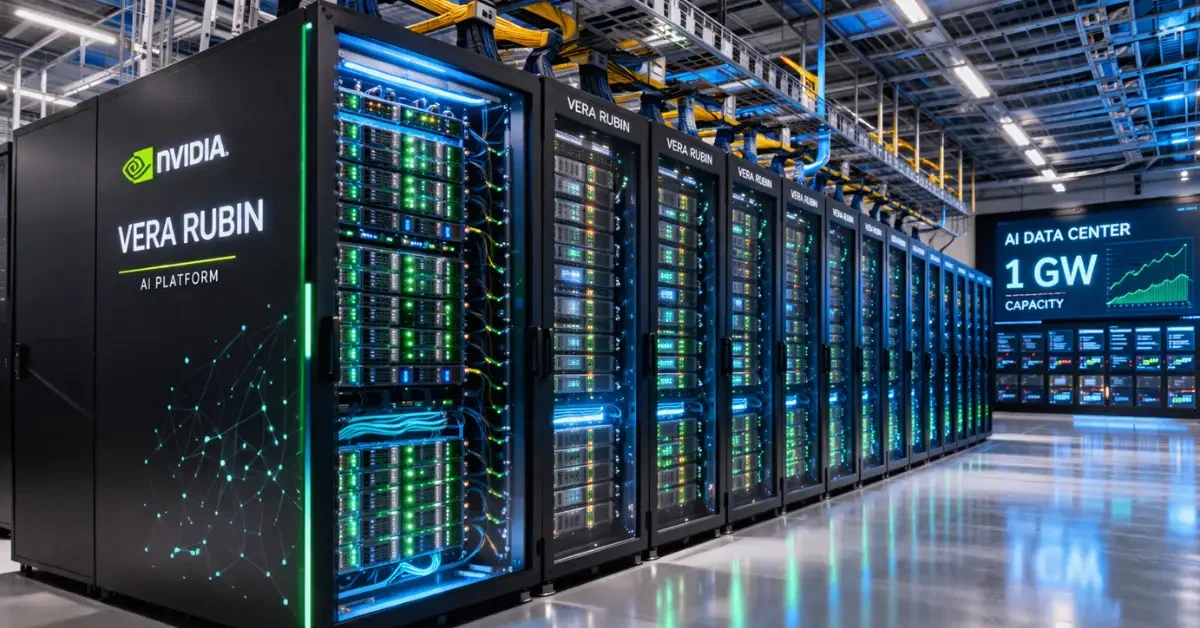
Nvidia is setting the stage for a massive expansion in the artificial intelligence sector. During the Nvidia GTC 2026 event in San Jose, CEO Jensen Huang announced that the company anticipates generating at least $1 trillion in revenue from its latest AI chips by 2027. This bold projection underscores the soaring demand for processing infrastructure that powers advanced AI models.
The Nvidia GTC 2026 conference, which drew over 20,000 in-person attendees, marked a major turning point for the technology giant. The company is evolving from a semiconductor designer into a foundational provider of planetary-scale infrastructure. At the center of this transformation is the newly unveiled Vera Rubin platform, designed to power massive gigawatt-scale facilities known as “AI factories.”
The Shift to Agentic AI and Inference
The AI economy has officially moved past its initial training phase and entered an era of practical application. Huang declared that the “inference inflection” point has arrived, driving unprecedented demand for sophisticated computing hardware. He noted that current computing demand far exceeds supply, pointing to the $500 billion in AI chip orders the company had already secured by October 2025.
This new phase is defined by agentic scaling, a development where AI systems can autonomously reason, use external tools, and communicate with other AI agents to complete complex workflows. To illustrate this shift, Huang praised an open-source AI agent named OpenClaw, developed by Peter Steinberger. He described the project as profound, noting that it has quickly become the most popular open-source project in human history, surpassing Linux in just a few weeks.
To help users manage these autonomous agents securely, the company introduced Nvidia NemoClaw, an agent toolkit that interacts directly with OpenClaw. Looking ahead, Huang predicted a fundamental change in the software industry. He expects traditional software as a service companies to transition into “agentic AI as a service” providers, offering capable AI agents instead of standard software applications.
The Vera Rubin Platform and Disaggregated Computing
To meet the extreme computational demands of agentic AI workflows, Nvidia is rethinking traditional data center designs. The Vera Rubin platform introduces a strategy called workload disaggregation, splitting compute tasks across specialized rack-scale systems. A key component of this new architecture is the Vera CPU, specifically engineered to handle the sequential reasoning required by agentic AI.
The company is also utilizing a portfolio approach to balance high-throughput processing with ultra-low-latency interactive inference. To achieve this, third-generation Groq Language Processing Units, manufactured by Samsung, are being integrated into the hardware ecosystem.
There are differing expectations regarding how data centers will allocate these resources. According to Nvidia, data centers should ideally allocate roughly 25% of their total compute to this Groq-enhanced setup for low-latency tasks, leaving the remaining 75% for Vera Rubin GPU infrastructure. However, according to Cerebras representative Andrew Feldman, the market share for fast inference will rapidly scale to 60% or 80%.
Powering the Physical AI Ecosystem
Beyond traditional data centers, Nvidia GTC 2026 highlighted advancements in physical AI and robotics. The company announced a foundational partnership with NXP Semiconductors to improve deterministic reliability in industrial robotics. By integrating the Holoscan Sensor Bridge with NXP’s edge processors, the collaboration aims to reduce the physical footprint, lower power consumption, and decrease overall system costs while minimizing latency between a robot’s sensors and its processing unit.
Other ecosystem partners are moving quickly to support the growing demands of physical AI and enterprise security. Hewlett Packard Enterprise is integrating Blackwell GPUs into its Private Cloud AI offerings. These systems feature enhanced agentic security through CrowdStrike and Fortanix, allowing for fully isolated, air-gapped configurations tailored for sovereign AI deployments.
Massive Infrastructure Deals and Supply Chain Readiness
The shift toward AI factories requires unprecedented capital investment, and major industry players are already committing significant resources. During the event, Nebius Group announced a massive $27 billion AI infrastructure agreement with Meta. This five-year deal includes $12 billion dedicated to early 2027 deliveries of the Vera Rubin platform, with an additional $15 billion committed for future Nebius clusters.
Hardware suppliers are actively scaling their operations to feed these massive systems. Micron announced that it has achieved high-volume production of HBM4 36GB memory designed specifically for the Vera Rubin platform. This new memory provides a 2.3x bandwidth improvement over previous generations while increasing power efficiency by 20%. Micron also introduced a PCIe Gen6 data center solid-state drive to eliminate data-path bottlenecks during large-scale agentic reasoning.
As the industry embraces this new infrastructure model, network disruptors like NeuReality have launched inference operating systems designed to orchestrate these rapidly diverging workloads. By coordinating tasks across heterogeneous hardware, these systems aim to transform fragmented GPU clusters into highly efficient token factories, maximizing the return on investment for large-scale deployments.
