

The tech industry gathered at the San Jose Convention Center for NVIDIA GTC 2026, where the silicon giant signaled a complete transformation. Speaking to a crowd of over 20,000 attendees, CEO Jensen Huang positioned the company as a foundational provider of planetary-scale infrastructure. Driven by skyrocketing compute demand from emerging startups, Huang projects the company will surpass $1 trillion in revenue between 2025 and 2027.
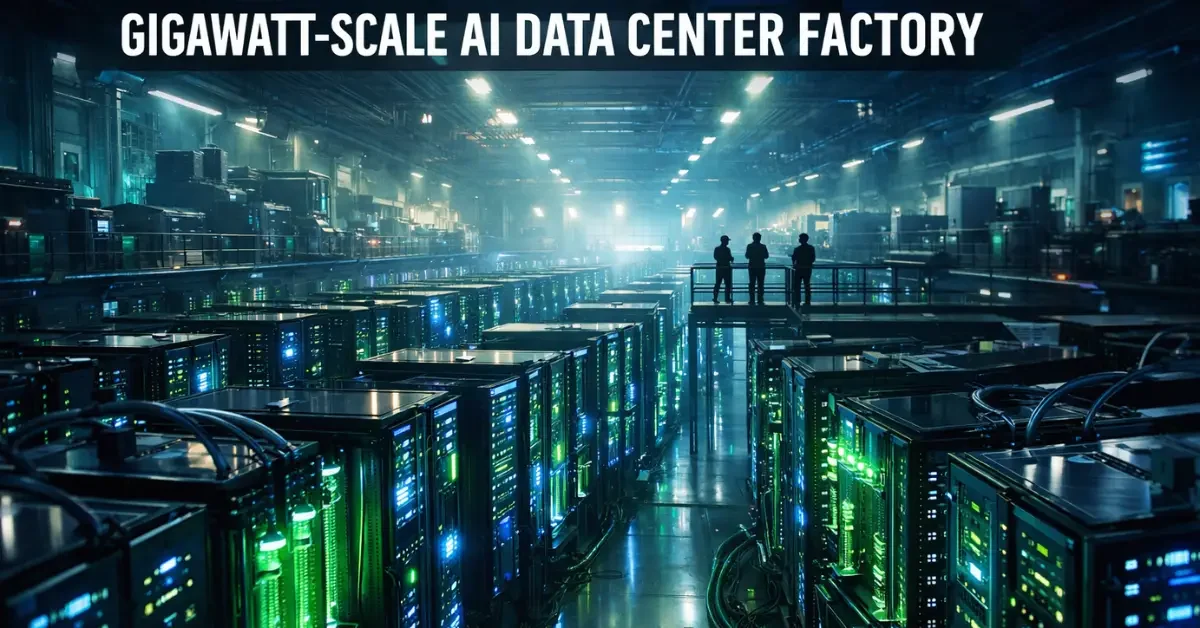
This year’s NVIDIA GTC 2026 centered on the dawn of agentic artificial intelligence and the rise of the “AI factory.” These gigawatt-scale data centers prioritize the AI token as their primary unit of economic output. Rather than just answering user prompts, agentic systems can act autonomously to reason, plan, use external tools, and complete multi-step workflows.
The Vera Rubin Platform and Disaggregated Compute
To support these intensive workloads, the company unveiled the Vera Rubin computing platform. Engineered for extreme full-stack hardware and software codesign, the architecture includes seven chips, five rack-scale systems, and a dedicated supercomputer.
A major shift in this hardware generation is workload disaggregation. Huang explained that the Vera Rubin graphics processing units are optimized for the initial data processing phase, while the decode workload is offloaded to Groq Language Processing Units. Samsung is currently manufacturing these third-generation Groq chips for the tech giant to utilize.
While Huang recommended data centers allocate about 25 percent of their total compute to this Groq-enhanced setup for extreme low-latency tasks, competitors see the market differently. Cerebras executive Andrew Feldman countered that the market share for fast inference will rapidly scale to 60 or 80 percent, highlighting a clear industry disagreement over the future breakdown of data center infrastructure.
Massive capital is already flowing into these new architectures. Nebius Group announced a landmark $27 billion infrastructure agreement with Meta over five years. This deal includes $12 billion in dedicated capacity powered by the Vera Rubin platform, with initial deliveries slated for early 2027. To keep these systems fed with data, Micron announced high-volume production of HBM4 36-gigabyte memory, which delivers a massive bandwidth improvement over previous hardware generations.
OpenClaw and the Token Economy
Software orchestration took center stage alongside the new hardware architectures. The event highlighted OpenClaw, a wildly popular open-source project that allows developers to create long-running, autonomous personal agents. To make this technology viable for corporate environments, the company introduced NemoClaw, an enterprise-optimized stack that adds strict privacy controls, policy enforcement, and network guardrails.
These agentic systems run on tokens, which break down words and data into numerical pieces for artificial intelligence models to process. The token is rapidly becoming a fundamental economic unit. Huang noted that token allocations are now a popular recruiting tool in Silicon Valley, acting as a productivity multiplier for engineers.
OpenAI CEO Sam Altman took the concept even further, suggesting that AI tokens could eventually power a system of Universal Basic Compute. In this scenario, citizens would receive a slice of computing power to use, resell, or donate, treating raw machine intelligence as a basic public utility akin to water or power.
However, this emerging token economy faces growing pains. Venture capitalist Chamath Palihapitiya recently noted that his company’s inference costs have more than tripled since November 2025, reaching into the millions without a corresponding jump in revenue. Furthermore, Microsoft CEO Satya Nadella warned that the industry could lose the social permission to consume massive amounts of energy for tokens if the technology does not tangibly improve sectors like healthcare and education.
Transforming Healthcare and Physical Robotics
The push toward autonomous systems is already reshaping major industries, with healthcare deploying the technology at more than twice the rate of the broader economy. Pharmaceutical giant Roche is currently deploying over 3,500 Blackwell graphics processing units across the United States and Europe to accelerate drug discovery and diagnostics. This follows a joint $1 billion pledge between Eli Lilly and the silicon designer to build a dedicated co-innovation lab.
Biological reasoning is also advancing rapidly. A collaboration involving Google DeepMind, the European Molecular Biology Laboratory, and Seoul National University added 1.7 million predicted protein complexes to the AlphaFold database. Concurrently, a new reasoning model called Proteina-Complexa successfully generated one million experimentally validated protein binders for structure-based drug discovery.
Beyond digital software, physical robotics are entering a new phase of industrial maturation. The newly available IGX Thor platform brings real-time processing to the industrial edge, attracting adoption from companies like Caterpillar and Hitachi Rail. Automotive partners including BYD, Hyundai, and Uber are also leveraging these platforms for autonomous driving networks.
To demonstrate this physical intelligence, Huang concluded his keynote by bringing a walking, talking version of Olaf the snowman from Disney’s Frozen onto the stage. The demonstration proved that the character’s movements and interactions were entirely simulated in real-time through the Omniverse platform, cementing the reality that autonomous systems are officially moving from the data center out into the physical world.
