

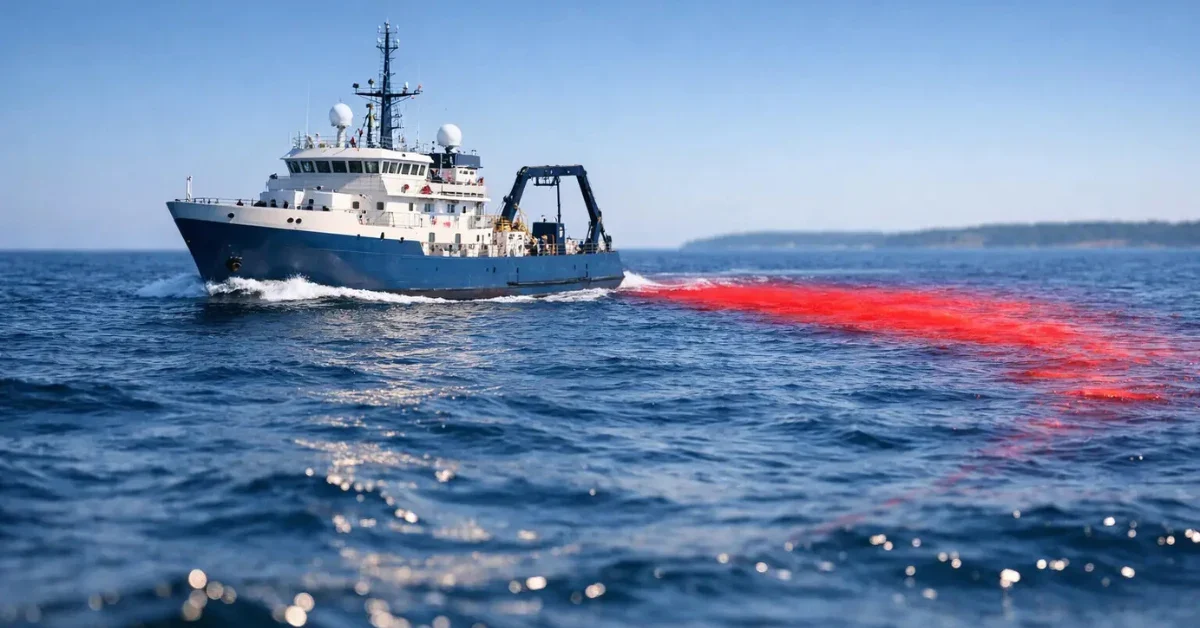
A groundbreaking ocean alkalinity enhancement trial conducted off the coast of Massachusetts has demonstrated promising preliminary results for capturing atmospheric carbon dioxide. On February 25, 2026, researchers from the Woods Hole Oceanographic Institution announced that their field experiment successfully sequestered carbon without causing measurable harm to marine life.
The findings from the LOC-NESS project were presented at the Ocean Sciences Meeting in Glasgow, Scotland. As the first experiment of its kind permitted by the U.S. Environmental Protection Agency, the trial marks a significant step in exploring marine carbon dioxide removal strategies to combat the global climate crisis.
Testing an Antacid for the Ocean
Since the industrial revolution, the world’s oceans have absorbed massive amounts of carbon dioxide. While this natural process helps reduce greenhouse gases in the atmosphere, it makes seawater increasingly acidic and damages marine ecosystems. Ocean alkalinity enhancement acts like a giant antacid, reducing acidity while boosting the water’s capacity to absorb even more carbon.
In August 2025, the Woods Hole research team poured more than 16,000 gallons of highly purified sodium hydroxide, along with a red tracer dye, into the Wilkinson Basin area of the Gulf of Maine. Over the course of five days, scientists tracked the alkaline patch using a sophisticated fleet of autonomous underwater vehicles, gliders, drifters, satellites, and shipboard sensors.
Adam Subhas, the principal investigator for the LOC-NESS project, reported that the experiment safely produced conditions allowing the surface ocean to absorb carbon. During the monitoring period, the patch sequestered between two and 10 tons of carbon dioxide. In a best-case scenario, the added alkalinity could ultimately remove up to 50 tons of carbon, an amount equivalent to the annual emissions of 10 gas-powered cars.
Monitoring Marine Life Impacts
A major goal of the trial was to determine how a sudden influx of caustic materials would affect local ecosystems. Researchers focused their biological assessments on the base of the marine food web, taking measurements of bacteria, phytoplankton, zooplankton, and the larvae of fish and lobsters.
Rachel Davitt, a Rutgers University doctoral student who helped lead the ecological assessment, stated that the trial resulted in no measurable impact on ocean life. Scientists found no significant differences in the health or abundance of these organisms when comparing water inside and outside the alkalinity patch. Furthermore, seawater acidity and tracer levels returned to their natural baselines within expected timeframes.
The Debate Over Marine Geoengineering
As global climate targets slip further out of reach, experts increasingly argue that society must actively remove billions of tons of carbon from the atmosphere. Tyler Kukla, a research scientist at the nonprofit CarbonPlan, praised the experiment for bridging the gap between laboratory models and real-world ocean deployments. Yale University biogeochemistry professor Peter Raymond echoed this sentiment, emphasizing that researchers must test these technologies now so they are ready for future use.
However, the concept of ocean geoengineering faces strong pushback from environmental advocates who warn of unintended consequences. Brett Hartl, government affairs director for the Center for Biological Diversity, described the experiment as foolish and counterproductive to addressing the climate crisis. Hartl strongly disputed the researchers’ claims of no ecological damage. He argued that the monitoring methods may not be sophisticated enough to detect long-term harm or impacts on organisms living on the seafloor, calling it implausible that the caustic compound caused no damage.
Critics also worry that marine carbon removal strategies could give industries an excuse to continue burning fossil fuels. Benjamin Day, a senior campaigner at Friends of the Earth, expressed doubt that ocean alkalinity enhancement could ever work on a global scale. He noted that scaling up the process would multiply ecosystem risks and require mining massive amounts of limestone, a process that releases its own emissions and makes the environmental math impossible to balance.
Navigating the Future of Carbon Removal
Despite the controversy, the commercial market for marine carbon removal is already moving forward. In 2025, a Canadian company operating in Nova Scotia delivered the world’s first carbon credits for ocean alkalinity enhancement, selling certificates for over 600 tons of removed carbon to major corporations, including Shopify and British Airways.
The Woods Hole researchers emphasize that their non-profit work is purely scientific and not an endorsement of large-scale commercial deployment. Prior to the launch, the LOC-NESS team participated in more than 50 community engagement events with fishing communities, tribal representatives, and industry stakeholders to build trust and gather feedback.
Moving forward, the research team will continue to analyze the data collected in the Gulf of Maine. The preliminary results are expected to be compiled into a peer-reviewed publication in the coming months, providing further transparency into the effectiveness and risks of ocean alkalinity enhancement.
