

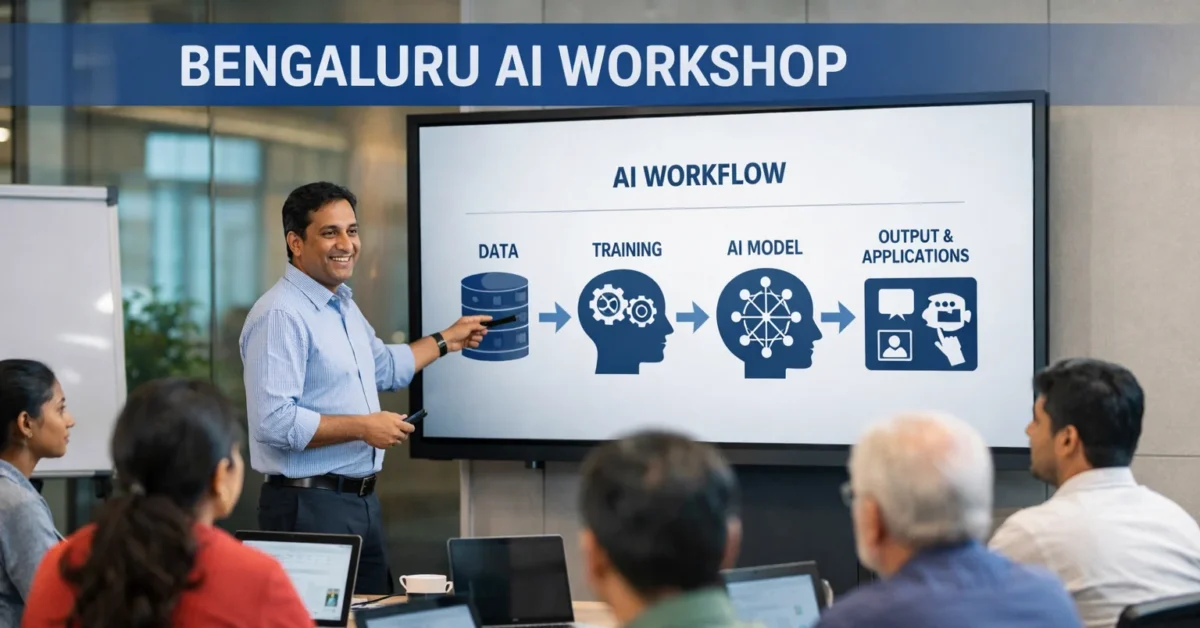
OpenAI has launched a hands-on workshop series in India called the Nonprofit AI Jam to help nonprofit organisations move beyond small experiments and start using AI tools at scale. The series began in Bengaluru and is designed to help groups that work with rural and underserved communities build practical, reusable AI workflows for everyday tasks.
The workshops focus on helping nonprofits integrate AI into real operations—especially where teams face common barriers like limited data infrastructure, manual record-keeping, and talent shortages. Alongside practical training, the effort also stresses that AI should support human decision-making and be used ethically and appropriately.
Bengaluru workshop aims for practical deployment
The Bengaluru session is described as a hands-on, workflow-first program where participants are expected to build at least one reusable AI workflow they can apply to their organisation’s daily work. The stated goal is to help nonprofits translate AI from “pilot mode” into scalable deployment across larger regions and diverse communities.
In the workshop format, nonprofits explore how AI can reduce time spent on repetitive work and improve speed and consistency across tasks that often slow down field teams. Examples of targeted use cases mentioned across the sources include lesson planning, automated grading, health triage, and community outreach.
Three workflows participants build
In a published resource hub for the India Nonprofit AI Jam, OpenAI Academy lays out three core workflows for participants to learn and test during the day.
The first workflow is a “Knowledge Assistant” designed to answer common questions from an organisation’s documents and support translation into local languages. The second workflow focuses on turning program data into insights by uploading spreadsheets and asking questions in plain language to generate summaries, checks, and outputs without manual formulas. The third workflow is an “Outreach Campaign Kit” intended to create WhatsApp-ready messages and simple visuals that can work across languages and channels.
A full-day, sprint-based agenda
OpenAI Academy’s agenda for the India Nonprofit AI Jam describes a full-day format that starts with arrival, breakfast, and networking, followed by a welcome and keynote. The schedule then moves into “workflow-first” demos, a nonprofit roundtable, and a design sprint.
The day ends with build sprints, a showcase format for sharing what was built, and a closing segment focused on resources and next steps. OpenAI Academy also defines “done” as saving a project, document, or GPT, keeping a starter prompt, generating at least one real input-output example, and creating a short quality checklist.
Positioning AI for broader social impact
One report describes the Bengaluru event as part of a broader multi-city rollout in India, aimed at helping nonprofits operationalize AI across sectors such as education, public health, skilling, climate action, and gender inclusion. The same report says the rollout is being done in partnership with the nonprofit Karya and is supported by Wadhwani AI.
The approach emphasises practical deployment, with nonprofits building workflows meant to be reused instead of one-off tests. Another report frames the objective as scaling impact without needing a matching increase in human capacity, by using AI to streamline bottlenecks like administration, data handling, and outreach content creation.
Examples tied to an India accelerator cohort
One report also links the workshops to a broader OpenAI Academy and “AI for Impact Accelerator” program in India, saying it provided $150,000 in API credits to a cohort of 11 Indian nonprofit organisations. It highlights examples of how AI tools were used in different domains, including automating parts of caregiver engagement, supporting reproductive health services through an AI-powered chatbot, and distributing personalised early childhood education content through WhatsApp.
Additional examples in the same report include efforts to identify and re-integrate out-of-school girls in rural India, build a culturally sensitive reproductive health chatbot for local-language guidance, and convert large volumes of web pages into accessible formats for visually impaired users. The report also points to agriculture-focused organisations as a pathway for AI use connected to climate resilience, including crop advice and farmer learning insights.
