

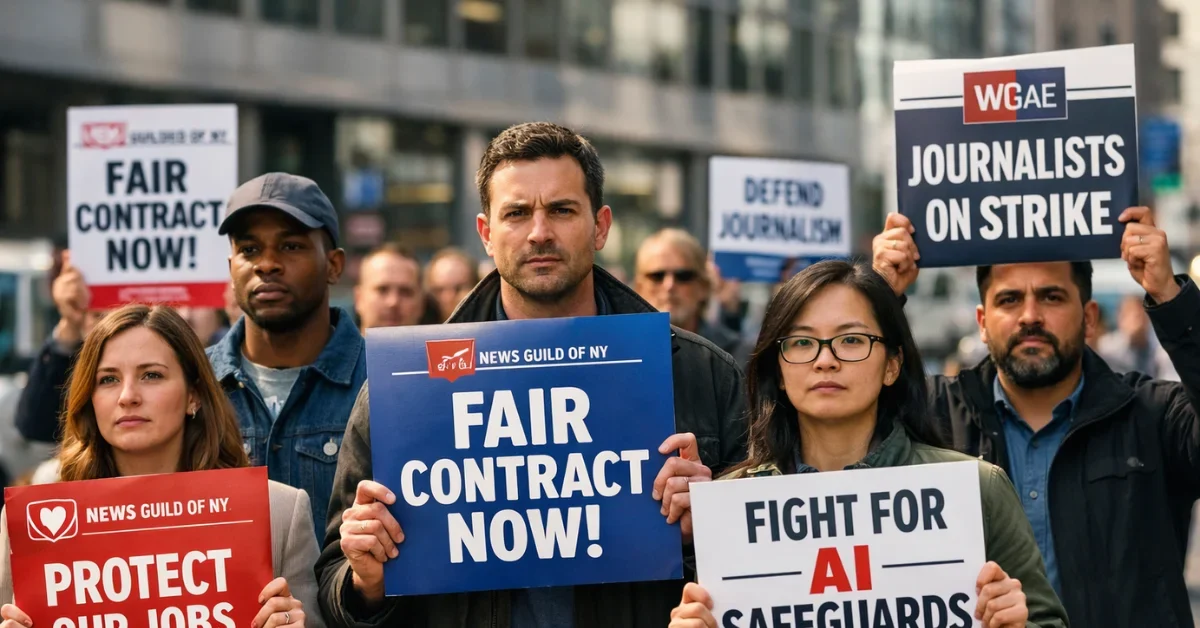
Roughly 150 employees at the Pulitzer Prize-winning nonprofit newsroom ProPublica initiated a 24-hour strike on Wednesday. Represented by the NewsGuild of New York, the journalists and business staff walked off the job following more than two years of stalled negotiations over their inaugural collective bargaining agreement. Demonstrators gathered outside the publication’s offices in New York, Chicago, and Washington, D.C., marking a significant escalation in the ongoing labor dispute.
The core issues driving the ProPublica union strike include demands for clear restrictions on using artificial intelligence to replace human workers. Staff members are also fighting for fundamental workplace protections, such as “just cause” employment provisions, seniority rules regarding potential layoffs, and wage increases that reflect the rising cost of living. Last month, 92 percent of the union’s membership voted to authorize the walkout due to the lack of progress at the bargaining table.
The Fight for AI Guardrails and Job Security
At the center of the standoff is the role of artificial intelligence in the future of journalism. The union is demanding concrete contractual language that prevents management from replacing journalists with AI tools. Workers want a voice in how these technologies are deployed, citing concerns over both job security and editorial integrity.
Katie Campbell, a member of the ProPublica Guild, noted that the union has been attempting to resolve the contract dispute quietly for over two years before reaching this breaking point. Jeff Ernsthausen, a senior data reporter and union secretary, echoed this sentiment during the walkout. He stated that the members are united in seeking standard union protections, urging management to take the strike seriously and engage in meaningful dialogue about the staff’s concerns.
Susan Carava, president of NewsGuild New York, emphasized the essential role the staff plays in maintaining the newsroom’s esteemed reputation. She stated that employees left their desks to remind ProPublica’s leadership of their value and to demonstrate their commitment to securing a fair contract.
Unfair Labor Practice Charge Over AI Policy
Tensions escalated on the Monday prior to the strike when the union filed an unfair labor practice charge with the National Labor Relations Board. The filing alleges that ProPublica leadership unilaterally imposed an artificial intelligence policy without negotiating with the union first.
According to the disputed policy, the newsroom will not use AI to create or manipulate audio, video, or images. It also requires human staff to review any AI-generated content prior to publication, emphasizing that journalists remain accountable for all published material. Despite these stated guidelines, union members argue that imposing the rules without collective bargaining violates their labor rights and fails to provide binding security against future automation.
Management Defends Proposals and AI Exploration
In response to the work stoppage, a ProPublica spokesperson stated that the organization remains dedicated to reaching a fair and sustainable first contract. Management maintains that their current proposals preserve the competitive salaries and benefits the company has historically provided, noting that these offers align with standards at other prominent publications like The New York Times, The New Yorker, and The Atlantic.
Addressing the concerns about job security, the spokesperson pointed out that ProPublica has never implemented layoffs. Regarding artificial intelligence, management described it as premature to determine exactly how the technology will reshape reporting workflows. Instead of agreeing to commitments they feel they cannot responsibly uphold, leadership stated they are currently investigating how AI tools might open new opportunities for deeper, creative investigative journalism.
A Broader Reckoning Across the Media Industry
The ProPublica union strike reflects a wider anxiety sweeping through the journalism industry as media outlets grapple with declining ad revenues and the sudden emergence of generative AI. Across the country, newsroom unions are drawing a hard line on automation.
At The New York Times, union leaders recently sent a letter to management describing the company’s AI standards as grossly insufficient, arguing that the lack of clarity creates editorial complications and undermines reader trust. The Times guild is actively pushing for safeguards against using AI in performance evaluations and demanding better disclosures around AI application in reporting.
Similarly, employees at McClatchy-owned publications, including the Sacramento Bee and the Charlotte Observer, have clashed with management over a new AI tool designed to rewrite older articles with fresh headlines. Elsewhere, unionized journalists at Politico and E&E News successfully won an arbitration case against their management last year over the implementation of AI tools that the workers argued violated editorial standards.
As the 24-hour walkout concludes, the standoff at ProPublica stands as a crucial test case for how media companies and organized labor will negotiate the boundaries of artificial intelligence in the newsroom.
