

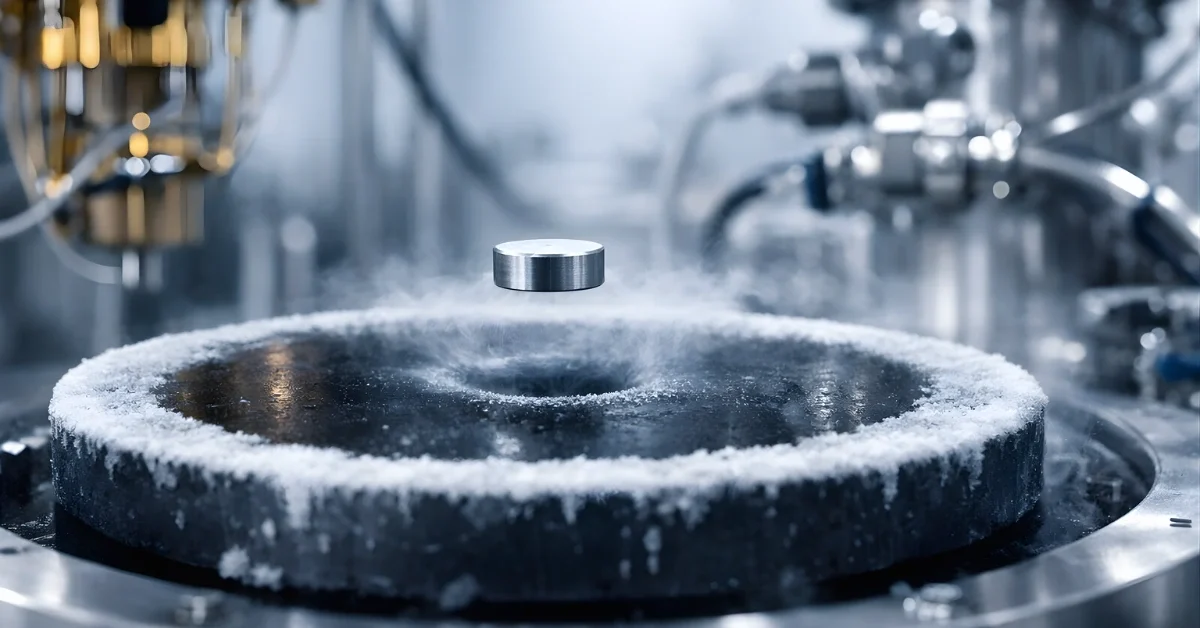
Scientists have shown that quantum magnetic levitation may be possible for tiny magnets, even though a classic rule of physics says stable levitation with permanent magnets should not work.
Two 2017 papers described how a single, non-rotating nanomagnet could stay stably suspended in a static magnetic field because magnetism comes from quantum spin, not just classical motion.
How quantum spin beats Earnshaw’s theorem
Earnshaw’s theorem, first proved in 1842, says permanent magnets cannot form a stable levitating setup in a static field because small disturbances make the system crash.
Researchers linked the possible “escape hatch” to quantum mechanics: electron spin creates real angular momentum, and that quantum angular momentum is tied to magnetism.
In 2017, a team connected with Oriol Romero-Isart’s group said that, at the nanoscale, a tiny, non-gyrating nanoparticle can levitate stably in a magnetic field because quantum properties that don’t matter much in everyday objects become dominant.
2017 theory: stable levitation phases
In Physical Review Letters, the authors of “Quantum Spin Stabilized Magnetic Levitation” reported a theoretical result: despite Earnshaw’s theorem, a non-rotating, single-domain nanoparticle could be stably levitated in an external static magnetic field.
They said the stabilization comes from the quantum-spin origin of magnetization through the gyromagnetic effect, and they predicted two stable phases linked to the Einstein–de Haas effect and Larmor precession.
At the stable point, they derived a quadratic Hamiltonian for quantum fluctuations and said that, without thermal fluctuations, the equilibrium state could include entanglement and squeezing.
2025 experiment: gyroscopic coupling observed
A 2025 arXiv paper reported experimental “signatures of gyroscopic effects” in the rotational motion of a non-spinning permanent ferromagnet levitated in a superconducting trap.
The researchers said they detected spin-rotation coupling between different librational (rocking) modes and found agreement with theoretical predictions, allowing them to infer the magnet’s intrinsic angular momentum and its gyromagnetic g-factor.
The paper describes a hard ferromagnetic sphere made from a rare-earth alloy, levitated in a cylindrically symmetric superconducting trap based on a type-I superconductor, with two pickup coils connected to dc SQUIDs to measure motion through magnetic flux.
A separate twist: levitation by rotation
Magnetic levitation research is also producing new classical effects that rely on rotation, not quantum spin.
A team at the Technical University of Denmark reported a setup where one magnet (“rotor”) spins at around 10,000 rpm while a second magnet (“floater”) starts spinning and then hovers a few centimeters below the rotor, returning to equilibrium after being disturbed.
Their simulations suggested the levitation comes from a mix of gyroscopic behavior and magnetostatic dipole-dipole coupling, creating a mid-air energy minimum where the floater can remain stable.
