

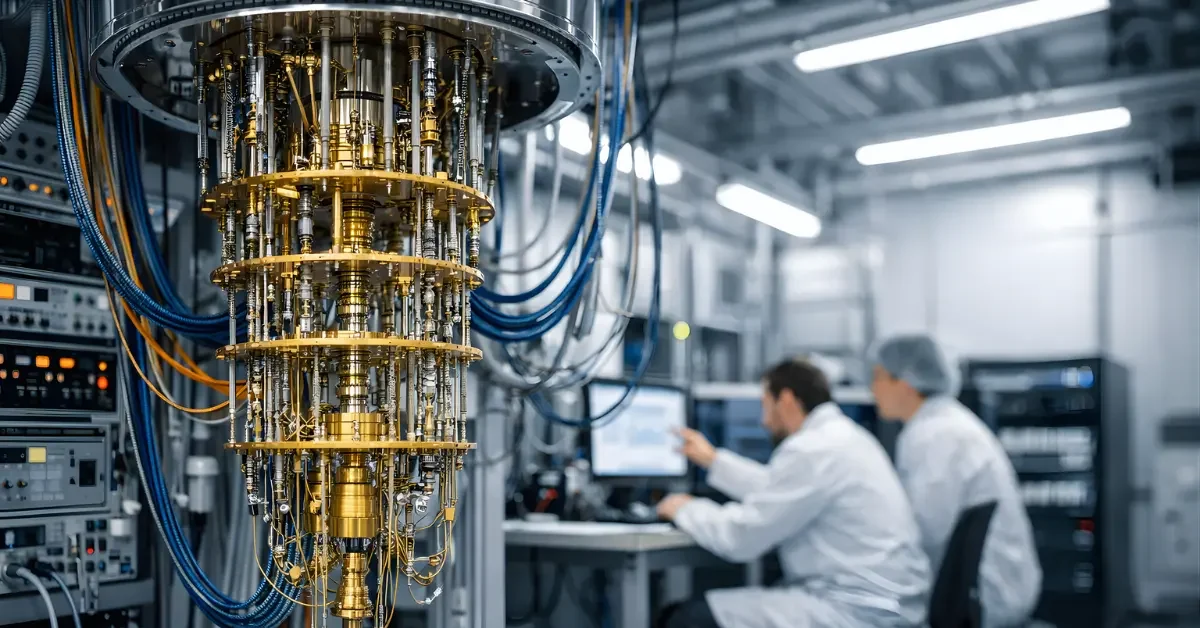
Quantum technology has reached a “transistor moment,” researchers say—real working systems now exist, but turning them into powerful, widely useful machines will take major engineering and manufacturing advances. A new paper highlighted by the University of Chicago argues the field is moving beyond pure lab demonstrations toward practical use, while warning that the biggest breakthroughs may still be years away.
The researchers compared several leading approaches to quantum information hardware and mapped out what is working today, where performance is still limited, and what must improve to scale quantum computing, quantum networking, and quantum sensing. Their message echoes the long road classical computing traveled before transistors and industrial production changed the world: progress can be transformative, but not immediate.
Why researchers call it a “transistor moment”
The University of Chicago summary says the new Science paper describes quantum technology as entering a critical phase similar to early classical computing before the transistor reshaped modern electronics. Lead author David Awschalom said the core physics ideas are established and “functional systems exist,” but the field now needs partnerships and coordinated efforts to reach “utility-scale” impact.
The paper’s author list includes researchers from the University of Chicago, Stanford University, the Massachusetts Institute of Technology, the University of Innsbruck (Austria), and Delft University of Technology (Netherlands). It focuses on “quantum information hardware,” looking at both opportunities and obstacles in building scalable systems.
ScienceDaily’s technology page also spotlighted the same theme, running the headline “Scientists Say Quantum Tech Has Reached Its Transistor Moment” dated Jan. 27, 2026. The Computer Science and Quantum Computers sections likewise listed it as a top headline on the same date.
What’s working today—and what’s limited
The summary says quantum technologies have progressed over the last decade from proof-of-concept experiments into systems that can support early uses in communication, sensing, and computing. It credits the speed of progress to collaboration among universities, government agencies, and industry—paralleling how microelectronics matured in the 20th century.
At the same time, the researchers caution that even when advanced prototypes can operate as full systems and be accessed through public cloud platforms, overall performance is still limited. The paper notes that some high-impact goals—such as large-scale quantum chemistry simulations—could require millions of physical qubits, along with much lower error rates than current technology can support.
How the study compared quantum platforms
The researchers reviewed six major hardware platforms: superconducting qubits, trapped ions, spin defects, semiconductor quantum dots, neutral atoms, and optical photonic qubits. To compare progress across computing, simulation, networking, and sensing, they used large language AI models including ChatGPT and Gemini to estimate technology readiness levels (TRL).
The ScienceDaily summary explains TRL as a 1-to-9 scale, where 1 is basic principles observed in a lab setting and 9 is proven in an operational environment. It also stresses that a higher TRL does not automatically mean a technology is close to broad everyday use; it can simply reflect more complete system functionality has been demonstrated.
The paper’s snapshot found different leaders depending on the use case: superconducting qubits ranked highest for quantum computing, neutral atoms for quantum simulation, photonic qubits for quantum networking, and spin defects for quantum sensing. Coauthor William D. Oliver said readiness scores can mislead without historical context, arguing that a high TRL today does not mean the end goal has been reached or that science is finished.
The scaling problems the authors highlight
A major message from the summary is that scaling quantum systems will depend on advances in materials science and fabrication, so devices can be made consistently and at scale. The authors also point to wiring and signal delivery as major hurdles, since many platforms still rely on individual control lines for each qubit—an approach that becomes impractical if systems move toward millions of qubits.
The paper links that wiring challenge to a historic issue in classical computing known as the “tyranny of numbers,” referencing similar pain points faced by engineers in the 1960s. It also flags additional scale-related burdens, including power management, temperature control, automated calibration, and system-level coordination as machines become more complex.
The ScienceDaily summary says the authors see lessons in how long classical breakthroughs took to move from research to industry, including lithography methods and new transistor materials that required years or decades to reach industrial production. They argue quantum technology is likely to follow a similar path and call for top-down system design, open scientific collaboration that avoids early fragmentation, and realistic expectations about timelines.
Security and crypto concerns enter the debate
A separate Securities.io analysis says the “transistor-era” framing matters because it shifts the conversation from proving the physics to scaling, integrating, and manufacturing reliable systems. That analysis connects the shift to “Q-Day,” defined as the point when a quantum computer could break widely used public-key cryptography at practical cost and speed, and it describes “PQC” as post-quantum cryptography designed to resist both classical and quantum attacks.
Securities.io says Bitcoin’s relevant pressure point is its signature scheme (ECDSA/secp256k1) and argues the credible risk is not rewriting the blockchain, but selective private-key recovery under specific conditions—if large-scale, fault-tolerant quantum systems arrive. It describes one scenario as exploiting the window between a transaction broadcast and confirmation, when a public key becomes visible, and another as targeting older “pay-to-public-key” (P2PK) outputs where the public key is already visible on-chain.
The same Securities.io piece says Coinbase created an independent advisory board focused on quantum computing and blockchain, listing Scott Aaronson, Dan Boneh, Justin Drake, Sreeram Kannan, Yehuda Lindell, and Dahlia Malkhi. It also argues that post-quantum readiness for exchanges and custodians would require changes across the custody stack, including signing workflows and key lifecycle management, rather than being “just a chain hard fork.”
