

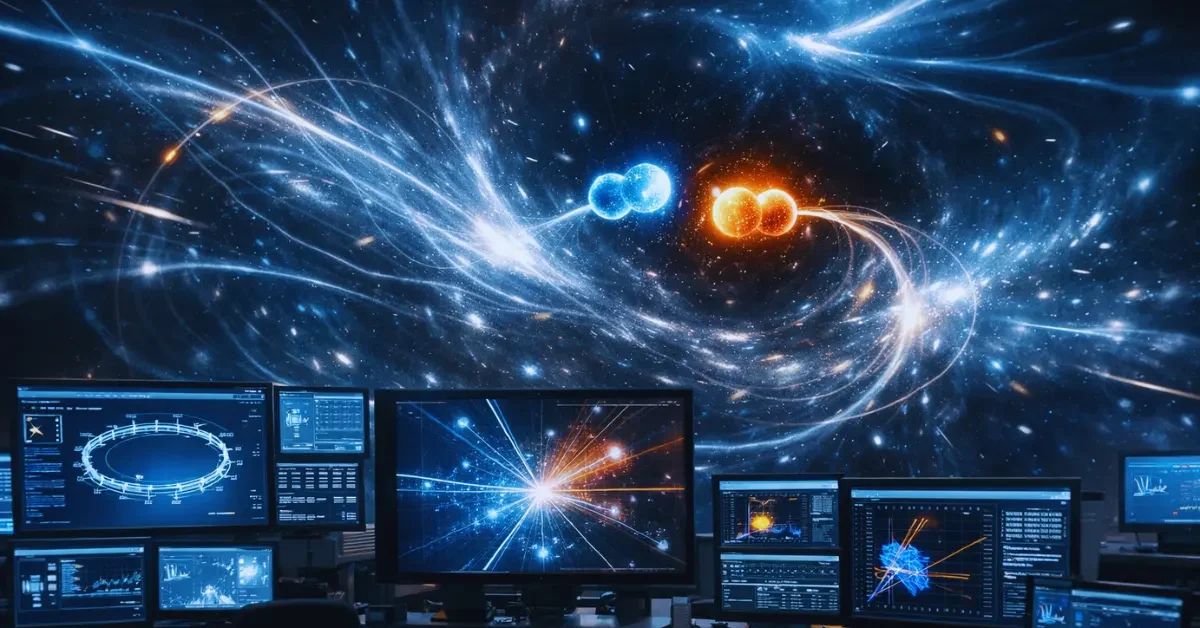
Physicists at Brookhaven National Laboratory and the STAR Collaboration say they have found experimental evidence linking the quantum vacuum to the way visible matter forms, using data from proton-proton collisions at the Relativistic Heavy Ion Collider. The study, published in Nature, focuses on particle spin correlations that researchers say provide a direct view of how fleeting virtual quark-antiquark pairs from the vacuum can become real, detectable matter.
The finding adds new weight to a long-standing idea in quantum physics: that empty space is not truly empty. Instead, the vacuum is described as a sea of fluctuating energy fields that can briefly generate entangled matter-antimatter pairs, which normally disappear too quickly to be observed as real particles. In the Brookhaven experiment, researchers say the high-energy collisions provided the extra push needed for some of those virtual particles to survive as parts of real particles recorded by the STAR detector.
What the Team Found
The researchers examined lambda and antilambda particles created in proton-proton collisions at RHIC because those particles are especially useful for spin studies. Their decay patterns reveal spin direction, and they contain strange quarks, which gave scientists a way to trace the particles back to strange quark-antiquark pairs in the quantum vacuum. According to the study summaries, lambda and antilambda particles produced close together showed full spin alignment, matching the spin alignment expected from the virtual strange quark pairs in the vacuum.
That result is central to the claim that the detected particles preserved information from their vacuum origin. Researchers said the analysis directly connected the observed spin correlations to spin-aligned virtual quark-antiquark pairs generated in the quantum vacuum. In simple terms, the particles seen after the collision did not appear random; their shared spin pattern pointed back to linked quantum partners that existed before becoming real matter.
Why It Matters
The work is being described as a new window into one of physics’ biggest questions: how the ordinary matter that makes up the visible universe emerges from underlying quantum processes. The Brookhaven team said the result may open a new era in studying how visible matter forms and how its basic properties emerge. That makes the finding important not only for particle physics, but also for broader efforts to understand mass, structure, and the transition from quantum behavior to the classical world people experience every day.
The research also stands out because it moves beyond indirect theory and gives scientists an experimental handle on the vacuum itself. For about a century, physicists have understood that the vacuum is not empty, but seeing a direct connection between vacuum fluctuations and the properties of real particles has been much harder. The new analysis suggests that the spin alignment of entangled virtual quarks can survive the transformation into real matter, offering a measurable signature of that process.
Limits and Next Steps
The effect was strongest when the lambda and antilambda particles were produced near each other, and the correlation weakened as the particles were found farther apart. Researchers said that pattern could reflect the influence of the surrounding environment after the collision, though they also noted that more measurements are needed to determine whether the system represents entangled states or a more classical form of correlation. That means the result is a major step, but not the final word on how quantum vacuum behavior turns into stable visible matter.
Scientists involved in the project say the method could help them work backward from detected particles to study the complicated chain that turns virtual particles into matter. They also say the approach opens a path to investigate deeper questions about how mass and structure arise in the universe. Future work at Brookhaven, including studies with more advanced tools, is expected to sharpen that picture and test the connection between the quantum vacuum and the matter people can see.
