

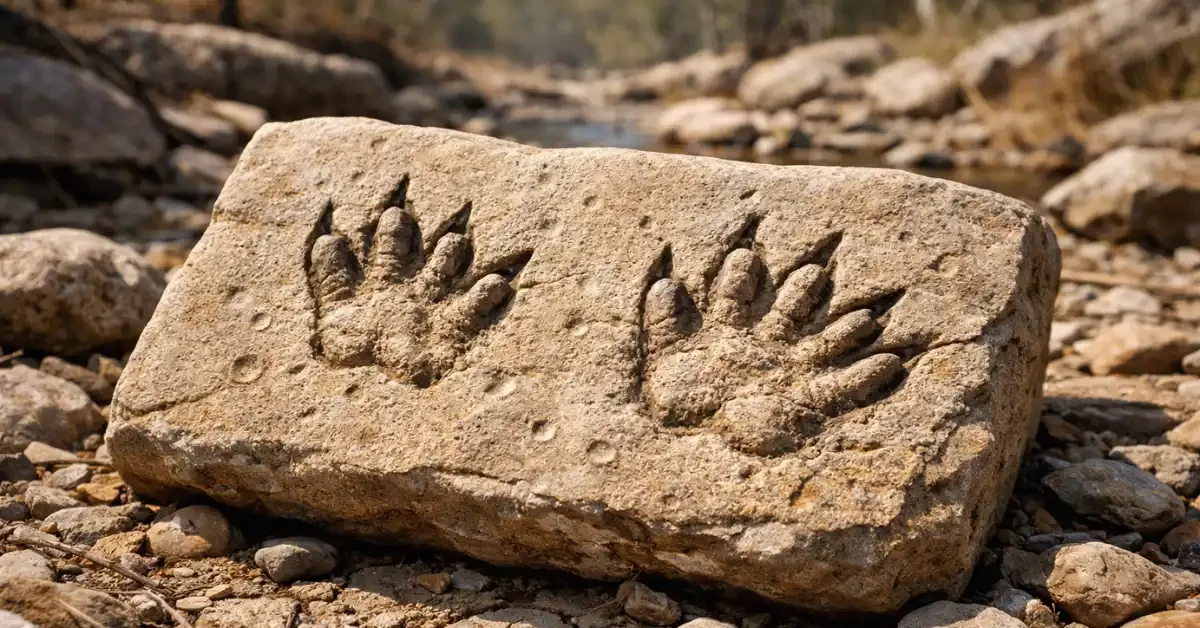
A remarkable discovery in Australia is fundamentally changing our understanding of early animal history. Fossilized tracks uncovered in a riverbed reveal that early reptile-like creatures existed far earlier than previously believed. These footprints push the timeline of reptile evolution back by an astonishing 35 to 40 million years, challenging long-held scientific assumptions about when backboned animals first adapted to life on land. The findings represent the oldest known evidence of these primitive animals walking the Earth, rewriting the established chapters of terrestrial evolution.
The Groundbreaking Discovery in Victoria
The historic find occurred in the Mansfield district of northern Victoria, Australia, on land known as Taungurung Country. Two amateur paleontologists, builder Craig Eury and winemaker John Eason, were searching for fossils along a riverbed when the distinctive tracks caught their attention. The angle of the sun cast a shadow perfectly over the imprints, making them clearly visible on the rock surface.
The fossilized tracks are preserved on a sandstone slab measuring approximately 14 inches across. This slab originates from the Snowy Plains Formation. When the amateur fossil hunters first spotted the tracks, they initially suspected they belonged to an early amphibian. However, closer inspection by scientific experts revealed characteristics pointing to a more advanced creature. The footprints display five toes and sharp claw marks. The slab also features long scratches, indicating the animal dragged its feet as it moved. Furthermore, the rock surface is covered in small dimples caused by raindrops, suggesting a brief shower occurred right before the tracks were set in the mud.
Redefining the Amniote Timeline
Researchers identified the tracks as belonging to an early amniote. Amniotes are an advanced group of four-legged animals that evolved the ability to lay eggs containing protective membranes. This crucial adaptation allowed them to reproduce away from water, eventually giving rise to modern reptiles, birds, and mammals.
Scientists dated the fossilized rock to the early Tournaisian stage of the Carboniferous period, estimating its age between 354 million and 359 million years old. Prior to this discovery, the emergence of advanced tetrapods was estimated at around 334 million years ago, based primarily on Northern Hemisphere records. By demonstrating that amniotes were present in Australia up to 40 million years earlier, this new evidence indicates that tetrapod evolution happened much faster than experts previously calculated.
Expert Insights and International Significance
The study analyzing the footprints was led by John Long, a paleontologist at Flinders University, and published in the journal Nature. Long noted that identifying the trackmaker as an amniote provides the world’s oldest evidence of reptile-like animals walking on land. The research team included Grzegorz Niedźwiedzki and Per Ahlberg from Uppsala University in Sweden. They emphasized that the combination of clear claw scratches and the specific shape of the feet strongly suggests a primitive reptile, as claws are almost never found in other early tetrapod groups.
Jillian Garvey from La Trobe University coordinated with the Taungurung Land and Waters Council for the research. She highlighted that the discovery reshapes our understanding of the ancient supercontinent Gondwana, proving that significant evolutionary milestones occurred in Australia long before established records. The team also identified similar, slightly younger record-breaking tracks in Poland.
Scientific Disagreement Over the Environment
While the age of the tracks is groundbreaking, scientists disagree on the specific environment in which the footprints were made. Anthony Romilio, a paleontologist at the University of Queensland who was not involved in the study, argues against the assumption that the amniote was walking on dry land. According to Romilio, similar claw-like marks are frequently seen across various animal species when the creature is primarily supported by water, suggesting an aquatic movement.
John Long firmly disputes this aquatic theory. He maintains that the sharp claws dug into the trackway with too much precision to suggest the animal was merely clawing at loose sediment underwater. Furthermore, Long and his team point to the preserved raindrop dimples on the sandstone slab as strong environmental indicators that the surface was exposed to the open air.
The Search for Further Evidence
While the footprints offer an incredible glimpse into the past, they cannot answer every question about the trackmaker. The tracks alone do not reveal the exact size, physical appearance, or specific traits of the animal, such as whether it possessed a tail.
To fully verify the anatomy of amniotes during this early period, researchers agree that more physical evidence is required. Erich Fitzgerald, a senior curator of vertebrate paleontology at Museums Victoria Research Institute who was not involved in the study, notes that scientists will ultimately need to find body fossils, such as actual bones, preserved in these rocks. Until skeletal remains are uncovered, these ancient footprints stand as the strongest testament to a significantly earlier dawn for reptile evolution.
