

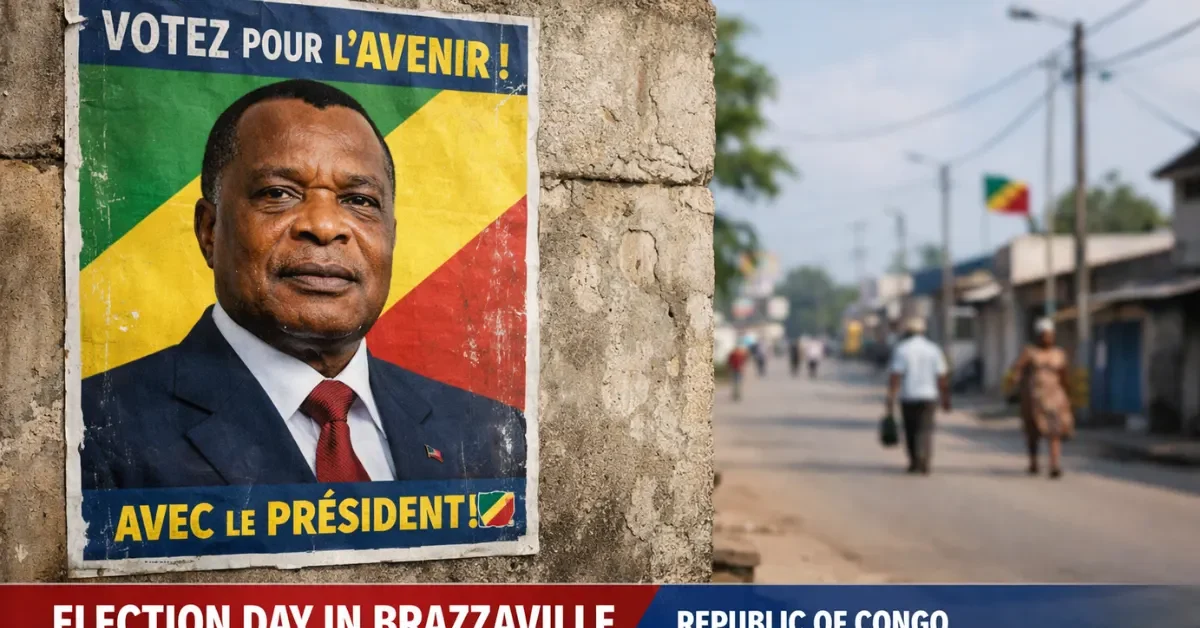
The Republic of Congo election took place on Sunday, with 82-year-old incumbent President Denis Sassou Nguesso widely expected to secure a fifth term and extend his four-decade rule. The presidential vote was marked by nationwide internet blackouts, a widespread opposition boycott, and significant voter apathy. As electoral officials begin counting ballots in the capital city of Brazzaville, the outcome seems heavily tilted in favor of the current administration.
For the citizens of this oil-rich Central African nation, the Republic of Congo election arrives amid severe economic stagnation and a heavily restricted civic space. Major opposition parties chose to boycott the ballot entirely, urging their supporters to stay home and follow their conscience rather than participate. These political groups cited a lack of transparency and an uneven playing field, arguing that the electoral process serves merely to confirm the status quo rather than offer a genuine democratic contest.
A Fragmented Opposition and Rights Concerns
President Sassou Nguesso faces a remarkably weak field of challengers. While six other candidates are officially on the ballot, political analysts and civil society groups describe them as minor figures who lack the institutional machinery to mount a credible threat. The opposition’s absence is further compounded by the fact that two of the country’s best-known political rivals are currently serving time in prison.
Human rights organizations have documented a persistent crackdown on dissenting voices, activists, and journalists leading up to the vote. On election day, the government severed internet access across the country, limiting communication and independent monitoring. Additionally, security forces utilized early voting so they could be available to patrol polling stations during the general election. While officials claim this facilitates public safety, critics argue the heavy presence of armed forces serves primarily to intimidate the electorate.
Structural hurdles also prevent a competitive electoral environment. Members of the Independent National Electoral Commission are appointed through a process dominated by the ruling Congolese Party of Labour, leading to ongoing concerns about institutional bias. Throughout the campaign, the incumbent’s posters lined every major roundabout in Brazzaville. This visual dominance contrasted sharply with the near-invisible presence of opposition campaigns, which struggled to secure physical space and broadcasting airtime. In the previous 2021 election, Sassou Nguesso secured 88 percent of the vote amid similar allegations of widespread irregularities.
Economic Stagnation and a Deepening Generational Divide
Despite the country’s vast oil wealth, the Republic of Congo remains dangerously shackled to volatile global oil markets. Unresolved governance challenges have left poverty levels stubbornly high, and youth unemployment hovers above 40 percent in several urban centers. This economic reality has created a volatile situation for the administration and laid bare severe tensions between older and younger generations.
This generational divide is deeply felt in rural areas like the village of Mayitoukou. Joseph Batangouna, the 80-year-old village chief, openly urged the youth to turn out in force and vote for the incumbent president. However, many younger residents remain unconvinced by the political establishment. Guelord Mienagata, a 27-year-old local laborer, flatly refused to participate in the election, stating that he would not cast a ballot because the same individuals always remain in power.
The disconnect extends beyond politics into the local economy and environmental management. President Sassou Nguesso has issued strict injunctions urging citizens to develop agriculture and return to farming. In Mayitoukou, only the older generation has heeded this call. Village elders like Batangouna have heavily criticized the younger generation’s pursuit of quick cash, which has led young people to cut down the once-vast forests surrounding the village instead of working in the agricultural fields.
The conflict over local resources has occasionally turned violent. Antoine, another village elder in Mayitoukou, reported that when he attempted to stop local youths from cutting down trees, he was physically beaten and accused of witchcraft. These localized disputes highlight the broader frustration of a youth population that feels abandoned by the current economic system and entirely disconnected from the national political process.
International Observation and Next Steps
As the country waits for the official vote count, international observers are monitoring the situation on the ground. The African Union deployed an election observation mission to oversee the Sunday ballot. This delegation is being led by former Ghanaian President Nana Addo Dankwa Akufo-Addo.
However, with the internet blackout and a tightly controlled electoral landscape, the international community is scrutinizing the process less as a competitive race for leadership and more as a reflection of the country’s enduring political dynamics. For many Congolese citizens, the ballot simply represents a familiar outcome, leaving the nation to grapple with its unresolved economic challenges and a deeply divided society under the continued leadership of its long-serving president.
