

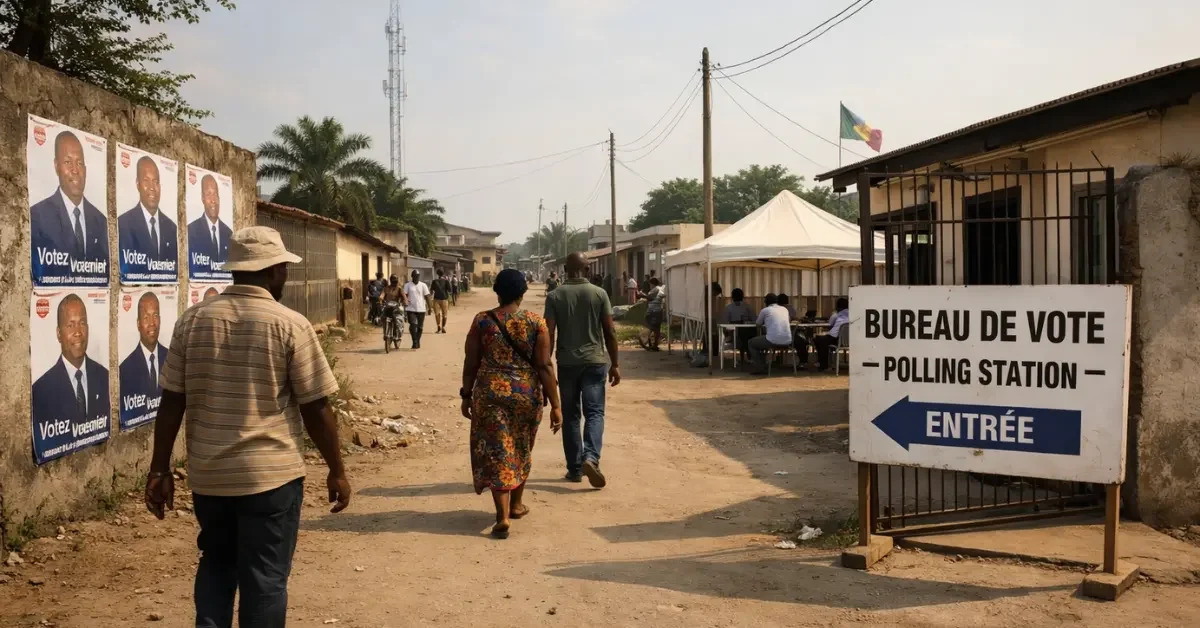
The Republic of Congo presidential election concluded on Sunday amidst a nationwide internet blackout and reports of thin voter turnout. President Denis Sassou Nguesso, who has been in power for 42 years, is widely expected to secure a fifth consecutive term. The 82-year-old incumbent faced six lesser-known challengers in a contest where major opposition parties boycotted the process, citing concerns over electoral credibility.
As election officials count the ballots, the race has drawn attention for its restrictive environment rather than its competitiveness. The internet shutdown, confirmed by the monitoring group NetBlocks, left the Central African nation in a digital silence as voters headed to the polls. Traffic was also heavily restricted across the capital city of Brazzaville.
Low Voter Turnout and an Unfair Playing Field
More than 3.2 million Congolese citizens were registered to vote. However, polling stations reported minimal lines throughout the day. Civil society groups and political analysts predicted the final turnout would fall significantly below the 68% participation rate recorded during the previous election in 2021.
The lack of suspense surrounding the outcome contributed heavily to voter apathy. Sassou Nguesso’s primary opponents are either incarcerated or living in exile, leaving only inexperienced candidates to run against him. Two of the country’s most prominent opposition parties actively boycotted the election, pointing to unfair practices and an electoral commission heavily influenced by the ruling Congolese Labour Party.
The campaign period highlighted a severe imbalance between the incumbent and his challengers. Sassou Nguesso was the only candidate who actively traveled across the country to canvass for votes. In Brazzaville, the streets were heavily adorned with his effigies. His campaign emphasized continuity, promising to speed up development initiatives and improve access to vocational training and education.
Political Climate and Human Rights Concerns
Human rights organizations have raised alarms about a shrinking political space in the Republic of Congo. These groups point to the arrests of activists and the suspension of opposing political parties. A 2015 constitutional referendum removed presidential age and term limits, allowing Sassou Nguesso to continue running. He is currently the third-longest-serving leader in Africa, trailing only the presidents of Cameroon and Equatorial Guinea.
Despite these criticisms, government officials maintain the election was conducted properly. Prime Minister Anatole Collinet Makosso rejected claims of electoral favoritism toward the incumbent. He asserted that the nation’s oversight institutions would guarantee a fair and transparent electoral process.
However, many citizens remain skeptical. Clarisse Massamba, a teacher who voted in Brazzaville, told The Associated Press that the president was guaranteed to win against inexperienced opponents. She argued the government should not have cut off the internet for an uncompetitive election. Another Brazzaville resident stated the election had a predetermined outcome and expressed no hope for future improvements.
Remadji Hoinathy from the Institute for Security Studies noted that the opposition is fragmented and lacks a unifying leader. While acknowledging potential voter fatigue, he concluded this weariness would not impact the incumbent’s chances of securing another term.
Economic Struggles in an Oil-Rich Nation
The Republic of Congo boasts one of the largest oil reserves in sub-Saharan Africa. Despite this natural wealth, the country faces severe economic challenges. These include skyrocketing youth unemployment and a crushing international debt burden standing at 94.5% of its gross domestic product.
While the economy has shown signs of stabilization recently following a prolonged slump, poverty remains widespread. However, reports differ regarding the exact population and poverty levels based on World Bank data. Several international news outlets report the World Bank indicates 52% of the country’s 6.1 million inhabitants live in poverty. In contrast, The Associated Press reports World Bank figures showing a population of 5.7 million, with more than half living in poverty. Both accounts agree that poverty affects at least half the nation.
The demographic makeup highlights an urgent need for economic opportunity, as 47% of the population is under the age of 18. Provisional election results are anticipated within 48 to 72 hours of the polls closing.
Sassou Nguesso first seized power in 1979. He governed continuously until 1992, when he organized the country’s first multi-party elections and temporarily lost power. He returned to the presidency as a militia leader following a four-month civil war in 1997 and has maintained his grip on the nation ever since.
