

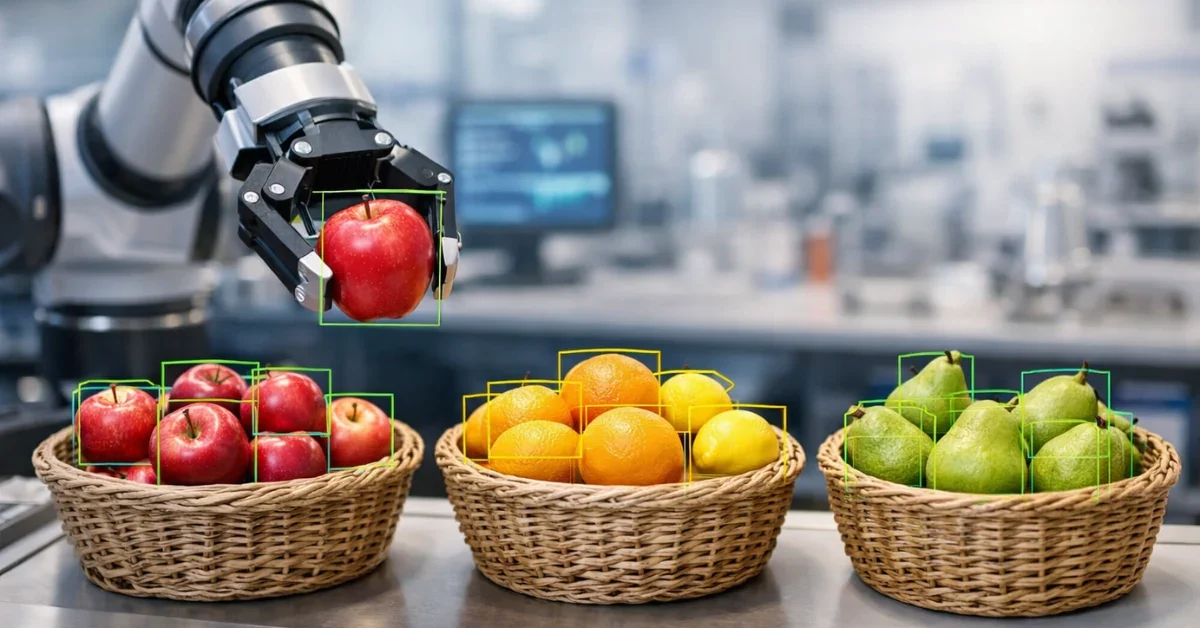
Alibaba has unveiled RynnBrain, an open-source “embodied AI” model designed to help robots perceive their surroundings, reason about what they see, and carry out physical tasks.
The model was introduced by Alibaba’s DAMO Academy and is positioned as a foundation for robots and other devices that operate in the real world, not just on screens.
What Alibaba announced
Alibaba describes RynnBrain as a robotics “brain” that can move beyond simple, preprogrammed routines and support physically aware reasoning and more complex real-world actions.
In a demonstration video highlighted in multiple reports, a robot identifies fruit and places it into a basket—an example meant to show perception and precise movement working together.
RynnBrain is built on Alibaba’s Qwen3-VL visual-language system, according to both Alibaba’s statements and coverage of the release.
How RynnBrain is meant to work
RynnBrain is described as part of a broader “vision-language-action” (VLA) approach, which combines computer vision, natural language understanding, and action or motor control so a robot can interpret a scene and respond with movement.
Alibaba says a key target is a common weakness in current embodied AI systems: limited memory of spatial and temporal context, which can cause robots to lose track of where objects are or misread a changing environment.
To address that, the company says RynnBrain includes spatiotemporal memory so robots can remember where items were and anticipate how they may move next.
Alibaba also describes “global retrospection,” a capability meant to let robots review earlier actions before choosing the next step to reduce errors during complicated tasks.
Open-source release and performance claims
Alibaba is pursuing an open-source strategy with RynnBrain, making it available for developers and researchers to use and adapt rather than keeping it proprietary.
Coverage of the launch says DAMO Academy released additional open-source models alongside RynnBrain, including models described as foundational and specialized for commercial applications.
Alibaba also introduced an evaluation system called RynnBrain-Bench, described as focusing on spatiotemporal tasks rather than only static image recognition in embodied AI assessment.
On performance, Alibaba says RynnBrain achieved record-setting results across 16 open-source embodied AI benchmarks and claims it outperformed competing systems referenced in coverage, including Google DeepMind and Nvidia models.
In another set of technical claims, Alibaba describes RynnBrain as using a mixture-of-experts design with 30 parameters while activating only 3 billion parameters during inference, which it argues supports faster decisions and smoother robotic movement under real-world constraints.
Why “physical AI” is getting more attention
RynnBrain’s launch is framed as part of a growing push toward “physical AI,” where AI systems are embedded in machines that interact directly with the world, such as robots and self-driving vehicles.
One report links the momentum behind physical AI to pressures like aging populations and labor shortages, which can increase demand for machines that can support or replace human labor in certain tasks.
The same coverage points to Deloitte’s 2026 Tech Trends report as describing physical AI as shifting from a research timeline toward an industrial one, helped by faster iteration through simulation and synthetic data.
Safety and governance questions
As physical AI expands, one report argues the limiting factor may increasingly be governance—how responsibility, authority, and intervention are handled when AI systems operate in environments where mistakes have real consequences.
That coverage cites a World Economic Forum analysis describing three layers of governance for physical AI: executive governance (risk appetite and non-negotiables), system governance (engineering controls such as stop rules and change controls), and frontline governance (clear authority for workers to override AI decisions).
The same report also notes that deployments today are concentrated in areas like warehousing and logistics and gives examples including Amazon’s announcement of its millionth robot and its DeepFleet AI model, as well as BMW testing humanoid robots at its South Carolina factory.
