

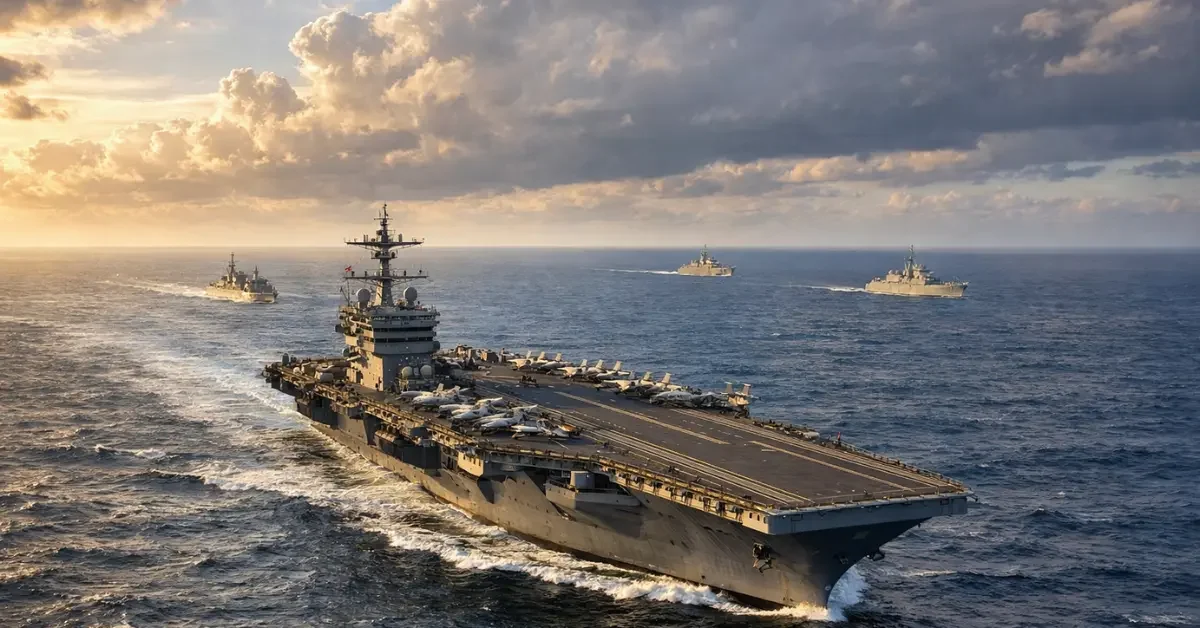
The United States is preparing to send a second aircraft carrier to the Middle East, with the USS Gerald R. Ford expected to deploy to the region to reinforce another carrier already operating there amid rising tensions with Iran.
A person familiar with the plans said the move would add more U.S. military firepower behind President Donald Trump’s push to pressure Iran into a deal focused on its nuclear program.
USS Gerald R. Ford deployment plans
The USS Gerald R. Ford’s planned deployment would place two U.S. aircraft carriers, along with their accompanying warships, in the region. The USS Abraham Lincoln and its guided-missile destroyers are already in the Arabian Sea, according to the same account.
The person familiar with the plans spoke on condition of anonymity to discuss military movements. The deployment plan was first reported by The New York Times, and the account of the plan was described by a person familiar with it.
Tensions and recent incidents at sea
The situation in the region has already led to confrontations, with U.S. forces shooting down an Iranian drone that approached the USS Abraham Lincoln. The same account said Iran also tried to stop a U.S.-flagged ship in the Strait of Hormuz on the same day as the drone incident.
Gulf Arab nations have warned that any attack could spiral into a wider regional conflict in a Middle East still reeling from the Israel-Hamas war in the Gaza Strip. The increased carrier presence comes as Trump pursues a strategy that blends military pressure with an effort to keep diplomacy moving.
Nuclear talks, pressure, and timelines
The planned Ford deployment follows Trump’s recent public suggestion that another round of talks with Iran was close, though those negotiations did not materialize, according to reporting that cited a person familiar with the deployment plan. That account said a top Iranian security official visited Oman and Qatar during the week and exchanged messages with U.S. intermediaries.
Trump warned that failure to reach an agreement would be “very traumatic,” and Iran and the United States held indirect talks in Oman the previous week, according to the same reporting. Asked about his timeline for reaching a deal, Trump said, “I guess over the next month, something like that,” adding, “It should happen quickly. They should agree very quickly.”
In an interview with Axios earlier in the week, Trump said he was considering sending an additional carrier strike group and framed it as a precaution if negotiations fail. “We will either reach an agreement or we will have to resort to something very tough like last time,” Trump told Axios, and he added, “An armada is already en route, and I might send another one.”
Axios also reported that a U.S. official confirmed discussions about deploying another carrier strike group to the area, in addition to the USS Abraham Lincoln strike group. Axios said Trump expected the next round of talks between the U.S. and Iran to take place the following week.
Netanyahu meeting and broader regional issues
Trump held lengthy talks with Israeli Prime Minister Benjamin Netanyahu and told reporters he insisted negotiations with Iran needed to continue, according to the account of the planned deployment. The same reporting said Netanyahu has urged the administration to push Tehran to scale back its ballistic missile program and end support for militant groups such as Hamas and Hezbollah as part of any agreement.
In the Axios interview, Trump said any agreement should cover Iran’s nuclear program and argued it should also address Iran’s ballistic missile arsenal, calling it a “no-brainer.” Axios also reported that Netanyahu was set to visit Washington and planned to share Israel’s views on principles for the negotiations.
A fast turnaround after other missions
The planned Middle East deployment would be a quick shift for the Ford, which Trump previously sent from the Mediterranean Sea to the Caribbean in October as the administration built up a major military presence ahead of a raid that captured then-Venezuelan President Nicolás Maduro, according to the same reporting. That development was described as potentially at odds with the administration’s national security and defense strategies emphasizing the Western Hemisphere.
In response to questions about the Ford’s movement, U.S. Southern Command said U.S. forces in Latin America will continue to “counter illicit activities and malign actors in the Western Hemisphere,” adding, “While force posture evolves, our operational capability does not,” according to a statement attributed to Col. Emanuel L. Ortiz.
The Ford set out on deployment in late June 2025, and the reporting said its crew would have been deployed for eight months in about two weeks’ time. While it was unclear how long the ship would remain in the Middle East, the same account said the move could set the crew up for an unusually long deployment.
