

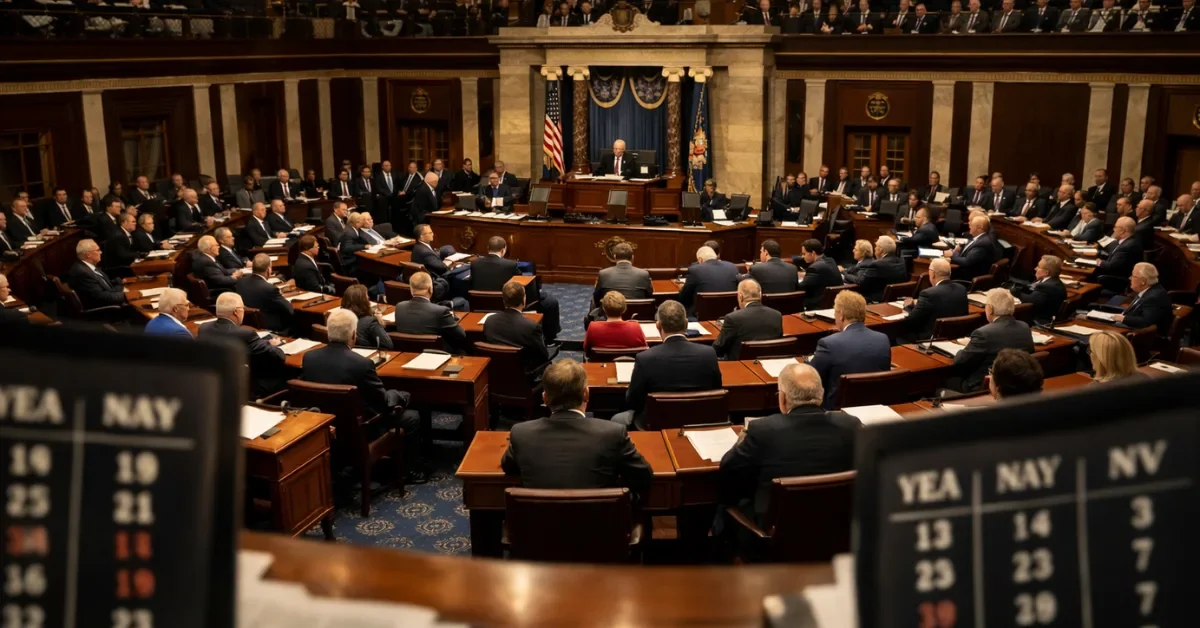
The U.S. Senate voted 47 to 53 on Wednesday to block a war powers resolution that would have limited President Donald Trump’s authority to continue military operations against Iran. The failed measure marks the second time in less than a year that Congress has turned down efforts to rein in Trump’s military actions in the Middle East.
The resolution, introduced by Democratic Sen. Tim Kaine of Virginia and co-sponsored by Republican Sen. Rand Paul of Kentucky, would have directed the removal of U.S. Armed Forces from hostilities in or against Iran that Congress had not formally authorized. It fell short of the simple majority needed to advance.
One Republican Crossed the Aisle — One Democrat Did Not
The vote exposed sharp divisions both across and within party lines. Rand Paul was the only Republican to side with Democrats in favor of the resolution. On the other side of the aisle, Democratic Sen. John Fetterman of Pennsylvania broke with his party and voted against the measure — a move that effectively made the math even harder for Democrats.
Before the vote, Democrats had hoped that moderate Republicans — including Sens. Todd Young of Indiana, Susan Collins of Maine, and Lisa Murkowski of Alaska — might cross party lines. All three ultimately voted with their party against the resolution.
Young explained his position directly. “The United States and our allies are now in conflict with a brutal, hostile, and dangerous regime,” he said. “I believe that danger will only grow if we limit the President’s military options at this critical moment.”
Kaine’s Push and Democratic Frustration
Kaine has been persistent in forcing these votes. A similar resolution failed in June 2025, following U.S. strikes on three Iranian nuclear sites — a conflict that ended with a ceasefire after twelve days. That first effort also drew support from most Democrats and Paul, while Fetterman again voted with Republicans against it.
Even before this week’s vote, Kaine acknowledged the long odds. But he argued that the principle mattered — that members of Congress should go on record when lives are at stake. “If you don’t have the guts to vote yes or no on a war vote, how dare you send our sons and daughters into war where they risk their lives,” Kaine said.
Democrats left a classified briefing with Trump administration officials on Tuesday feeling deeply uneasy. Sen. Chris Murphy of Connecticut said administration officials told lawmakers the operation was open-ended and hadn’t “really started in earnest yet.” Murphy added that officials refused to rule out sending in ground troops, and warned that more American casualties were coming. Sen. Cory Booker of New Jersey flatly stated, “There clearly was no imminent threat.”
Senate Minority Leader Chuck Schumer also voiced alarm, citing what he described as constantly shifting justifications from the administration. “They have shifting goals, different goals all the time, different answers every day,” Schumer said. “And I am truly worried about mission creep.”
White House and Pentagon Stand Firm
Republican leadership and the White House pushed back firmly against the resolution. Senate Majority Leader John Thune of South Dakota argued that Trump’s actions are “consistent with what previous administrations have done” and that “the president was perfectly within his rights to take the steps that he took.”
Defense Secretary Pete Hegseth was even more direct. “We are accelerating, not decelerating,” he told reporters Wednesday. “Iran’s capabilities are evaporating by the hour, while American strength grows fiercer, smarter and utterly dominant.” Hegseth also indicated the operation was “just getting started” and could last several weeks.
In a formal notification to Congress, Trump pointed to “repeated efforts to achieve a diplomatic solution to Iran’s malign behavior,” saying that the threat to the United States and its allies had become “untenable.” He also noted that it was not yet possible to know the full scope or duration of the military operations ahead.
Secretary of State Marco Rubio addressed the broader legal question, noting that no presidential administration — from either party — has ever accepted the 1973 War Powers Act as fully constitutional. Still, Rubio maintained that the administration had complied with the law completely.
A Symbolic Fight With Real Stakes
Even if the Senate had passed the resolution, its practical impact would have been limited. The president could veto it, and overriding a veto would require a two-thirds supermajority in both chambers — a threshold far beyond Democratic reach.
A public opinion poll from CBS News found that most Americans disapprove of the war with Iran, and that the Trump administration has not clearly communicated its goals. About half of those surveyed believe the conflict could drag on for months or even years.
A parallel resolution was expected to come up for a vote in the House on Thursday. House Speaker Mike Johnson of Louisiana expressed confidence that the measure would be defeated there as well.
Kaine indicated he may continue forcing votes on the issue in coming weeks, suggesting that some colleagues who voted against the resolution could change their position if the situation with Iran escalates further.
