

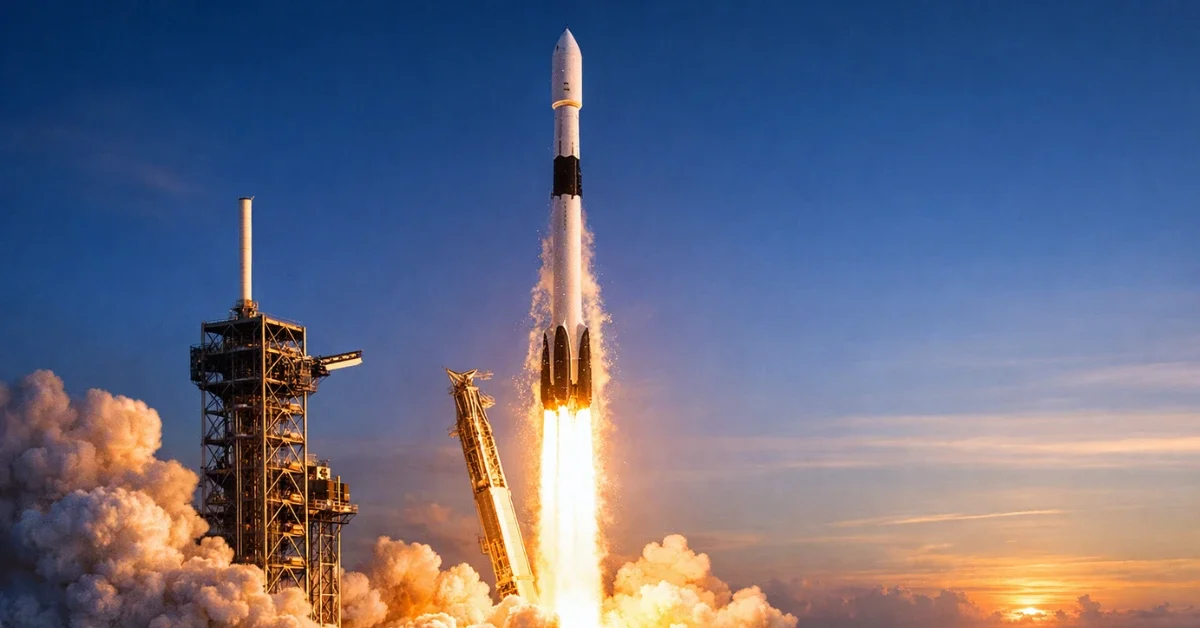
SpaceX is preparing for a landmark public debut, with a confidential SpaceX IPO filing expected as soon as March 2026. This financial milestone coincides with a surge in the company’s operational achievements, including an aggressive Starlink launch cadence and critical testing for the next generation of its Starship rocket.
The potential public offering could pave the way for a June 2026 listing. However, reports conflict regarding the expected valuation. According to an AI-generated report by AInvest, the IPO targets a $1.5 trillion valuation, while Teslarati reports that the valuation may exceed $1.75 trillion. Both sources note the offering aims to raise up to $50 billion, which would surpass Saudi Aramco’s $29 billion debut to become the largest initial public offering in history. Major financial institutions, including Goldman Sachs, JPMorgan Chase, Morgan Stanley, and Bank of America, are reportedly positioned for senior roles in the transaction.
Driving Force Behind the SpaceX IPO
The planned public offering is heavily fueled by the exponential growth of the Starlink satellite internet network. Financial forecasts indicate that SpaceX could generate approximately $15 billion in total revenue in 2025, with Starlink accounting for 69% of that figure. By 2026, total revenue is projected to jump 53.5% year-over-year to $23.8 billion. Starlink alone is expected to see its revenue climb by 80% to reach $18.7 billion.
A successful listing could profoundly impact the net worth of early investors. CEO Elon Musk, who invested $100 million in 2002, holds an estimated 42% stake in the aerospace firm. At a $1.75 trillion valuation, his share would be worth roughly $735 billion, potentially positioning him as the world’s first trillionaire. Other major backers, such as Alphabet Inc. and Founders Fund, could also see their investments grow into the tens of billions. To maintain leadership continuity, the company is considering a dual-class share structure that would allow insiders to retain enhanced voting control.
Accelerating Starlink Launch Operations
As financial preparations advance, SpaceX continues to expand its orbital infrastructure. The company concluded February 2026 with three successful Falcon 9 rocket flights within a single week, deploying a total of 83 new Starlink satellites into low Earth orbit.
On Tuesday, February 24, a Falcon 9 launched 29 satellites from Space Launch Complex 40 at Cape Canaveral Space Force Station in Florida. The following day, another rocket lifted 25 satellites from Space Launch Complex 4 East at Vandenberg Space Force Base in California. A third mission wrapped up the week on Friday, February 27, launching an additional 29 satellites from Cape Canaveral. According to satellite tracker Jonathan McDowell, these missions boosted the commercial broadband constellation to more than 9,850 units in orbit. All three first-stage boosters successfully returned to Earth, landing on ocean-based drone ships. Friday’s flight marked SpaceX’s 25th Falcon 9 mission of 2026 and was the 30th flight for that specific booster.
Operations are set to continue immediately into March. A launch is scheduled for early Sunday, March 1, from Vandenberg Space Force Base. This mission will carry 25 Starlink V2 Mini satellites into a southerly trajectory, utilizing a booster making its 20th flight.
Starship Upgrades and NASA Artemis Adjustments
Beyond its Falcon 9 operations, SpaceX is advancing the development of its fully reusable Starship system. The first Starship V3 flight of 2026 is targeted for March. The upgraded V3 design features newer Raptor engines intended to reduce weight and cost while delivering higher thrust.
Elon Musk recently confirmed that Starship V3 Ship 1 is heading for ground tests. He also clarified the company’s recovery strategy, noting that SpaceX will only attempt to catch the Starship upper stage with the launch tower’s robotic arms after achieving two perfect soft landings in the ocean. “The risk of the ship breaking up over land needs to be very low,” Musk stated.
Meanwhile, the company’s role in NASA’s lunar exploration plans is facing adjustments. NASA recently announced a revamped architecture for its Artemis program, focusing on a step-by-step approach and increased flight rates. The Artemis 3 mission, now planned for 2027, will no longer land astronauts on the moon. Instead, it will remain in low Earth orbit to demonstrate rendezvous and docking procedures between the Orion crew capsule and commercial landers.
According to the space agency, Artemis 3 will involve landers from SpaceX, Blue Origin, or both. NASA Administrator Jared Isaacman emphasized the need to move faster and eliminate delays, while pushing competition between contractors. The first crewed lunar landing is now envisioned for the Artemis 4 mission in 2028.
