

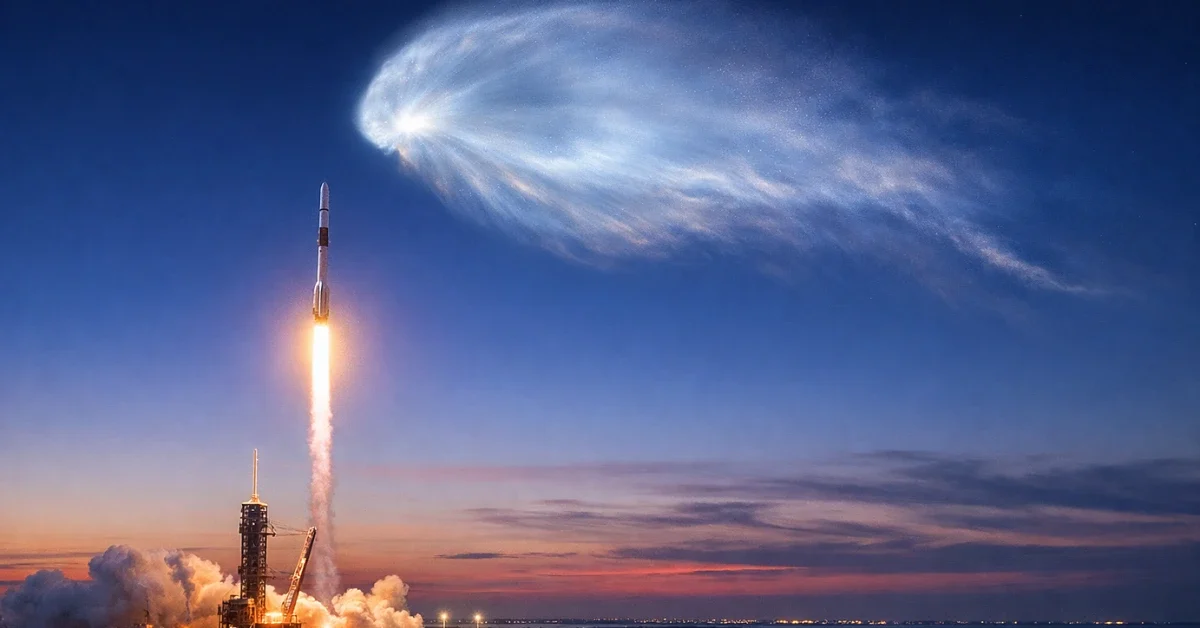
SpaceX carried out a SpaceX Starlink launch early March 4, sending 29 Starlink satellites to low Earth orbit on a Falcon 9 rocket from Cape Canaveral Space Force Station in Florida. The mission also produced a striking “space jellyfish” effect in the predawn sky as sunlight lit the rocket’s high-altitude exhaust plume.
Liftoff took place at 5:52:20 a.m. EST from Space Launch Complex 40, with the rocket flying on a north-easterly path after leaving the pad. The flight was identified as the Starlink 10-40 mission and added 29 broadband internet satellites to SpaceX’s Starlink megaconstellation.
Predawn launch and ‘jellyfish’ plume
The March 4 launch stood out for more than its payload. Observers saw a glowing cloud in the sky as the rocket climbed, a visual sometimes called a “space jellyfish.”
Space.com reported that this effect happens when Falcon 9 launches around dawn or dusk, when the sky is still dark enough for people on the ground to notice changes in brightness. In those conditions, sunlight can illuminate exhaust from the rocket’s upper stage, which Space.com said is made mostly of water vapor and carbon dioxide.
Booster landing and mission counts
After launching the 29 satellites, the Falcon 9’s first stage returned for a landing on the droneship A Shortfall of Gravitas in the Atlantic Ocean. Spaceflight Now said the droneship was positioned off the coast of South Carolina, while Space.com described it as positioned off the coast of Florida.
Spaceflight Now said the mission used booster B1080 and marked its 25th flight, noting the booster had supported previous missions including Axiom private astronaut flights, Northrop Grumman’s NG-21, and NASA’s CRS-30. Space.com also reported B1080 completed its 25th trip to space and back.
Several mission and landing tallies were reported across outlets. Spaceflight Now said Starlink 10-40 included the 600th Starlink satellite launched in 2026 and that B1080’s recovery was SpaceX’s 581st booster landing to date, as well as the 145th landing on A Shortfall of Gravitas. Space.com, however, said the landing was the 580th in SpaceX history, and described the March 4 flight as SpaceX’s 28th mission of the year, adding that 23 of the 28 launches in 2026 had been dedicated to Starlink.
Weather also appeared favorable. Spaceflight Now reported that the 45th Weather Squadron forecast a 90% chance of acceptable conditions during the launch window, with meteorologists watching for possible issues tied to cumulus clouds and recovery weather.
Starlink build-out and next upgrades
The March 4 launch came amid a rapid pace of Starlink missions. Space.com described Starlink as quickly approaching 10,000 satellites in orbit.
Earlier in March, Space.com reported that SpaceX began the month with two Starlink launches from opposite coasts, recovering both boosters. In that report, Space.com said booster 1082 completed its 20th flight with a landing on the droneship Of Course I Still Love You in the Pacific, while booster 1078 completed its 26th launch with a landing on the Just Read the Instructions droneship in the Atlantic.
That same Space.com report said the launches pushed the number of Starlink satellites in orbit to more than 9,900, citing satellite tracker Jonathan McDowell. Space.com also said the Sunday evening Florida flight was SpaceX’s 27th launch of the year and the company’s 620th completed mission.
Spaceflight Now’s coverage of the March 1 Starlink 10-41 mission also highlighted a north-easterly trajectory from Cape Canaveral and a droneship landing for booster B1078 on Just Read the Instructions. Spaceflight Now described that launch as SpaceX’s 22nd mission of the year supporting its broadband internet satellite constellation and said SpaceX confirmed deployment of the 29 satellites.
While Falcon 9 currently carries the full load of Starlink launches, SpaceX has outlined a shift to larger satellites and a new rocket. A Bloomberg report republished by The Star said SpaceX expects to start launching larger, more powerful Starlink satellites in mid-2027 as part of a long-planned upgrade designed to rely on Starship, the company’s next-generation vehicle.
At Mobile World Congress in Barcelona, SpaceX President Gwynne Shotwell and Starlink vice president Mike Nicolls discussed future plans for Starlink, according to The Star. Nicolls said the company’s goal is to deploy a constellation capable of global and contiguous coverage within six months, describing that as roughly 1,200 satellites, and he added that Starship could eventually launch 50 of the larger Starlink satellites at a time.
The Star also reported that SpaceX is rebranding its Starlink direct-to-cell service as Starlink Mobile. Nicolls said SpaceX has 650 satellites with Starlink Mobile capabilities, has 10 million monthly active users, and expects to exceed 25 million monthly active users by the end of 2026.
