

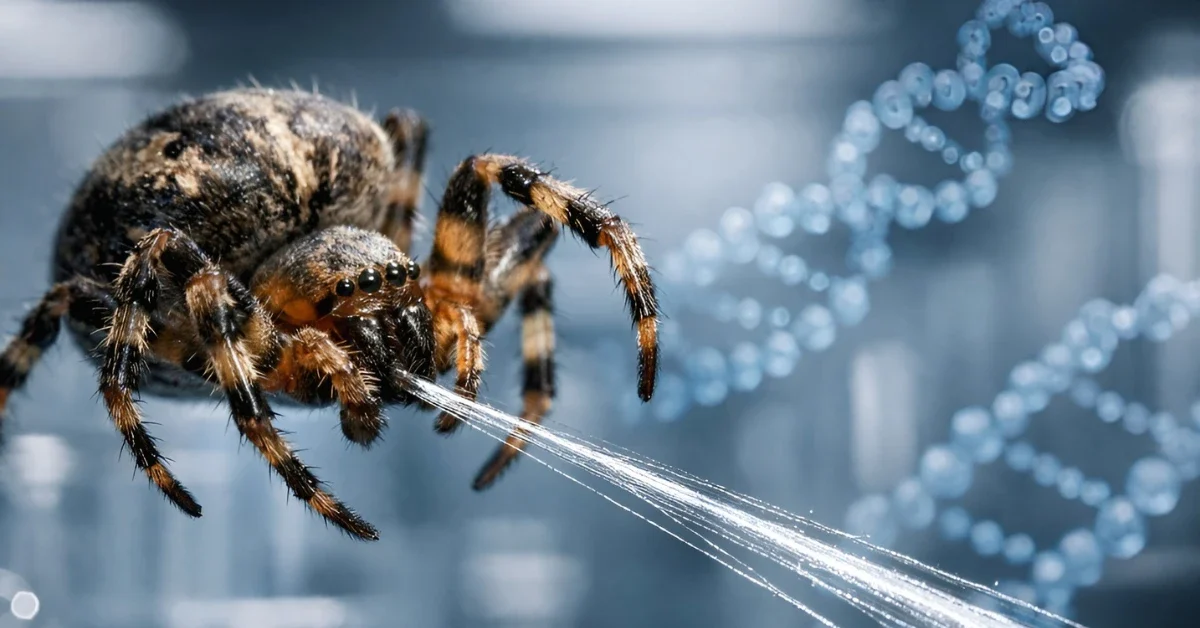
Researchers have finally decoded the mechanism that makes spider silk stronger than steel and tougher than Kevlar. A new study reveals that specific amino acids within silk proteins act as “molecular stickers,” holding the material together and enabling its transformation from a liquid into a solid fiber. This discovery could pave the way for next-generation aviation materials, protective gear, and medical devices.
The collaborative research, led by scientists from King’s College London and San Diego State University (SDSU), identifies the precise molecular interactions responsible for spider silk’s legendary mechanical properties. By mapping these interactions, the team has provided a blueprint for engineering sustainable, high-performance synthetic fibers that mimic nature’s design.
The Chemistry of Spider Silk
Spiders store silk proteins in a specialized gland as a thick, concentrated liquid known as “silk dope.” When the spider needs to spin a web or suspend itself, it pulls this liquid into a solid fiber with exceptional strength and flexibility. For years, scientists understood that these proteins clumped together into droplets before becoming fibers, but the molecular details of this process remained a mystery.
Using advanced tools like AlphaFold3 structural modeling and nuclear magnetic resonance spectroscopy, the research team discovered that two specific amino acids—arginine and tyrosine—drive this transformation. These amino acids interact to trigger the initial clustering of silk proteins. Crucially, this interaction does not stop once the proteins come together; it persists as the fiber forms, creating the complex nanostructure that gives the silk its power.
Chris Lorenz, a professor of Computational Materials Science at King’s College London, explained that this study offers an atomistic-level explanation of how disordered proteins organize themselves into highly ordered structures. The interaction acts like a natural glue, ensuring the fiber maintains its integrity under immense stress.
From Nature to Engineering
The implications of this discovery extend far beyond understanding spiders. Unlocking the secret of these molecular stickers allows engineers to replicate the process for human applications. Because spider silk creates a material that is incredibly lightweight yet robust, synthetic versions could revolutionize industries that rely on heavy, energy-intensive materials.
Potential applications include components for airplanes, which would benefit from the weight reduction, leading to better fuel efficiency. The researchers also highlighted the potential for creating biodegradable medical implants, soft robotics, and advanced protective clothing that offers the toughness of bullet-proof vests without the bulk.
An Unexpected Link to Alzheimer’s
One of the study’s most surprising findings was the similarity between spider silk formation and biological processes in the human brain. Gregory Holland, a professor at SDSU, noted that the chemical sophistication of the silk was unexpected. He pointed out that the interactions driving silk formation are the same types used in hormone signaling and neurotransmitter receptors.
The research indicates that the way silk proteins undergo phase separation and form specific structures mirrors the mechanisms seen in neurodegenerative conditions like Alzheimer’s disease. By studying how spiders control this process to build healthy, functional fibers, scientists may gain a “clean,” evolutionarily optimized model for understanding how similar processes go wrong in human disease.
