

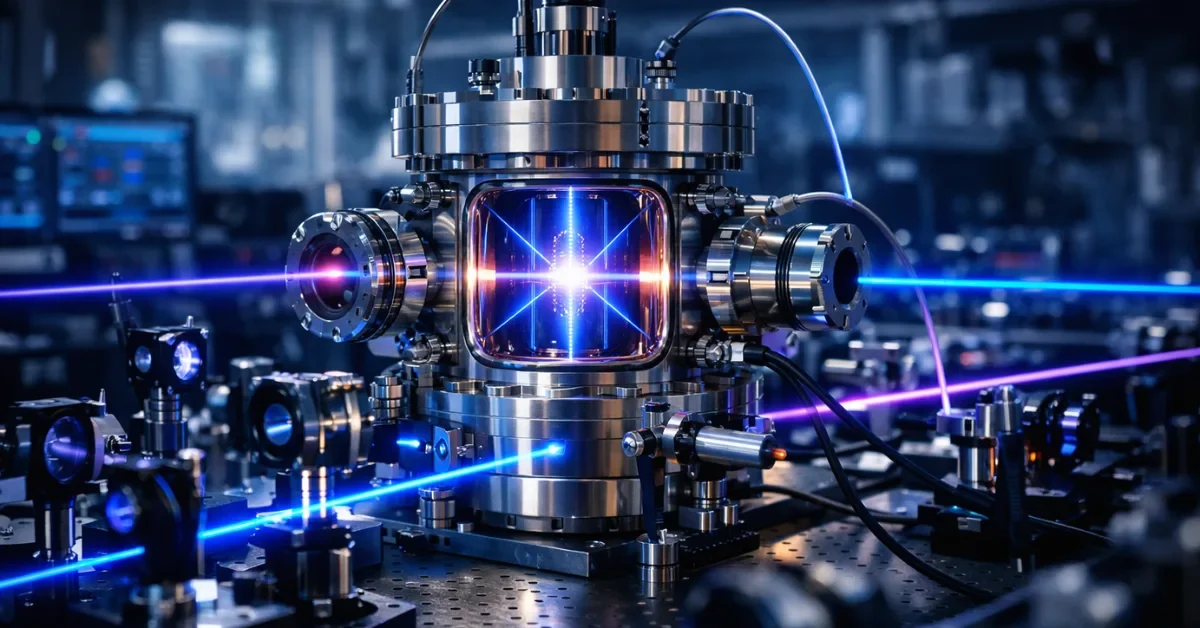
Timekeeping has just taken a monumental leap forward. Scientists from the University of Science and Technology of China have successfully developed a new generation of timekeeping device known as a strontium optical lattice clock. This breakthrough device can measure the passage of time with a level of precision that was previously considered almost impossible to achieve. According to the research team, the system is so incredibly stable that it would lose or gain less than one single second over a span of roughly 30 billion years. To put that into perspective, that length of time is more than twice the estimated age of the entire universe.
The research findings were published in the international metrology journal Metrologia. The study details how the development team, led by researcher Zhi-Peng Jia, achieved a level of stability and systematic uncertainty that both surpass the 10⁻¹⁹ level. Specifically, the clock demonstrated a systematic uncertainty of just 9.2 × 10⁻¹⁹. Before this achievement, most of the world’s most advanced optical clocks operated at the 10⁻¹⁸ level. Only a very small number of leading global institutions, such as the National Institute of Standards and Technology in the United States and the Physikalisch-Technische Bundesanstalt in Germany, had managed to approach this extraordinary level of timekeeping precision.
How the Ultra-Precise Clock Works
Optical clocks are currently recognized as the most precise timekeeping instruments in existence. They function by measuring time based on the frequency of light that is emitted when electrons transition back and forth between different energy levels within atoms. In this newly developed Chinese device, the primary functioning components are strontium-87 atoms. These microscopic atoms are carefully trapped inside a one-dimensional optical lattice, which is generated using highly focused laser light. Once the atoms are trapped in this lattice, scientists measure their quantum state using an ultra-stable laser operating at a specific wavelength of 698 nanometers.
Reaching this extreme level of accuracy was not an easy task. The researchers had to develop innovative techniques to eliminate various environmental factors that normally distort atomic oscillations and throw off the timekeeping process. One of the most significant hurdles the team faced was eliminating the light shift that is naturally caused by the optical lattice itself.
Additionally, the research team had to pay special attention to magnetic effects, which can easily disrupt ultra-precise measurements. By utilizing magnetically insensitive atomic transitions, the scientists were successfully able to reduce the negative influence of external magnetic fields by more than 22 times when compared to traditional timekeeping methods. Through rigorous testing and careful calibration, the team managed to minimize the errors caused by these magnetic shifts, proving that the clock can operate with remarkable frequency stability for extremely long durations.
Redefining Time and Navigation
This remarkable scientific milestone goes far beyond simply building a better clock. This strontium optical lattice clock could directly support the official redefinition of the second within the International System of Units. The achievement also firmly positions China among the top nations in the world regarding the development of advanced optical clocks.
According to university professor Dai Hanning, this breakthrough provides a highly feasible technical pathway for the future development of both portable, transportable optical clocks and space-based, satellite-borne optical clocks. Establishing a globally unified, ultra-high-precision time reference will fundamentally transform modern technology. It will provide highly accurate time references that are absolutely essential for the next generation of satellite navigation systems, global telecommunications networks, and advanced precision measurement tools.
Earth Science and Relativistic Geodesy
The practical applications for this technology extend into the realm of earth sciences. Because optical clocks like the USTC Sr1 are extraordinarily sensitive to gravitational potential, they can be utilized in a highly advanced field known as relativistic geodesy. This technique allows scientists to measure minute differences in height and altitude with millimeter-level precision simply by detecting incredibly tiny variations in Earth’s gravity.
Having the ability to measure gravitational potential at the millimeter level opens the door to a wide range of frontier geological applications. Scientists can use this technology to closely monitor the movement of tectonic plates and crustal deformation. It can also be deployed to track underground groundwater changes and monitor dangerous volcanic activity. Furthermore, this precision will greatly improve geoid mapping, which is crucial for early disaster prevention strategies and natural resource exploration.
Probing the Mysteries of the Universe
Perhaps the most exciting applications for the strontium optical lattice clock lie in the study of fundamental physics. These ultra-precise devices offer a completely new experimental platform for testing the fundamental laws of the universe, including Albert Einstein’s theory of general relativity.
Because the clock can measure extremely small variations in fundamental physical constants, physicists hope to use the technology to detect transient low-frequency signals. Capturing these elusive signals could potentially lead to the detection of low-frequency gravitational waves and provide new evidence of dark matter interactions. Some researchers have even suggested that placing a network of these highly synchronized optical clocks around the globe could eventually create a massive, planet-scale sensor. This network would be sensitive enough to detect subtle, previously unmeasurable changes in the fabric of space-time itself.
