

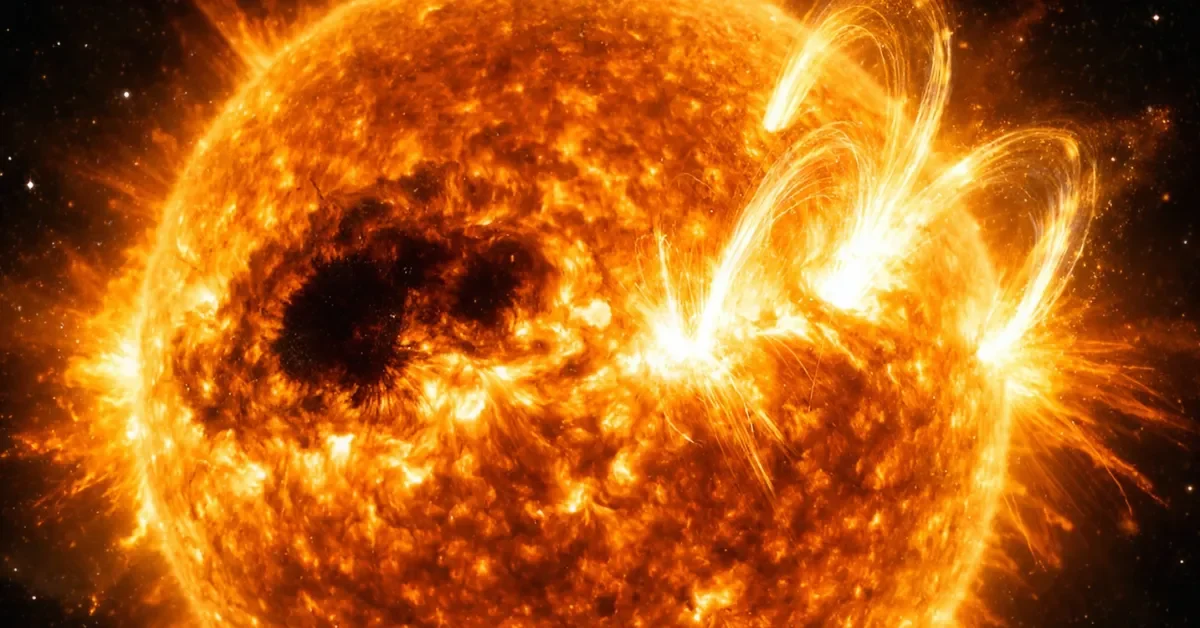
The sun has erupted with extraordinary force in recent days, unleashing multiple strong solar flares that have disrupted radio communications and put forecasters on alert for potential geomagnetic impacts. The culprit is a massive sunspot region designated AR4366, now nearly ten times wider than Earth, which has been unleashing intense bursts of energy since rotating into view on the eastern edge of the sun.
The largest of these eruptions was an X8.1 solar flare that peaked at 23:44 UTC on February 1, marking the third strongest flare of the current Solar Cycle 25. This powerful blast of energy triggered strong radio blackouts across the sunlit side of Earth, particularly affecting the Pacific region east of Australia and into New Zealand. Flares are intense bursts of electromagnetic radiation that can impact radio communications, electric power grids, navigation signals, and pose risks to spacecraft and astronauts.
Record Breaking Flare Activity
NASA’s Solar Dynamics Observatory captured four strong solar flares over a two-day period from February 1 to February 2. The first flare peaked at 7:33 a.m. Eastern Time on February 1 and was classified as an X1.0. This was followed by the massive X8.1 flare later that day at 6:37 p.m. ET, then an X2.8 flare at 7:36 p.m. ET. On February 2, a fourth strong flare peaked at 3:14 a.m. ET, classified as an X1.6.
The flaring activity has continued relentlessly since then. Solar activity reached very high levels between February 1 and February 2, with 26 flares observed during a single 24-hour period, including five X-class flares and 21 M-class flares. One notable sequence involved a marathon triple-peaked flare lasting more than six hours on February 1, with peaks at M7, X1, and M6 levels.
Monster Sunspot Keeps Firing
The explosive activity is being driven by sunspot region AR4366, which has grown into a magnetically complex beta-gamma-delta configuration. This unstable magnetic structure makes the region highly prone to producing powerful eruptions. Over the following day from February 2 to February 3, AR4366 continued its assault, releasing 14 M-class flares, with the strongest being an M7.2 that drove a moderate radio blackout across parts of Earth’s sunlit hemisphere.
All the M-class flares recorded during these periods originated from AR4366, far outpacing the relatively quiet behavior of the other numbered sunspot regions on the visible solar disk. The region dominated the Earth-facing side of the sun, remaining the largest sunspot group in extent as viewed from our planet.
Radio Blackouts Hit Communications
The X8.1 flare caused an R3-level radio blackout, classified as strong on the NOAA space weather scale. This disrupted high-frequency radio communications for about an hour, affecting aviation, maritime operations, and amateur radio users. The intense extreme ultraviolet radiation from the flare strongly ionized Earth’s upper atmosphere, causing prolonged signal absorption below 20 MHz.
Shortly after the X8.1 eruption, AR4366 fired again with an X2.9 flare at 00:42 UTC on February 2, hammering nearly the same sector of Earth’s atmosphere and reinforcing the ongoing radio impacts. Additional X-class flares, including an X1.5, X2.8, and X1.7, all produced R3-level strong blackout conditions on the dayside of the planet. Even the M7.2 flares reached R2-moderate levels, causing limited blackouts of high-frequency radio communication for tens of minutes.
Geomagnetic Storm Watch Issued
NOAA’s Space Weather Prediction Center issued a watch for G1-level minor geomagnetic storm conditions on February 5 and February 6. Forecasters indicated that coronal mass ejections associated with the X8.1 flare would likely deliver glancing influences by late on February 5. Analysis and modeling suggested an Earth arrival on February 5 near 23:00 UTC, with geomagnetic activity estimates of Kp 3 to 4, suggesting mostly active-to-unsettled conditions.
However, initial assessments noted uncertainty about whether a full coronal mass ejection was directed toward Earth. While early coronagraph views showed several eruptions lifting off the solar limbs that did not appear Earth-directed, coronal dimming signatures in satellite imagery often indicate that a CME has been launched. Initial modeling suggested any associated eruption would be slow-moving, with a glancing-hit scenario favored by operational guidance.
Forecasters Remain On High Alert
Solar activity is expected to continue at moderate to high levels through mid-February as Region 4366 transits across the visible disk. The 27-day forecast issued on February 2 predicts further M-class flares and a high chance for additional X-class flares through February 10. The greater than 10 MeV proton flux is likely to reach minor-to-moderate storm levels on February 2 through 4 due to proton prediction model guidance from the recent X8.1 flare.
Space weather forecasters anticipate low levels of activity with a chance for M-class flares from February 11 to 22, followed by an increase to moderate-to-high levels again from February 23 to 28 as Region 4366 returns to the visible disk after rotating around the far side of the sun. The geomagnetic field is expected to remain at mostly quiet levels barring potential impacts from coronal mass ejections related to the recent major eruptions.
If the magnetic field in any incoming solar material turns southward, it could open the door for stronger geomagnetic responses and brighter auroras later this week. Aurora may be visible at high latitudes, particularly in the northern tier of the United States such as northern Michigan and Maine, and potentially as far south as New York to Wisconsin to Washington state if conditions intensify to G2-moderate storm levels.
