

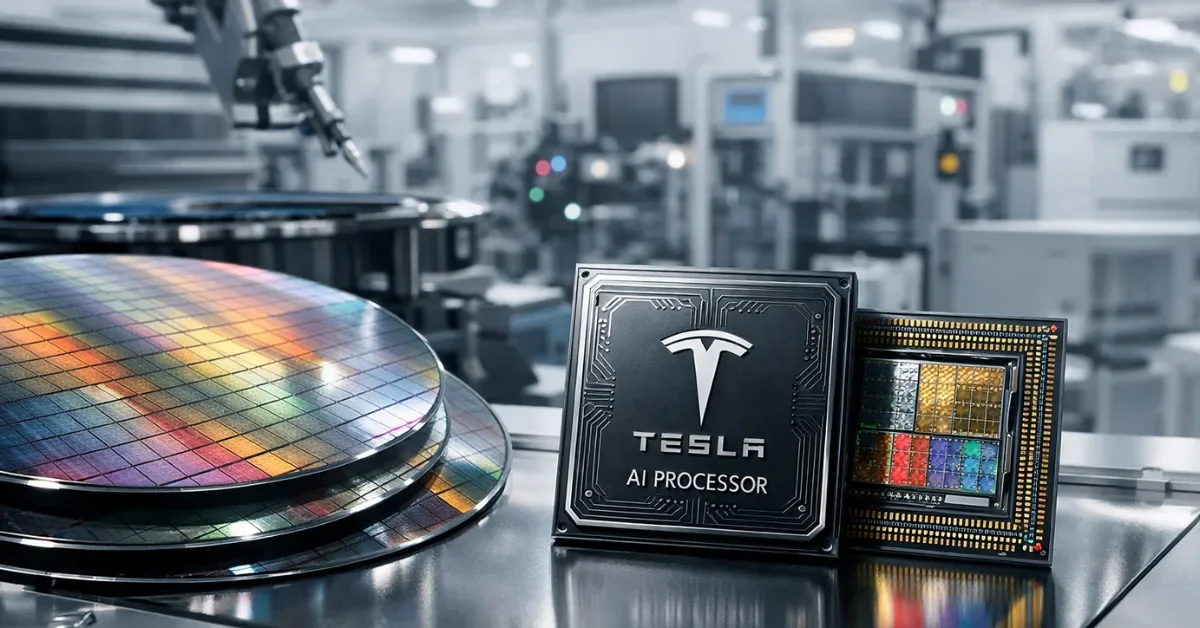
Tesla’s planned Terafab chip factory is set to launch in seven days, according to CEO Elon Musk, who said the project is moving ahead as the company looks for a bigger and more reliable supply of artificial intelligence chips.
The announcement puts Tesla’s semiconductor strategy back in focus at a time when the company is pushing deeper into autonomous driving, robotics, and large-scale AI computing. Musk said last year that Tesla might have to build its own massive chip fabrication plant because expected output from outside suppliers may still fall short of what the company needs.
Why Tesla wants Terafab
Tesla’s chip demand has risen with its expanding AI work, including systems tied to vehicles, robotics, and data centers. Mint reported that the planned facility would produce large volumes of advanced processors for Tesla’s AI systems used in vehicles.
Musk has been signaling this direction for some time. Mint said he previously indicated Tesla may need its own semiconductor manufacturing facility to meet rising AI chip demand, while The Times of India reported that he had described the idea as a huge chip fab needed for future technologies.
The company currently depends on outside chipmakers for key supply. Mint said Tesla relies heavily on TSMC, Samsung Electronics, and Micron Technology, while The Times of India said Musk has also referred to work with TSMC and Samsung on the AI5 chip used in Tesla’s autonomous driving systems.
AI plans behind the project
Tesla’s AI buildout requires enormous computing power. Mint reported that the company runs some of the industry’s largest AI supercomputing clusters to train autonomous driving systems and robotics models, and that Tesla already uses tens of thousands of Nvidia GPUs for AI training.
The company’s chip roadmap is also shifting. Mint said that after the cancellation of Tesla’s Dojo chip program, the company plans to rely on its AI5 processors for vehicles and humanoid robots, while also deploying those processors in data centers.
That broader push helps explain why Musk has framed Terafab as more than a manufacturing expansion. Both Mint and The Times of India said Musk has argued that even optimistic supply projections from current partners may not satisfy Tesla’s future needs, making an in-house fabrication plant a possible answer.
Scale and production targets
Some of the most detailed claims about Terafab’s scale came from FinTech Weekly, which said Tesla first confirmed the project during its January 28, 2026 earnings call. That report said Tesla expects a supply constraint within three to four years and wants the facility to combine logic processing, memory storage, and advanced packaging in one vertically integrated operation.
FinTech Weekly also reported that Terafab could cost about $25 billion and was discussed as part of Tesla’s record 2026 capital spending plan, which it said exceeds $20 billion. The same report said Tesla’s finance chief, Vaibhav Taneja, acknowledged that the full Terafab cost was not yet included in that spending figure.
On production, FinTech Weekly said the plant is designed to make between 100 billion and 200 billion custom AI and memory chips a year, starting at 100,000 wafer starts per month and aiming to scale far beyond that. It also said Tesla is targeting 2-nanometer manufacturing for the facility, with small-batch production of the AI5 chip expected in 2026 and volume production projected for 2027.
What comes next
For now, the clearest confirmed development is Musk’s statement that the launch is expected within seven days. The Times of India said Tesla did not immediately respond to a Reuters request for more detail on the project.
If the launch proceeds on that timeline, Terafab would mark one of Tesla’s boldest moves yet to gain more direct control over the hardware behind its AI ambitions. Mint said the project could eventually turn Tesla into an integrated device manufacturer that both designs and produces its own semiconductors, giving the company tighter control over its hardware supply chain.
