

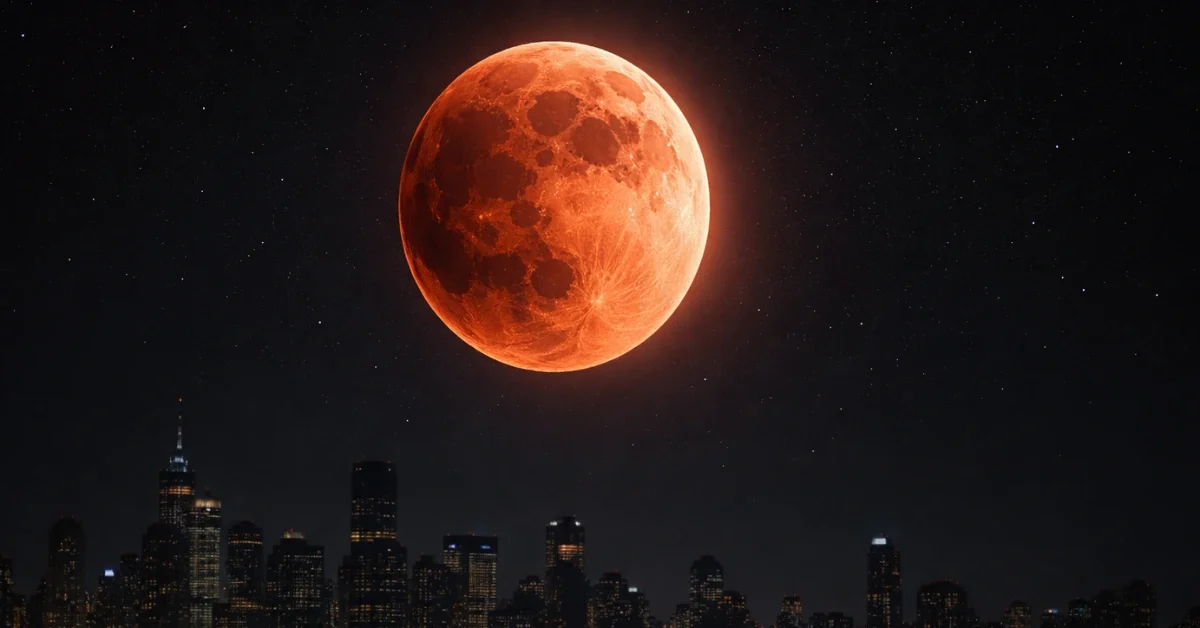
On March 3, 2026, the night sky put on a striking show as a rare total lunar eclipse transformed the full moon into a deep copper-red orb. Widely referred to as a “Blood Moon,” this dramatic astronomical event captivated an estimated three billion viewers around the world. The spectacular display lit up skies across multiple continents, offering a memorable celestial highlight for 2026. Because the March full moon is traditionally known as the “Worm Moon,” this alignment brought an extra layer of cultural significance to skies over regions spanning from Sydney, Australia, to New York.
The Science Behind the Red Hue
A lunar eclipse takes place when Earth moves directly between the Sun and the Moon. During this alignment, Earth cuts off direct sunlight and throws its shadow across the lunar surface. The Moon does not go completely dark; instead, it turns a striking shade of red.
This colour change occurs because sunlight bends as it filters through Earth’s atmosphere. The atmosphere scatters blue light and leaves only longer red wavelengths to illuminate the Moon. According to NASA, the visual effect is exactly as if all of Earth’s sunrises and sunsets are projected onto the moon at once.
Unlike a solar eclipse, which requires eye protection, a lunar eclipse is safe to watch. Skygazers around the globe looked at the reddened Moon with the naked eye or binoculars without needing special filters. Clear skies and an unobstructed view toward the horizon provided the best chances for viewing.
Global Viewing Highlights
The eclipse offered spectacular views across large parts of the world. Observers in much of Australia, Japan, South Korea, China, and the broader Pacific region had an excellent evening view. The total phase lasted just under an hour, with maximum redness appearing at the peak of totality. In Auckland, New Zealand, residents had the privilege of witnessing a complete view of the eclipse from beginning to end.
In North America, western parts of the continent saw the eclipse in the early morning hours, featuring clear visibility of the entire sequence as the Moon set. Photographers successfully captured the full blood moon rising over California Street in San Francisco. Meanwhile, in Las Vegas, Nevada, the Sphere transformed its massive digital exterior into a giant Blood Moon, prominently displaying the glowing orb in the foreground while the actual eclipsed moon shone behind it.
Stunning Sights Across Continents
Other international cities also enjoyed magnificent sights. In Seoul, South Korea, observers were treated to a view of the blood moon passing dramatically behind the N Seoul Tower. In Manila, the Philippines, a full moon was photographed rising over densely packed buildings, while observers in Beijing, China, also caught sight of the reddened moon. In Buenos Aires, Argentina, the moon rose in a waxing gibbous phase behind local architecture.
Conversely, areas of Europe and Africa missed the key phases entirely, as the Moon was positioned below the horizon during totality. Despite missing the total eclipse phase, a full moon was still seen setting behind the Penshaw Monument near Sunderland in the United Kingdom.
Disputed Viewing Times in India
Within India, there is a clear disagreement between sources regarding the specific timing and visibility of the eclipse. According to the publication Outlook Traveller, the total lunar eclipse in India began in the afternoon and continued into the evening. The official timing data cited indicated that the eclipse started at 3:20 PM Indian Standard Time. Totality kicked off at 4:34 PM and continued until approximately 5:33 PM, winding down by 6:48 PM.
Due to this late moonrise, Outlook Traveller noted that the most vivid moments had already passed for western and central Indian regions. Residents in northeastern states and the Andaman and Nicobar Islands were reportedly better placed to catch totality. In cities such as Delhi and Mumbai, where moonrise occurred between 6:20 PM and 6:40 PM, skywatchers only saw the final, fading parts.
However, the New York Post provided a conflicting account of the Indian viewing experience. According to the New York Post, astronomy enthusiasts in the western Indian city of Ahmedabad rose early to catch a glimpse of the blood moon just before the break of day.
Regardless of local viewing times, this spectacular event holds special value. People around the world were especially excited to catch a glimpse, as astronomical forecasts indicate that there will not be another total lunar eclipse until late 2028. For the three billion people who looked up, this rare copper-red orb provided a breathtaking visual connection to the solar system.
