

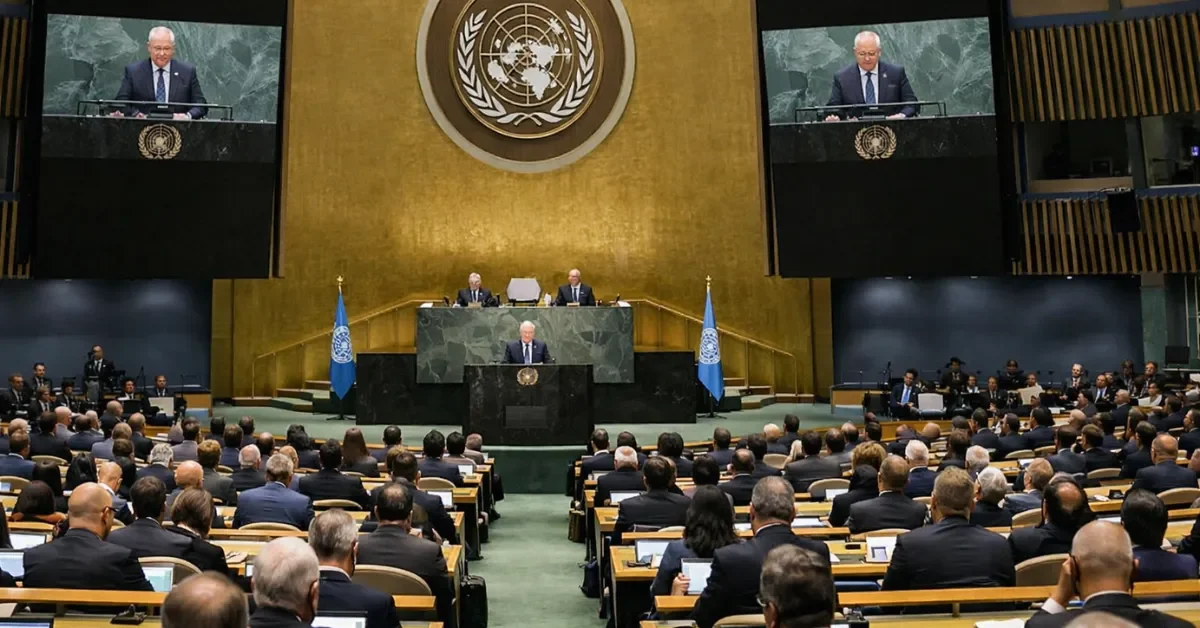
The UN General Assembly has appointed 40 experts to a new Independent International Scientific Panel on Artificial Intelligence, a body created to deliver evidence-based assessments on how AI is affecting people, economies, and societies. UN Secretary-General António Guterres has described the move as a step toward building shared understanding of a fast-moving technology that countries are struggling to fully grasp, let alone govern.
The panel was established by a General Assembly resolution adopted in 2025 and is described as the first global scientific body of its kind focused on AI’s opportunities, risks, and impacts. The experts will serve for three years in their personal capacity, with a term running from February 2026 to February 2029.
Recorded vote highlights divisions
The appointments were approved after the United States requested that the vote be recorded, and the US delegation voiced strong objections to the panel’s creation as it is currently set up. The US representative argued that the panel, along with the related Global Dialogue on AI Governance, represents an overreach of the UN’s mandate and competence, and urged the UN to focus on what it described as core missions such as peace and security, human rights, and humanitarian assistance.
In the recorded vote, 117 countries voted in favour of appointing the 40 panel members, while two voted against and two abstained. Paraguay and the United States voted against the appointments, and Tunisia and Ukraine abstained.
Other delegations defended the move and framed it as a way to keep AI governance inclusive. Uruguay, speaking for the Group of 77 and China, reiterated the bloc’s call for international frameworks that ensure developing countries are fairly included in shaping AI governance. The statement also pointed to AI’s potential, if properly governed, to improve public services, expand access to education and health, and support progress on the 2030 Agenda for Sustainable Development.
What the panel is expected to do
The General Assembly decision outlines a clear output: the panel is expected to issue an annual report containing evidence-based scientific assessments that synthesize and analyse existing research on AI’s opportunities, risks, and impacts. UN messaging around the panel has emphasized that this kind of structured, independent assessment can help countries engage in AI discussions on a more equal footing, regardless of their technological capacity.
Guterres has repeatedly stressed the pace and pressure created by rapid AI development. In earlier remarks announcing nominees to be submitted to the General Assembly, he warned that “AI is moving at the speed of light” and said the world needs shared understandings to build effective guardrails, unlock innovation for the common good, and foster cooperation. He also said the panel can help the world “separate fact from fakes, and science from slop.”
Beyond annual reporting, UN communications have described the panel as a forum for experts to exchange ideas and run “deep dives” into priority areas including health, energy, and education, while sharing leading-edge research. The panel is also expected to feed into the Global Dialogue on AI Governance, a separate UN-backed mechanism aimed at supporting international discussion and coordination.
How members were chosen
According to the UN, the panel’s 40 members were selected from more than 2,600 candidates. The selection followed an independent review involving the International Telecommunication Union, the UN Office for Digital and Emerging Technologies, and the UN Educational, Scientific and Cultural Organization.
UN officials have also pointed to geographic diversity and gender balance as part of the selection approach. A UN briefing on the nominees said the list included 19 women and 21 men, and provided examples of individuals on the slate such as Sonia Livingstone of the United Kingdom, Balaraman Ravindran of India, and Maria Ressa of the Philippines.
Even supporters acknowledged that building agreement could be difficult given the panel’s size and the wider political climate. UN officials have argued that scientific cooperation has persisted even in tense geopolitical periods, and that the UN can provide mechanisms to advance common understanding.
Science-led governance and “meaningful human oversight”
Guterres has connected the panel’s work to broader goals, including sustainable development, while warning about the risks of fragmented AI rules and standards. Speaking at an event held on the margins of the AI Impact Summit in New Delhi, he said science-led governance can turn AI from uncertainty into a more reliable engine for the Sustainable Development Goals, and argued that policy cannot be built on guesswork if AI is to serve humanity.
He also raised concerns that without a common baseline, different regions could adopt incompatible policies and technical standards, potentially raising costs, weakening safety, and widening divides. In that context, he said the panel, alongside the Global Dialogue on AI Governance, can help countries align technical baselines.
The Secretary-General also emphasized that human control must be practical, not just rhetoric. He called for meaningful human oversight in high-stakes decisions such as justice, healthcare, and credit, and for clear accountability so responsibility is never outsourced to an algorithm. He added that people must be able to understand decisions, challenge them, and get answers.
