

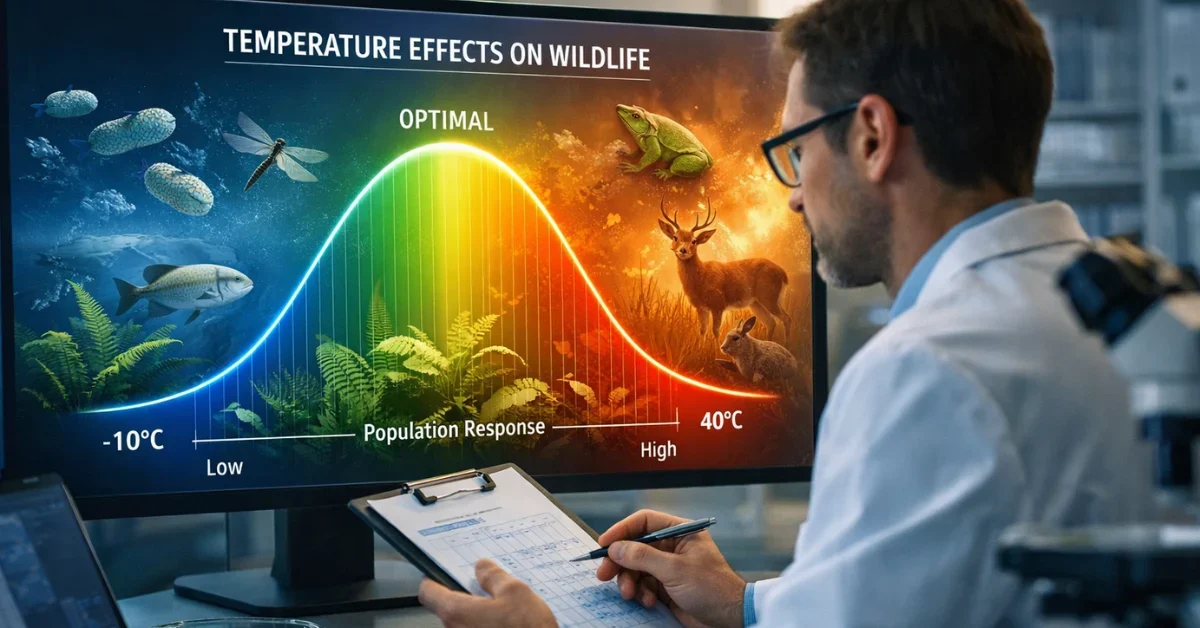
Researchers at Trinity College Dublin and their collaborators say they have identified a universal thermal performance curve, or UTPC, that appears to describe how temperature affects life across the tree of life. The study says biological performance usually rises as organisms warm, reaches an optimum, and then drops sharply when temperatures continue to climb.
The finding matters because the researchers say this shared pattern could limit how far evolution can help species adjust to rapid climate warming. The work was published in Proceedings of the National Academy of Sciences and is described by the authors as a single mathematical equation that unifies how temperature influences processes from enzymes to ecosystems.
What the study found
The researchers say the UTPC brings together many temperature-response curves that had previously been treated as separate patterns in biology and ecology. According to the study accounts, the same underlying shape can describe very different kinds of performance, including lizards running, sharks swimming, and bacterial cell division.
Across the sources, the pattern is described in similar terms even when the examples differ. Performance increases gradually with warming until it reaches a peak, but once temperatures move above that point, the decline is fast and can lead to physiological failure or death.
The reporting also says species do not all peak at the same temperature. One source quotes co-author Andrew Jackson as saying optimal temperatures can range from 5 degrees Celsius to 100 degrees Celsius, even though the overall curve shape remains similar across groups.
Evidence across species
The study team included researchers from Trinity College Dublin, the University of Granada, and France’s CNRS Theoretical and Experimental Ecology Station in Moulis. EurekAlert names Ignacio Peralta-Maraver, Jean-François Arnoldi, Andrew L. Jackson, and Nicholas Payne among the researchers involved in the work.
The sources agree that the analysis covered a very large and diverse dataset, but they describe that evidence in different ways. Earth.com says the model emerged from more than 30,000 performance measurements across roughly 2,700 species. EurekAlert reports more than 30,000 different performance measures across a huge diversity of species. ScienceDaily, Phys.org, and SSB Crack instead describe the study as an analysis of over 2,500 thermal performance curves.
Despite those different descriptions of the dataset, the sources point in the same direction on the main result. They say the pattern holds across major groups of life, including bacteria, plants, reptiles, fish, and insects, and across biological organization levels from molecular processes to ecosystems.
Why it matters
The study argues that this common curve places a strong constraint on adaptation. Phys.org and ScienceDaily describe the idea in especially stark terms, saying evolution has been able to shift the curve but has not found a way to break its basic shape. EurekAlert makes the same point by saying life forms remain constrained by a rule that governs how temperature affects function.
Another key result is the link between the optimum temperature and the upper limit at which death occurs. Jackson says those two points are tightly connected, which means that once temperatures move above the optimum, the viable temperature range becomes smaller. That result helps explain why overheating may become dangerous quickly rather than gradually.
Several of the reports say this matters for climate change because species may be more constrained than previously thought in their ability to cope with warming conditions. Earth.com adds that organisms already adapted to warm conditions may be especially sensitive because their optimal temperatures lie closer to the top of the curve.
What comes next
The researchers say the UTPC can now be used as a benchmark to look for exceptions. Their next step is to search for species or systems that may slightly depart from the pattern and then ask why that happens.
The work also points to practical uses beyond theory. Earth.com says conservation groups and resource managers could use the curve in models that forecast population growth, migration, or mortality under different warming scenarios. Even with that potential, the main message across the source coverage is simple: many forms of life may share one temperature rule, and that shared rule could shape how nature responds to a hotter world.
