

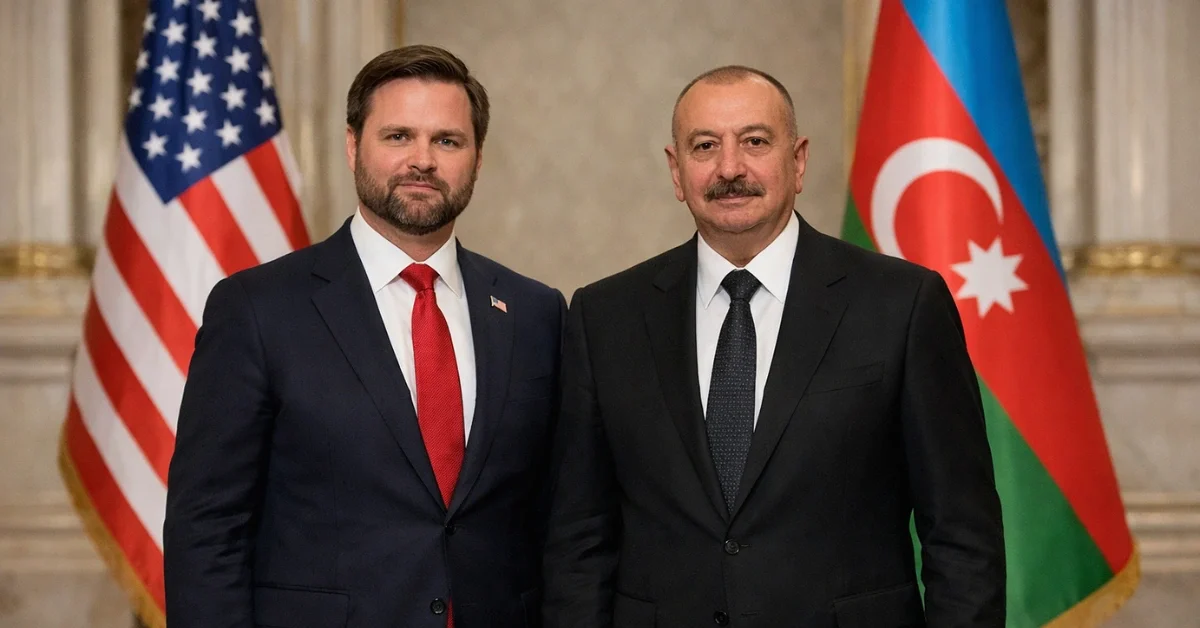
Vice President JD Vance arrived in Baku on Tuesday to formalize a landmark US-Azerbaijan strategic partnership, signaling a significant shift in American foreign policy within the South Caucasus. During his high-profile visit, Vance met with Azerbaijani President Ilham Aliyev to sign a Strategic Partnership Charter intended to deepen cooperation on energy, security, and regional stability. This agreement marks a pivotal moment for the Trump administration as it seeks to strengthen ties with energy-rich nations while navigating the complex geopolitical landscape of the region.
The US-Azerbaijan strategic partnership focuses on five primary goals that will guide the relationship between the two nations in the coming years. These objectives include ensuring global energy security, promoting regional peace, expanding economic trade, enhancing defense capabilities, and supporting governance reforms. By establishing this formal framework, the United States aims to secure a more reliable flow of energy to European markets and bolster its influence in a territory that sits at the crossroads of Europe and Asia.
Strengthening Energy and Economic Ties
A central component of the new charter involves a commitment to energy security and the expansion of the Southern Gas Corridor. Vice President Vance emphasized the importance of Azerbaijan as a critical partner in providing alternative energy sources to Europe, especially as global markets face ongoing volatility. The agreement outlines plans for increased technical cooperation to improve the efficiency of existing gas exports while also looking toward a future of sustainable energy production.
Beyond traditional fossil fuels, the partnership highlights a new focus on renewable energy projects within the Caspian region. The United States and Azerbaijan have agreed to explore joint ventures in wind and solar power, aiming to modernize Azerbaijan’s energy infrastructure with American technology and investment. This economic cooperation is expected to create new opportunities for US businesses while helping Azerbaijan diversify its economy away from a sole reliance on oil and gas exports.
Economic discussions during the visit also touched upon trade barriers and the potential for increased American private-sector investment in Baku’s growing technology and agricultural sectors. President Aliyev welcomed the renewed American interest, noting that the charter provides a stable environment for long-term commercial projects. Both leaders expressed confidence that the strategic partnership would lead to a more integrated and prosperous regional economy.
Maritime Security and Defense Cooperation
Security cooperation is another major pillar of the signed agreement, with Vice President Vance making a significant announcement regarding military assistance. The United States has committed to delivering 12 advanced patrol boats to Azerbaijan’s State Border Service. These vessels are specifically designed to enhance maritime security in the Caspian Sea, allowing Azerbaijan to better monitor its territorial waters and protect critical underwater energy infrastructure from potential threats.
The delivery of these patrol boats underscores a shared interest in counter-terrorism and the prevention of illicit trafficking across the Caspian. Vance noted that a secure Azerbaijan is essential for a secure region, and the provision of these assets demonstrates the Trump administration’s willingness to provide tangible support to its strategic partners. This move is seen as a way to bolster Azerbaijan’s defense capabilities without directly involving US ground forces in regional conflicts.
In addition to the naval hardware, the charter establishes a framework for regular military-to-military consultations and training exercises. These programs will focus on border security, emergency response, and modernizing Azerbaijan’s defense protocols to meet international standards. The agreement reflects a pragmatic approach to security, focusing on coastal defense and internal stability as key components of the broader bilateral relationship.
Pursuing Peace in the South Caucasus
The visit to Baku is part of a broader regional strategy, as Vice President Vance is scheduled to travel to Armenia immediately following his meetings in Azerbaijan. This back-to-back diplomatic effort is intended to facilitate a permanent peace treaty between the two neighboring nations. During his remarks in Baku, Vance urged both sides to seize the current opportunity for a lasting settlement, emphasizing that regional stability is a prerequisite for the full success of the strategic partnership.
The strategic charter specifically lists regional peace as one of its five core goals, indicating that the United States intends to play an active role as a mediator. Vance highlighted that the Trump administration views the resolution of long-standing border disputes as vital for the economic integration of the South Caucasus. By maintaining a presence in both Baku and Yerevan, the US hopes to balance its interests and encourage a diplomatic breakthrough that has remained elusive for decades.
While the partnership emphasizes defense and energy, it also includes language regarding democratic reforms and the rule of law. The fifth goal of the charter focuses on strengthening institutional transparency and protecting human rights within Azerbaijan. While secondary to the immediate security and energy concerns, these elements are included to ensure the partnership remains aligned with broader international standards as both nations move forward in this new era of cooperation.
