

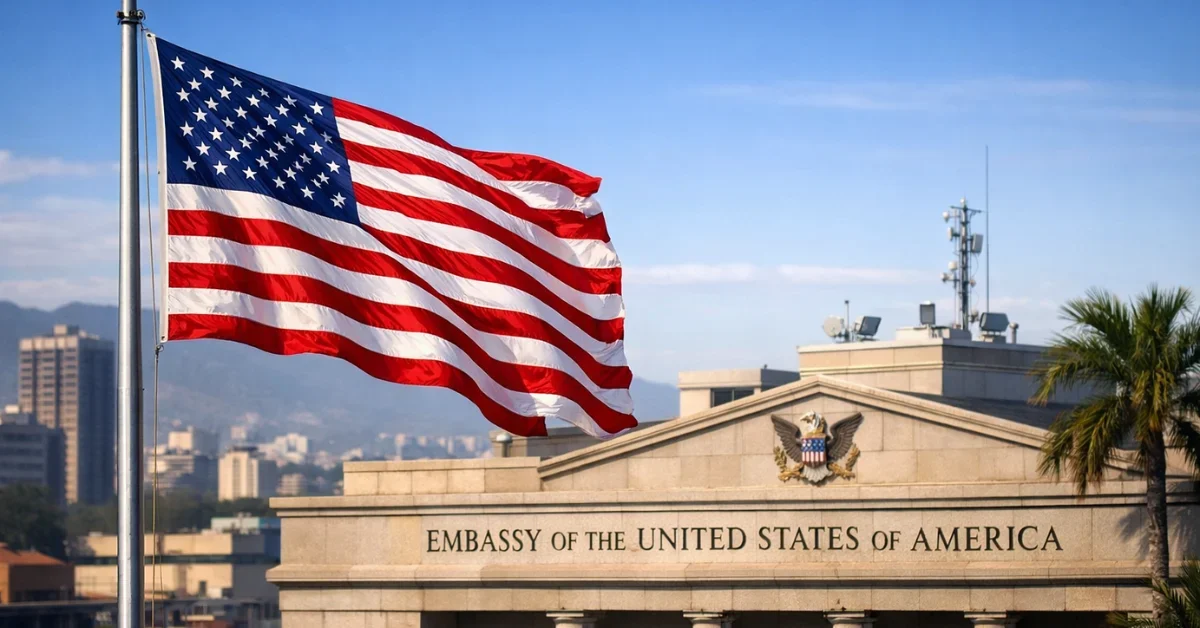
The United States flag is once again flying over the US Embassy in Venezuela for the first time since 2019. The official flag-raising event took place in Caracas on Saturday, ending a seven-year absence of American diplomatic representation in the South American country. This symbolic reopening marks a dramatic shift in international relations between Washington and Caracas, arriving shortly after former President Nicolás Maduro was captured and removed from power by American troops during a military operation in January.
Although the American flag has been hoisted to signal the restoration of diplomatic efforts, the embassy is not yet ready for regular operations. The facility is currently undergoing extensive renovations, and officials note it remains uncertain when the building will fully reopen to the public. Charge d’Affaires Laura Dogu, who leads the American diplomatic team in Caracas, highlighted that the flag was raised exactly seven years to the day after it was removed on March 14, 2019. She emphasized the significance of the moment, declaring that a new era for the two nations has begun while affirming a commitment to stay engaged with Venezuela.
Trump Administration Pushes for Oil Access
The reopening of the American diplomatic mission directly follows the United States officially reinstating diplomatic relations earlier this month. US President Donald Trump has expressed strong support for Maduro’s successor, acting President Delcy Rodríguez. In the wake of Maduro’s ousting, Rodríguez has actively tried to keep negotiations and dialogue open with the American government. However, the Trump administration has used this relationship to press the interim Venezuelan government for significant concessions, particularly demanding access to the country’s vast oil reserves and other natural resources.
In response, Rodríguez has advocated for legislation designed to open Venezuela’s nationalized oil and mining sectors to foreign investment. Her administration has already facilitated the transfer of approximately 80 million barrels of Venezuelan oil to the United States. The Trump administration has subsequently sold these transferred oil reserves. Revenues generated from these US-led oil sales are deposited into a US-controlled bank account intended to be shared between the two countries. Rodríguez publicly called on Trump on Friday to lift the remaining US sanctions against Venezuela, arguing that removing these economic barriers is necessary to improve domestic conditions for her citizens.
Control Over Natural Resources Sparks Debate
The growing American influence over the Venezuelan oil industry has become a major focal point. President Trump and his advisors, including Stephen Miller, have publicly claimed that Venezuelan oil should be considered United States property. They justify this position by pointing to historical American oil exploration in the region and citing a 2007 initiative by the Venezuelan government that expropriated assets from American energy companies like ExxonMobil. Miller recently argued that American ingenuity created the Venezuelan oil industry, describing the past nationalization as a massive theft of American wealth.
The Trump administration has openly discussed maintaining control over Venezuela’s natural resources permanently. During a speech on January 3, Trump stated that the United States would essentially run the country’s oil operations indefinitely. Furthermore, in a January 4 interview, he issued a direct threat to acting President Rodríguez, warning that if she does not comply with American interests, she will pay a severe price worse than what Maduro experienced. Legal experts contend that these assertions undermine Venezuelan sovereignty, pointing out that international law guarantees every nation permanent sovereignty over its own natural resources. The United States also continues to maintain significant oversight over Venezuela’s oil exports globally, which includes actively restricting the country’s fuel trade with neighboring Cuba.
Public Reaction to the Flag-Raising Event
Despite the aggressive posturing over oil, the physical reopening of the embassy drew positive attention from local residents in Caracas. Luz Verónica López described the flag-raising as a wonderful development, expressing hope that other countries would also return to establish diplomatic ties so the nation can progress. Similarly, Alessandro Di Benedetto observed a cheerful atmosphere among the crowds gathered near the embassy, characterizing the event as an important step forward.
However, these optimistic views are not universally shared. Large segments of the Venezuelan public remain highly critical of President Trump. There is lingering opposition to his decision to forcefully remove Maduro from office and jail him alongside his wife, Cilia Flores, in New York. Critics are equally concerned about the rapidly expanding American presence in the nation’s crucial oil sector. As the US Embassy slowly resumes its functions, the complex dynamic of diplomatic engagement combined with disputes over sovereign resources will continue to define the future of the relationship between the two countries.
