

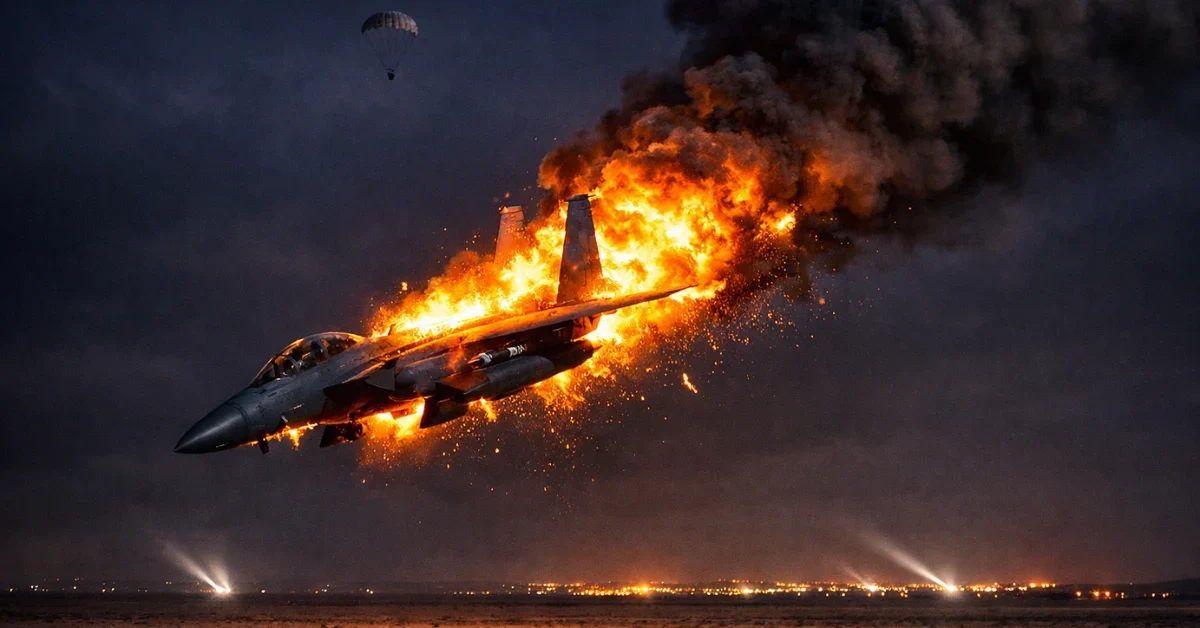
Three American F-15E Strike Eagles were mistakenly brought down by Kuwaiti air defenses late on March 1 in what the U.S. military confirmed as a friendly fire incident. All six crew members aboard the jets ejected safely and were recovered in stable condition.
What Happened Over Kuwait
The incident occurred at 11:03 p.m. ET on March 1, while the aircraft were conducting missions in support of Operation Epic Fury, the U.S. military’s active combat operation. Iranian forces were simultaneously carrying out a coordinated assault involving aircraft, ballistic missiles, and drones — creating a dangerously congested and high-pressure airspace over the region.
Amid that intense combat environment, Kuwaiti air defenses mistakenly engaged the three American jets. U.S. Central Command confirmed the incident officially, acknowledging Kuwait’s role while expressing appreciation for the Kuwaiti defense forces’ continued support of the ongoing operation.
All Six Crew Members Survive
Despite the complete loss of all three aircraft, no American airmen were killed in the shootdown. All six crew members ejected and were safely recovered, each reported to be in stable condition. Video footage that spread online — which CNN’s analysis suggested appeared to show an F-15E — captured one of the jets plunging from the sky in flames while a pilot descended on a parachute below.
Eyewitness Ahmed al-Asar told the Associated Press he raced to the scene with about a dozen others after hearing explosions and seeing a burning aircraft overhead. Al-Asar recalled initially assuming the parachuting airman was Iranian, only realizing he was American just before emergency responders arrived and whisked the pilot away.
Iran Claims Involvement, Cause Under Investigation
Iranian state television separately asserted that Iran had been responsible for shooting down one of the American aircraft that went down in Kuwait, though the claim came with no supporting details or evidence. The U.S. military has not confirmed that account, and the cause of the incident officially remains under investigation.
The competing claims underscore the complexity of the conflict, where Iranian forces and allied Arab air defense systems are simultaneously operating in the same combat airspace — conditions that make misidentification a serious and persistent risk.
Operation Epic Fury and the Wider Conflict
The friendly fire incident came during a rapidly escalating regional war. On Saturday, U.S. and Israeli forces jointly launched what officials described as major combat operations inside Iran. Those strikes resulted in the death of Iranian Supreme Leader Ayatollah Ali Khamenei, a development that upended the regional security landscape almost overnight.
Iran responded by vowing what it called devastating acts of retaliation and began launching missiles at neighboring countries and U.S. military targets across the region. According to the Iranian Red Crescent Society, at least 555 people inside Iran have been killed since the U.S.-Israeli strikes began over the weekend.
Casualties Spread Across the Region
The violence has reached well beyond Iran’s borders. Israeli airstrikes on Beirut and southern Lebanon on Monday killed at least 31 people and left 149 others injured, according to Lebanon’s health ministry.
American casualties have also climbed. U.S. Central Command reported that the number of U.S. service members killed now stands at four, after one person seriously wounded during Iran’s initial attacks later succumbed to those injuries.
Kuwait’s Position in the Operation
Kuwait’s air defense forces are actively supporting the U.S.-led campaign. The friendly fire incident appears to have unfolded during a moment of simultaneous Iranian aggression — exactly the kind of chaotic scenario where split-second targeting decisions and communication breakdowns carry the most dangerous consequences.
Kuwait formally acknowledged responsibility for the shootdown, and U.S. Central Command publicly recognized the Kuwaiti military’s partnership and cooperation. A full investigation is now underway, with U.S. authorities committed to disclosing additional findings as they become available.
