

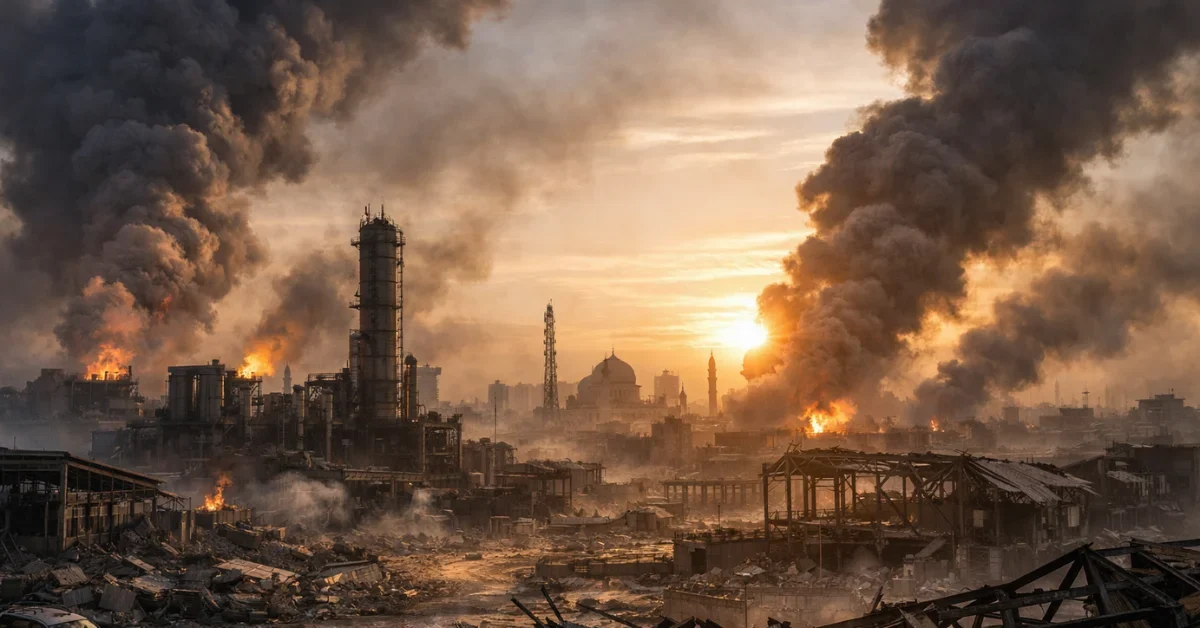
The Middle East conflict has reached a critical boiling point as the US-Israel attacks on Iran enter their eighth day. Military operations have rapidly intensified across the region, triggering widespread international concern and a rising death toll. With global stability in jeopardy, world leaders are urgently demanding a diplomatic resolution to the escalating war.
Intensified Military Strikes and Regional Retaliation
The joint military campaign, identified by U.S. officials as Operation Epic Fury, has severely impacted Iranian infrastructure. Over the past week, the United States and Israel have struck more than 3,000 targets. These coordinated airstrikes have focused on ballistic missile launchers, naval assets, drone facilities, and Islamic Revolutionary Guard Corps installations. Recent bombardments also hit Tehran’s Mehrabad International Airport, sending large plumes of dark smoke over the Iranian capital.
The human cost of the conflict is mounting. Reports indicate that at least 1,332 civilians have been killed in Iran. The initial wave of U.S. and Israeli airstrikes also resulted in the deaths of Iran’s Supreme Leader Ayatollah Ali Khamenei, members of his family, and multiple senior military and political officials.
In response, Iran has launched extensive retaliatory strikes. Tehran has fired missiles and drones at Israel, as well as at U.S. military installations and neighboring Gulf nations, including Saudi Arabia, Qatar, Kuwait, Bahrain, and the United Arab Emirates. The violence has claimed the lives of six American soldiers, 11 people in Israel, and over 200 individuals in Lebanon, where Israeli forces have concurrently engaged Hezbollah militants.
Mixed Messages from Iran’s Leadership
As the crisis deepens, Iran’s political and military leaders are sending conflicting signals regarding their strategy. Iranian President Masoud Pezeshkian has seemingly advocated for a more measured, de-escalatory approach to regional security. However, this diplomatic posture contrasts sharply with aggressive rhetoric from the Islamic Revolutionary Guard Corps and parliamentary officials, who emphasize Iran’s right to self-defense and vow to continue retaliatory strikes.
Ali Larijani, a senior Iranian leader and former military officer, issued a chilling warning to U.S. President Donald Trump. Larijani stated that Trump must face consequences and “pay the price” for the deaths of Iran’s supreme leader and citizens. Meanwhile, President Trump has signaled a willingness to speak with Iran’s new leadership but also warned that Iran would be struck forcefully, stating that certain regions and groups face guaranteed destruction.
International Outcry and Legal Concerns
The relentless US-Israel attacks on Iran have sparked significant international backlash. Swiss Defence Minister Martin Pfister publicly condemned the military actions, stating that the United States and Israel, much like Iran, have violated international law and the United Nations Charter. Pfister emphasized that the attacks breach the global prohibition on violence and called on all parties to halt hostilities to protect civilian lives.
China has also voiced strong opposition to the war. Chinese Foreign Minister Wang Yi stated that the conflict “should never have happened” and cautioned the world against reverting to the “law of the jungle.” Ahead of an anticipated meeting with President Trump, Wang adopted a diplomatic tone but noted that pursuing regime change in Iran will not garner popular backing. He warned that descending into further confrontation could jeopardize the entire global economy.
Similarly, Russian President Vladimir Putin engaged in diplomatic discussions with Iranian President Pezeshkian, expressing condolences for the extensive loss of life. Putin called for an immediate cessation of hostilities and urged a swift return to diplomatic negotiations, rejecting the use of military force to solve issues in the Middle East.
Gulf Nations React to the Growing Crisis
The spillover effects of the war are deeply affecting neighboring Gulf states. Following aerial interceptions that left debris and caused at least one fatality in Dubai, United Arab Emirates President Mohamed bin Zayed Al Nahyan delivered an emotional televised address. He asked residents to “forgive us” for any shortcomings during the crisis while urging the public to remain calm and united. The UAE leader firmly assured citizens that the nation is resilient and fully prepared to defend itself against regional threats.
As military operations persist, the global community remains on high alert. With the United States preparing evacuation flights for its citizens and ongoing disruptions to global energy supplies, international efforts remain highly focused on halting the violence before it entirely engulfs the broader Middle East.
