

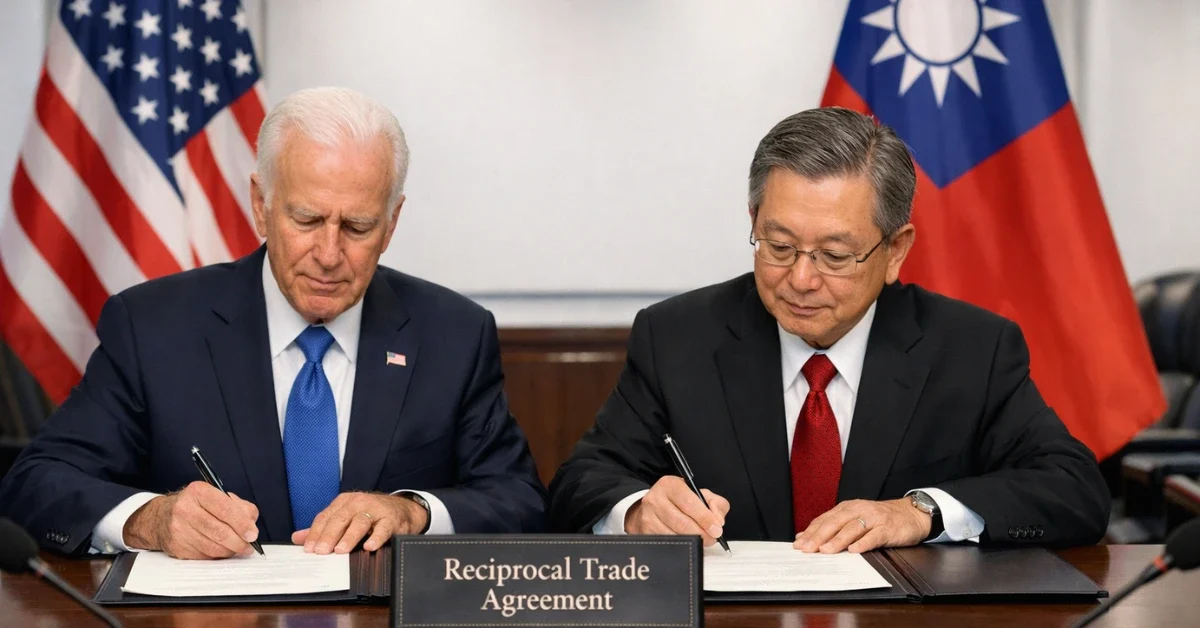
The United States and Taiwan have reached an “Agreement on Reciprocal Trade” that lowers U.S. tariffs on Taiwanese goods to a 15% rate and sets out plans for Taiwan to expand purchases of major U.S. products from 2025 to 2029. The agreement also outlines tariff and non-tariff changes aimed at widening access for U.S. industrial and agricultural exports into Taiwan, alongside commitments tied to supply chains and investment cooperation.
Taiwan’s Cabinet said the pact delivers favorable tariff treatment while protecting key domestic industries, and urged Taiwan’s Legislature to approve both the trade pact and a bilateral investment memorandum of understanding (MOU). The USTR fact sheet says the agreement was reached under the auspices of the American Institute in Taiwan (AIT) and the Taipei Economic and Cultural Representative Office in the United States (TECRO), and that it will proceed through domestic formalities before entering into force, including Taiwan submitting it to its legislature for review.
What changes on tariffs
Under the agreement, the U.S. side committed to reduce tariffs on goods originating from Taiwan and apply the higher of the U.S. Most Favored Nation (MFN) tariff rate or a tariff rate of 15%, including an element described as a reciprocal tariff. Taiwan’s Cabinet said the tariff rate on Taiwanese imports into the U.S. will be maintained at 15%, and that 2,072 items—nearly 20% of Taiwan’s total exports to the U.S.—will be exempt from reciprocal tariffs and subject only to standard MFN rates.
Taiwan’s Cabinet also said average U.S. tariffs on Taiwanese goods will drop to 12.33%, compared with 35.78% when negotiations began in April 2025 and 23.78% recorded in August 2025. ICIS, citing USTR information, reported that the pact cuts U.S. tariffs on Taiwanese goods to 15% from 20% previously. On semiconductors, Taiwan’s Cabinet said semiconductors and related products will receive the most favorable treatment available under Section 232 of the U.S. Trade Expansion Act.
Taiwan’s market access commitments
The USTR fact sheet says Taiwan will eliminate or reduce 99% of tariff barriers and provide preferential market access for a wide set of U.S. industrial exports, including autos and auto parts, chemicals, seafood, machinery, health products, electrical products, metals, and minerals. The fact sheet also lists preferential market access for U.S. agricultural exports including horticultural products, wheat, beef and beef products, dairy products, pork and pork products, lamb and sheep meat, tree nuts, dog and cat food, ketchup, and peanuts.
On non-tariff barriers, the USTR fact sheet says Taiwan committed to address longstanding barriers affecting U.S. exports of motor vehicles, medical devices, and pharmaceuticals. For vehicles, it says Taiwan will remove quantitative restrictions and accept U.S. vehicles built to U.S. Federal Motor Vehicle Safety Standards, as well as emissions standards, without additional requirements to enter Taiwan. For medical devices and pharmaceuticals, it says Taiwan will accept U.S. FDA marketing authorizations for products manufactured in the United States without additional entry requirements, and will ensure transparency and fairness in reimbursement and listing under its health care system.
For agriculture, the USTR fact sheet says Taiwan committed to resolve and prevent non-tariff barriers affecting U.S. agricultural exports including beef, pork, poultry, and processing potatoes, and it will work with the U.S. side to complete the regulatory process to allow bison meat into Taiwan. It also includes provisions intended to preserve U.S. market access for cheese and meat producers using common names, alongside transparency and fairness standards related to geographical indications.
Taiwan’s Cabinet described several areas where it said Taiwan kept protections for sensitive sectors while making targeted changes. It said Taiwan maintained existing tariffs on 27 U.S. agricultural imports such as rice and chicken, while cutting tariffs by half on 15 U.S. pork products over three years, and allowing U.S. ground beef and offal access based on scientific assessment with food safety controls remaining in place. On industrial goods, it said Taiwan will remove all tariffs on U.S.-made cars imported to Taiwan while maintaining the current rate on trucks.
Purchases, investment, and supply chains
The USTR fact sheet says Taiwan plans to facilitate long-term increased purchases of key U.S. goods from 2025 through 2029, including $44.4 billion of liquefied natural gas and crude oil and $15.2 billion of civil aircraft and engines. The fact sheet also lists $25.2 billion in purchases of power equipment and related goods—covering power grids, materials, generators, storage facilities, marine equipment, steel-making equipment, and other equipment—over the same period.
ICIS reported, citing the USTR factsheet, the same LNG/crude and civil aircraft and engines figures for 2025 through 2029, and said the agreement references a January 15 MOU committing Taiwan to help build “industrial parks and industry clusters” in high-tech sectors in the U.S. ICIS also said the January 15 MOU previously mentioned a $250-billion investment commitment into certain sectors in the U.S., but that figure was not mentioned in the February 13 factsheet. The USTR fact sheet says the MOU contemplates Taiwan companies significantly increasing investments in areas including the semiconductors supply chain, electronics manufacturing services (including AI applications), energy, and other sectors in the United States, with financial support from the Taiwan side.
Both sides also described supply chain goals in the agreement. The USTR fact sheet says the two sides are committed to strengthening cooperation to enhance supply chain resilience and will continue work to finalize commitments on combatting duty evasion, and it also describes commitments tied to strengthening economic and national security cooperation. Taiwan’s Cabinet said the pact commits both sides to improving transparency and the business environment and strengthening cooperation on secure and trusted supply chains.
Taiwan’s Cabinet said the agreement was signed by Taiwan’s representative to the U.S., Alexander Yui, and Ingrid Larson, managing director of AIT’s Washington Office. At a Washington press conference after the signing, Taiwan Vice Premier Cheng Li-chiun called the agreement “a milestone” for cooperation in trade, investment, and technology, and—citing U.S. Secretary of Commerce Howard Lutnick—said Taiwan is “a unique partner” of the United States. ICIS reported that U.S. trade representative Jamieson Greer said the agreement builds on a longstanding economic and trade relationship and will enhance supply chain resilience, particularly in high-technology sectors.
