

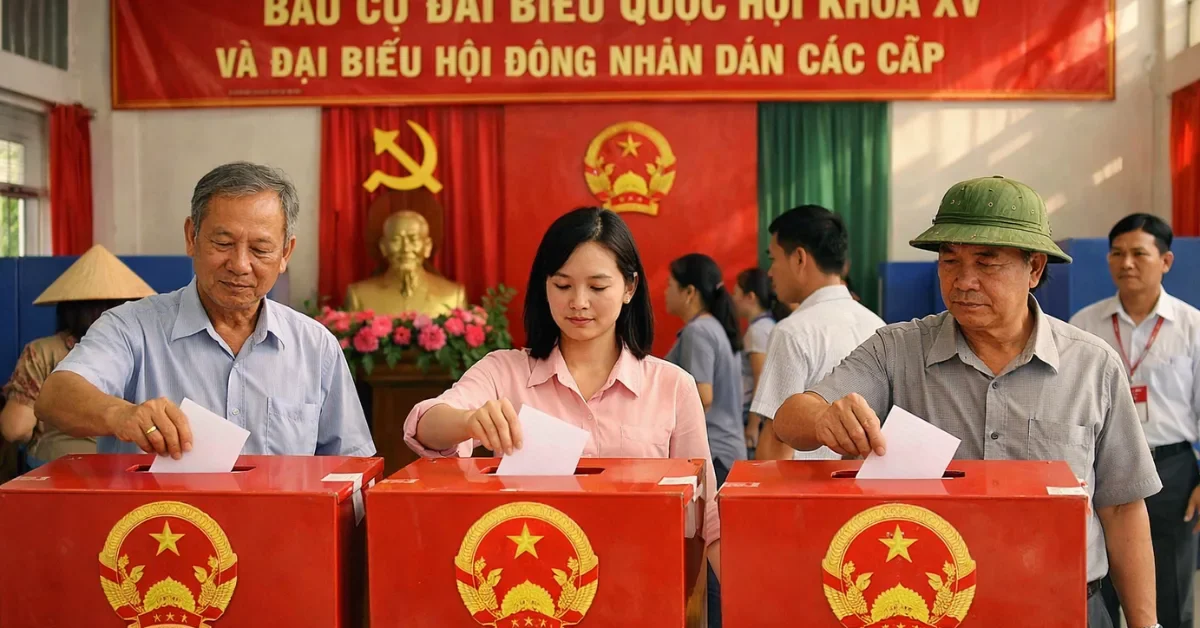
On Sunday, March 15, tens of millions of citizens headed to the polls for the Vietnam parliament elections to elect 500 delegates to the 16th National Assembly, alongside representatives for local People’s Councils for the 2026–2031 legislative term. Voting commenced promptly at 7:00 a.m. at more than 72,000 polling stations nationwide. Standard voting hours were scheduled to conclude at 7:00 p.m., though local extensions were permitted until 9:00 p.m. In certain areas, early voting had already taken place to accommodate specific local conditions, such as at the Dao San Border Guard Station.
The exact number of eligible voters participating in this election remains a point of disagreement among reporting organizations. According to Reuters, the electorate consists of nearly 73.5 million registered voters. Meanwhile, Bloomberg reports that some 78 million Vietnamese will cast their ballots, and Vietnam Plus places the figure at nearly 79 million voters.
Communist Party Dominance and Candidate Demographics
The electoral process in Vietnam remains heavily influenced by the ruling Communist Party, which has governed the nation unopposed for decades. These five-year elections serve as one of the rare instances of democratic engagement within a tightly regulated one-party framework. Out of the 864 candidates competing for the 500 available seats in the national parliament, nearly 93 percent are official members of the Communist Party. The remaining 7.5 percent are running as independent candidates, representing a slight decrease from the 8.5 percent of independents who ran in the 2021 elections. In the outgoing legislature, the Communist Party firmly controlled 97 percent of the parliamentary seats.
In terms of demographics, approximately 55 percent of the national assembly candidates are men, mirroring the gender distribution seen in the previous election cycle, where women ultimately secured about 30 percent of the seats. The candidate pool also features prominent business leaders who hold party membership, including Nguyen Thanh Tung, the head of Vietcombank—Vietnam’s largest bank by market capitalization—and Le Hong Minh, the chairman of the technology firm VNG.
Voters are not only selecting national delegates but also casting ballots for regional leadership. For provincial-level People’s Councils, citizens will elect 2,552 deputies from a pool of 4,217 candidates. At the commune level, 72,611 deputies will be chosen from 120,873 candidates.
Political Context and National Reforms
This nationwide voting event is a critical political milestone, following closely on the heels of the 14th National Congress of the Communist Party of Vietnam. During this twice-a-decade gathering, top officials established the nation’s key policy directions and predetermined the individuals who will occupy the most influential state positions.
According to state media, the election coincides with a significant period in Vietnam’s ongoing 40-year reform process. The country has recently engaged in efforts to reorganize and streamline its political apparatus. These initiatives involve adjusting administrative boundaries and transitioning to a two-tier local administration model. The stated goal of these structural changes is to foster a more efficient and effective governance system for future national development.
The government is actively using the current election to bolster public support for its ambitious economic targets, which includes a 10 percent growth agenda. Red banners and propaganda campaigns were deployed extensively across the country to urge high voter turnout. State news agencies note that turnout has exceeded 99 percent in each of the last seven parliamentary elections.
Paving the Way for Next Leadership
While the National Assembly occasionally amends proposed legislation, the legislative body possesses virtually no authority to challenge core decisions made by the Communist Party, particularly regarding high-level personnel appointments.
The newly elected parliament is scheduled to convene its opening plenary session in early April. During this upcoming meeting, lawmakers are expected to formally confirm the state’s top leaders, including the new president and prime minister, who were previously nominated by senior party officials.
The timeline for the official announcement of the election results varies among sources. Parliament Chairman Tran Thanh Man stated that the final results would be announced on March 23. Conversely, Bloomberg reported that the newly elected National Assembly deputies would be announced sometime before March 25. Regardless of the exact date, the outcome will officially set the stage for Vietnam’s next era of leadership.
