

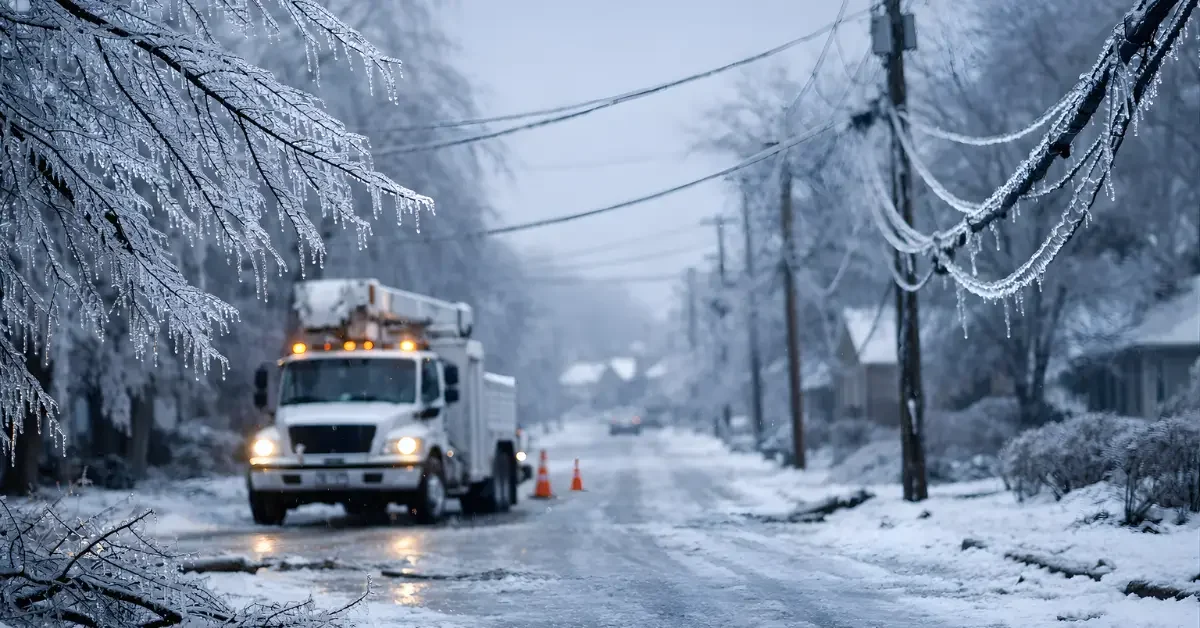
A massive winter storm is battering large parts of the United States, with at least 18 deaths attributed to the weather and widespread winter storm power outages across the South. Officials warned the dangerous conditions could last for days as ice, snow, and bitter cold continue to disrupt travel and slow power restoration efforts.
The storm spread from New Mexico to the eastern seaboard, bringing ice, sleet, and snow that made roads hazardous and affected major airports. The National Weather Service said the ice and snowfall were expected to continue into Monday, followed by very low temperatures that could cause dangerous travel and infrastructure impacts for days.
Power outages persist across the South
Ice-coated trees and power lines caused outages for more than a million customers across the South at the peak of the storm, and more than 800,000 homes and businesses were still without electricity by mid-morning Monday, according to PowerOutage.com as cited in the report. The outage total later fell below 700,000 by early afternoon, according to the same report.
Utilities and emergency officials said restoration work is being slowed by the ongoing freeze and falling trees. Middle Tennessee Electric said crews have been “fighting tree after tree,” and noted that new outages can happen quickly when more trees fall onto repaired lines. The National Weather Service also warned that the cold behind the storm could keep ice and snow from melting quickly, making restoration harder.
Travel disruptions and airport shutdowns
Air travel was heavily disrupted as the storm moved across multiple regions. Flight-tracking data cited in the reports said about 12,000 flights were canceled on Sunday and nearly 20,000 were delayed. A separate update said more than 12,000 flights were canceled Sunday, with more than 5,000 canceled by mid-day Monday.
The storm affected airports in areas including Philadelphia, Washington, Baltimore, North Carolina, New York, and New Jersey, according to the report. New York’s LaGuardia Airport closed and grounded all flights Sunday afternoon, according to the update. Aviation analytics firm Cirium said Sunday’s cancellations were the highest since the pandemic, according to the same report.
Deaths reported as cold intensifies
At least 18 deaths were attributed to the weather, according to the Associated Press as cited in the update. In New York City, Mayor Zohran Mamdani said at least five people who died were found outside as temperatures plunged Saturday, though the cause of their deaths was still under investigation. In Louisiana, two men died of hypothermia related to the storm in Caddo Parish, according to the state health department cited in the report.
The Federal Aviation Administration said seven people were killed when a private jet crashed on takeoff during a snowstorm in Bangor, Maine, with one crew member surviving, according to the update. The same report said Maine Public cited airport officials in Bangor as saying the plane’s manifest listed six people and that all six died, creating conflicting accounts of how many people were on board.
Record lows and warnings across many states
The National Weather Service said frigid temperatures are expected to persist over the eastern two-thirds of the U.S. this week, with numerous record lows forecast. The forecast cited in the update said sub-zero lows are expected nearly every morning from the Northern Plains through the Ohio Valley and into the Northeast. Separately, a meteorologist described the storm as unusually widespread, affecting areas from New Mexico and Texas to New England across roughly a 2,000-mile span.
In New York state, communities near the Canadian border saw record-breaking subzero temperatures, with Watertown at minus 34 degrees Fahrenheit and Copenhagen at minus 49 degrees Fahrenheit, according to Gov. Kathy Hochul as cited in the report. In Massachusetts, the update said more than 20 inches of snow fell, prompting closures of schools and government offices. Massachusetts Gov. Maura Healey was quoted in the update urging residents to take the storm seriously.
Emergency actions and local closures
President Donald Trump approved emergency declarations for at least a dozen states by Saturday, according to the report. The report also said the Federal Emergency Management Agency had rescue teams and supplies staged in numerous states, and Homeland Security Secretary Kristi Noem referenced that response.
Governors in several states urged residents to avoid travel and use warming resources if needed. North Carolina Gov. Josh Stein warned that the risk of slick roads and power outages was not over and said dangerously cold temperatures would continue through the week, especially at night. Kentucky Gov. Andy Beshear said the storm covered the state with snow, sleet, and ice for 36 hours and urged people without power to go to warming centers.
In Mississippi, the report described northern parts of the state as covered in ice and said emergency officials were distributing generators and fuel, cots and blankets, and food and water to affected counties. Another report said Mississippi’s governor described it as the state’s worst ice storm since 1994 and noted a record deployment of ice-melting chemicals totaling 200,000 gallons, along with salt and sand. The University of Mississippi said classes in Oxford were canceled through Sunday, according to the update.
