

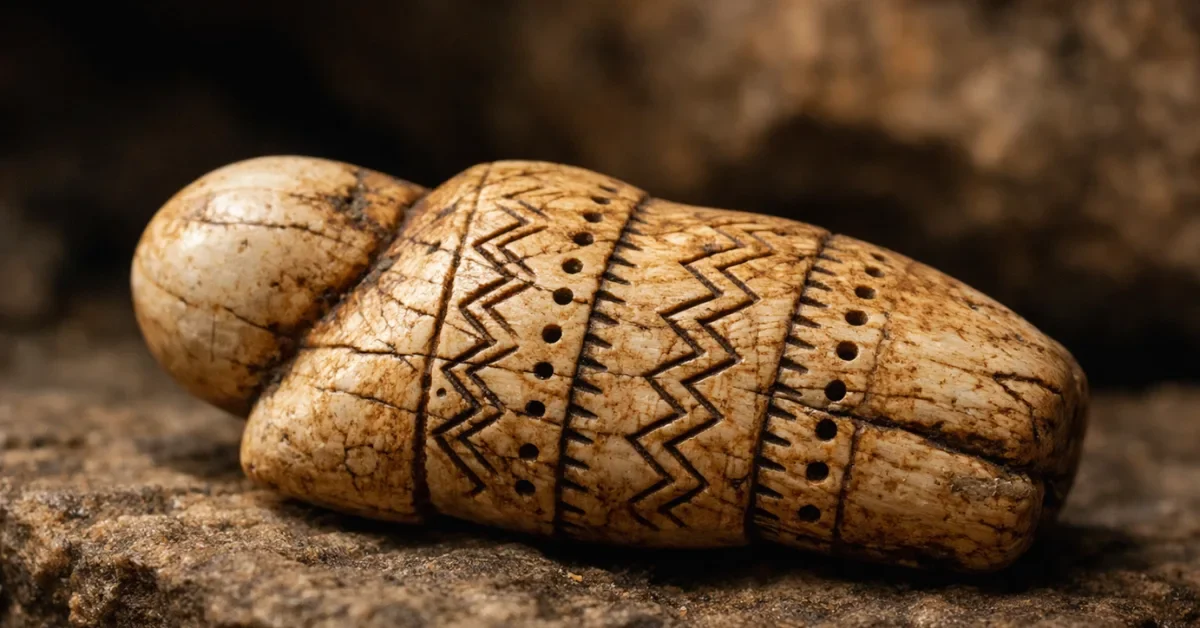
Over 40,000 years ago, early humans in what is now southwestern Germany carved mysterious sequences of dots, lines, and crosses into tools and animal figurines. For decades, archaeologists viewed these marks as simple decorations. However, a recent mathematical analysis reveals that these ancient carvings might be a written language precursor. This discovery suggests that Stone Age hunter-gatherers developed a structured system for recording information tens of thousands of years before formal alphabets emerged.
Researchers examined thousands of these geometric signs to understand their underlying structure. Published in the Proceedings of the National Academy of Sciences (PNAS), the findings show that these 40,000-year-old markings share a statistical fingerprint with some of the earliest known scripts. By analyzing the predictability of the carvings, scientists concluded that these artifacts represent a written language precursor with an information density comparable to early Mesopotamian writing.
Deciphering Ice Age Carvings in Germany
The artifacts at the center of this research date back to the Aurignacian period, an era between 34,000 and 45,000 years ago when Homo sapiens first arrived in Europe. Excavations in the Swabian Jura region of Germany have uncovered roughly 260 of these objects in locations like Vogelherd Cave, Hohlenstein-Stadel Cave, and Geißenklösterle Cave.
Crafted primarily from mammoth ivory, these Palaeolithic objects are small enough to fit in the palm of a hand. One notable piece from Vogelherd Cave is a tiny mammoth figurine covered in engraved rows of crosses and dots. Another striking artifact, known as the “Adorant” from Geißenklösterle Cave, is an ivory plaque depicting a hybrid lion-human creature adorned with systematic notches. A similar “Lion Human” from Hohlenstein-Stadel Cave also features notches placed at regular intervals along its arm.
The Statistical Fingerprint of Symbols
To uncover the nature of these carvings, linguist Christian Bentz of Saarland University and archaeologist Ewa Dutkiewicz compiled a digital database of the ancient symbols. The team analyzed over 3,000 individual signs across the 260 artifacts. They identified 22 distinct symbol types, with V-shaped notches, lines, crosses, and dots being the most frequently used.
The scientists did not attempt to translate the symbols. Instead, they used computational linguistics to measure structural properties, such as how frequently a sign was repeated. This method allowed them to calculate the “entropy,” or information density, of the carvings.
The analysis revealed that the Stone Age symbols are highly repetitive. Sequences like “cross, cross, cross” dominate the artifacts. This heavy repetition proves that the carvings do not represent spoken language. Modern alphabetic systems, which directly encode speech, feature high informational variation and completely different statistical characteristics.
However, when researchers compared the Ice Age marks to proto-cuneiform—an early script that emerged in ancient Mesopotamia around 3500 B.C.—they found a remarkable match. Proto-cuneiform also relied heavily on repetitive symbols before it evolved to represent spoken words. The mathematical structure of the 40,000-year-old sequences is statistically comparable to those early Mesopotamian tablets.
A Deliberate System of Information
The study highlights that these Palaeolithic markings were intentional and rule-governed. The researchers discovered that different types of symbols were applied to specific categories of objects. Crosses frequently appear on figurines depicting horses or mammoths but are completely absent from human figures. Conversely, dots were never used on practical tools. Furthermore, figurative sculptures carried about 15 percent more information density than everyday tools.
While the exact meaning of the symbols remains a mystery, the structured patterns offer tantalizing clues. Dutkiewicz suggests that certain arrangements could reflect calendric observations. The Adorant plaque features rows of 12 or 13 notches, which might have tracked lunar cycles or the passage of seasons. For ancient hunter-gatherers, tracking the changing seasons would have been crucial for anticipating the migration of prey.
Rethinking Human Cognition
Historically, the timeline of human writing begins with the cuneiform scripts of ancient Mesopotamia, which eventually gave rise to modern alphabets. The new findings do not suggest that the carvings in Germany directly evolved into Mesopotamian cuneiform, as the Aurignacian symbols vanished after about 10,000 years.
Instead, the research demonstrates that the cognitive capacity to encode and store structured information is far older than previously understood. The early humans who crafted these objects were highly skilled individuals who developed a complex system of visual communication. The markings on these ancient artifacts show that the human drive to record thoughts began tens of thousands of years before the first word was ever written.
