
By using this site, you agree to our Privacy Policy and Terms of Use.
Accept
VellaTimesVellaTimesVellaTimes
  • News
    NewsShow More
    Close-up of a silver espresso machine extracting a fresh shot of coffee into a glass cup in a softly lit cafe setting.
    Espresso Extraction Science: The Finer Grind Flaw
    May 18, 2026
    A smartphone resting on a wooden desk displaying an AI-powered Amazon search bar in a modern home office setting.
    Amazon Alexa for Shopping Replaces Rufus AI Assistant
    May 18, 2026
    Wide news-style image showing an OpenAI office scene with screens displaying audio waveforms and voice technology graphics
    OpenAI acquires Weights.gg to boost voice AI tools
    May 18, 2026
    Federal agents standing outside a modern university biology laboratory building at dusk during an active investigation.
    US Arrests Chinese Scientists for Smuggling Biological Materials
    May 18, 2026
    A dramatically lit modern corporate courtroom with futuristic technology elements, representing a high-stakes artificial intelligence legal trial.
    Elon Musk OpenAI Lawsuit Exposes Clashes Over AI Safety
    May 18, 2026
  • Technology
    TechnologyShow More
    Wide news-style image showing an OpenAI office scene with screens displaying audio waveforms and voice technology graphics
    OpenAI acquires Weights.gg to boost voice AI tools
    May 18, 2026
    A polished silicon wafer rests on a surface inside a modern semiconductor manufacturing facility.
    Samsung Strike Threatens Global AI Chip Production
    May 18, 2026
    A glowing computer screen displaying the text GPT-5.5 Instant in a modern, high-tech office environment with soft blue and purple lighting.
    GPT-5.5 Instant: OpenAI’s New Default ChatGPT Model
    May 10, 2026
    Wide view of a modern AI data center with server racks, glowing fiber-optic cables, and semiconductor hardware in the foreground.
    AI Infrastructure Spending Drives Nvidia, AMD Shares
    May 10, 2026
    A glowing computer monitor displaying lines of code and digital network graphics in a modern tech office setting.
    Airbnb AI Coding: 60% of New Software Now Generated by AI
    May 9, 2026
  • AI
    AIShow More
    A smartphone resting on a wooden desk displaying an AI-powered Amazon search bar in a modern home office setting.
    Amazon Alexa for Shopping Replaces Rufus AI Assistant
    May 18, 2026
    A dramatically lit modern corporate courtroom with futuristic technology elements, representing a high-stakes artificial intelligence legal trial.
    Elon Musk OpenAI Lawsuit Exposes Clashes Over AI Safety
    May 18, 2026
    A high-tech global map visualization showing glowing digital connections across different continents, representing the worldwide adoption of artificial intelligence.
    Global AI Adoption in 2026: Trends and Growing Divide
    May 10, 2026
    A modern smartphone displaying an artificial intelligence chat interface used for online shopping and product comparison.
    Alibaba Qwen AI Taobao Integration Launches Agentic Shopping
    May 10, 2026
    A split-screen illustration showing a high-tech modern office using advanced AI tools contrasted against an older, dimly lit workspace.
    Global AI Adoption Surges But Rich-Poor Divide Widens
    May 9, 2026
  • Science
    ScienceShow More
    Close-up of a silver espresso machine extracting a fresh shot of coffee into a glass cup in a softly lit cafe setting.
    Espresso Extraction Science: The Finer Grind Flaw
    May 18, 2026
    Federal agents standing outside a modern university biology laboratory building at dusk during an active investigation.
    US Arrests Chinese Scientists for Smuggling Biological Materials
    May 18, 2026
    Header image of a quantum communication lab setup with fiber-optic equipment, a telecom quantum dot device, and interferometer components used for long-distance quantum key distribution.
    Quantum Key Distribution Reaches 120 km With Quantum Dots
    May 10, 2026
    Abstract geometric representation of glowing quantum paraparticles interacting within a three-dimensional mathematical grid in deep blue and gold tones.
    Quantum Paraparticles Exist: New Math Challenges Physics
    May 10, 2026
    A large expedition cruise ship is navigating rough ocean waters under a cloudy sky.
    Global Authorities Respond to Andes Hantavirus Outbreak on MV Hondius Cruise Ship
    May 9, 2026
  • World
    WorldShow More
    Allu Arjun Commitment to Ethical Brand Partnerships
    Exploring Allu Arjun’s Commitment to Ethical Brand Partnerships
    December 18, 2023
    Orry aka Orhan Awatramani
    Orhan Awatramani ‘Orry’ Biography, Lifestyle and Rise to Fame
    December 8, 2023
    Alia Bhatt Latest Deepake Video Victim
    Alia Bhatt becomes latest victim of Deepfake Videos, Obscene Video goes Viral
    November 28, 2023
    Napoleon Movie Review
    Napoleon Movie Review: A Historical Epic by Ridley Scott Reviewed
    November 25, 2023
  • Bookmarks
Search
Category
  • News
  • Technology
  • AI
  • Science
  • World
Company
  • About Us
  • Contact Us
  • Fact Checking Policy
  • Terms & Conditions
  • Privacy Policy
  • Copyright Policy
Resources
  • Home
  • Web Stories
  • Bookmarks
  • Interests
  • Disclaimer
  • Sitemap
© 2022 VellaTimes • All Rights Reserved.
Reading: SEO Meta Title: 40,000-Year-Old Artifacts: A Written Language Precursor?
Share
Notification Show More
Font ResizerAa
VellaTimesVellaTimes
Font ResizerAa
  • News
  • Technology
  • AI
  • Science
  • World
Search
  • Explore
    • News
    • Technology
    • AI
    • Science
    • World
  • Useful Links
    • About Us
    • Contact Us
    • Fact Checking Policy
    • Terms & Conditions
    • Privacy Policy
    • Copyright Policy
  • Home
  • Web Stories
  • Bookmarks
  • Interests
  • Disclaimer
  • Sitemap
© 2022 VellaTimes • All Rights Reserved.
News

SEO Meta Title: 40,000-Year-Old Artifacts: A Written Language Precursor?

Nisha Pradhan
Last updated: 25/02/2026
Nisha Pradhan
Share
6 Min Read
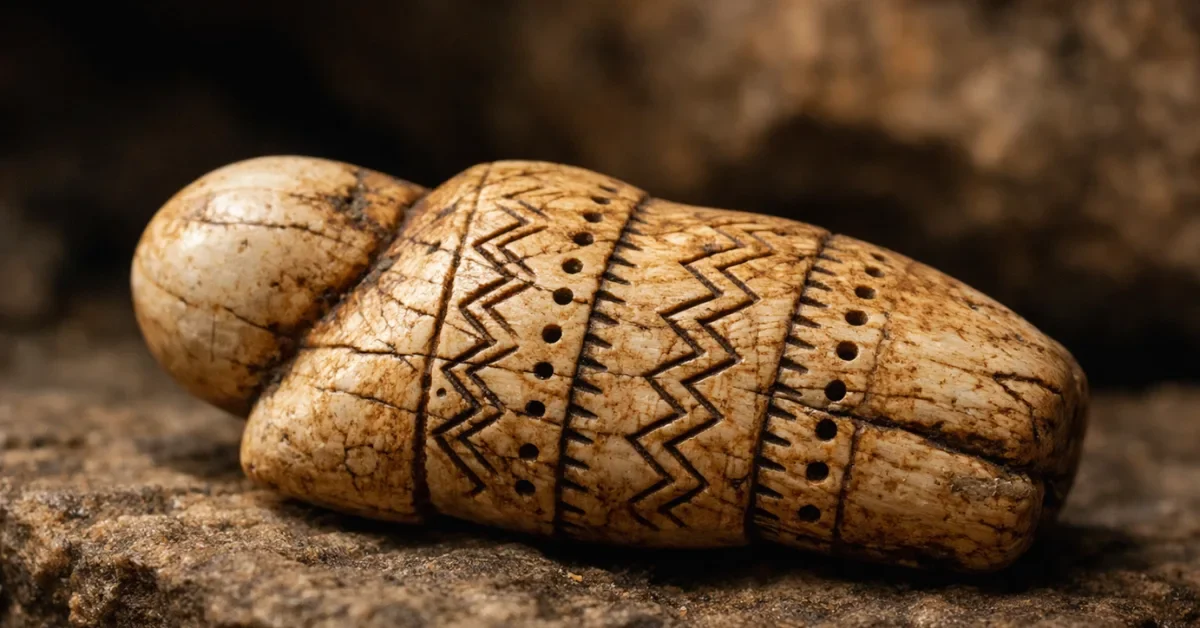
A close-up view of a 40,000-year-old mammoth ivory figurine carved with geometric notches and dots, resting on a stone surface.

Over 40,000 years ago, early humans in what is now southwestern Germany carved mysterious sequences of dots, lines, and crosses into tools and animal figurines. For decades, archaeologists viewed these marks as simple decorations. However, a recent mathematical analysis reveals that these ancient carvings might be a written language precursor. This discovery suggests that Stone Age hunter-gatherers developed a structured system for recording information tens of thousands of years before formal alphabets emerged.

Contents
Deciphering Ice Age Carvings in GermanyThe Statistical Fingerprint of SymbolsA Deliberate System of InformationRethinking Human Cognition

Researchers examined thousands of these geometric signs to understand their underlying structure. Published in the Proceedings of the National Academy of Sciences (PNAS), the findings show that these 40,000-year-old markings share a statistical fingerprint with some of the earliest known scripts. By analyzing the predictability of the carvings, scientists concluded that these artifacts represent a written language precursor with an information density comparable to early Mesopotamian writing.

Deciphering Ice Age Carvings in Germany

The artifacts at the center of this research date back to the Aurignacian period, an era between 34,000 and 45,000 years ago when Homo sapiens first arrived in Europe. Excavations in the Swabian Jura region of Germany have uncovered roughly 260 of these objects in locations like Vogelherd Cave, Hohlenstein-Stadel Cave, and Geißenklösterle Cave.

Crafted primarily from mammoth ivory, these Palaeolithic objects are small enough to fit in the palm of a hand. One notable piece from Vogelherd Cave is a tiny mammoth figurine covered in engraved rows of crosses and dots. Another striking artifact, known as the “Adorant” from Geißenklösterle Cave, is an ivory plaque depicting a hybrid lion-human creature adorned with systematic notches. A similar “Lion Human” from Hohlenstein-Stadel Cave also features notches placed at regular intervals along its arm.

The Statistical Fingerprint of Symbols

To uncover the nature of these carvings, linguist Christian Bentz of Saarland University and archaeologist Ewa Dutkiewicz compiled a digital database of the ancient symbols. The team analyzed over 3,000 individual signs across the 260 artifacts. They identified 22 distinct symbol types, with V-shaped notches, lines, crosses, and dots being the most frequently used.

The scientists did not attempt to translate the symbols. Instead, they used computational linguistics to measure structural properties, such as how frequently a sign was repeated. This method allowed them to calculate the “entropy,” or information density, of the carvings.

The analysis revealed that the Stone Age symbols are highly repetitive. Sequences like “cross, cross, cross” dominate the artifacts. This heavy repetition proves that the carvings do not represent spoken language. Modern alphabetic systems, which directly encode speech, feature high informational variation and completely different statistical characteristics.

However, when researchers compared the Ice Age marks to proto-cuneiform—an early script that emerged in ancient Mesopotamia around 3500 B.C.—they found a remarkable match. Proto-cuneiform also relied heavily on repetitive symbols before it evolved to represent spoken words. The mathematical structure of the 40,000-year-old sequences is statistically comparable to those early Mesopotamian tablets.

A Deliberate System of Information

The study highlights that these Palaeolithic markings were intentional and rule-governed. The researchers discovered that different types of symbols were applied to specific categories of objects. Crosses frequently appear on figurines depicting horses or mammoths but are completely absent from human figures. Conversely, dots were never used on practical tools. Furthermore, figurative sculptures carried about 15 percent more information density than everyday tools.

While the exact meaning of the symbols remains a mystery, the structured patterns offer tantalizing clues. Dutkiewicz suggests that certain arrangements could reflect calendric observations. The Adorant plaque features rows of 12 or 13 notches, which might have tracked lunar cycles or the passage of seasons. For ancient hunter-gatherers, tracking the changing seasons would have been crucial for anticipating the migration of prey.

Rethinking Human Cognition

Historically, the timeline of human writing begins with the cuneiform scripts of ancient Mesopotamia, which eventually gave rise to modern alphabets. The new findings do not suggest that the carvings in Germany directly evolved into Mesopotamian cuneiform, as the Aurignacian symbols vanished after about 10,000 years.

Instead, the research demonstrates that the cognitive capacity to encode and store structured information is far older than previously understood. The early humans who crafted these objects were highly skilled individuals who developed a complex system of visual communication. The markings on these ancient artifacts show that the human drive to record thoughts began tens of thousands of years before the first word was ever written.

TAGGED: ancient artifacts, archaeology news, Human Evolution, Palaeolithic art, Stone Age, Swabian Jura, written language precursor
Share This Article
Facebook Twitter Whatsapp Whatsapp Telegram Copy Link
By Nisha Pradhan
I am a passionate content creator with a deep love for travel, music, and food. Using my unique blend of these interests, I genuinely enjoy crafting high-quality travel, lifestyle, and entertainment-related news content.
Leave a comment

Leave a Reply Cancel reply

Your email address will not be published. Required fields are marked *


Most Read

Scientists Observe Positronium Wave Behavior in Lab

May 1, 2026

Anthropic $30B funding round values it at $380B

February 13, 2026

Elon Musk OpenAI Lawsuit Exposes Clashes Over AI Safety

May 18, 2026

Infosys AI Revenue Hits $275 Million in Q3 Boost

February 18, 2026

Microsoft AI Investment in Australia Reaches Record $25 Billion

April 23, 2026

OpenAI Acquires Tech Show TBPN to Boost Media Strategy

April 4, 2026

Related News

Close-up of a silver espresso machine extracting a fresh shot of coffee into a glass cup in a softly lit cafe setting.
News

Espresso Extraction Science: The Finer Grind Flaw

Nisha Pradhan Nisha Pradhan May 18, 2026
A smartphone resting on a wooden desk displaying an AI-powered Amazon search bar in a modern home office setting.
News

Amazon Alexa for Shopping Replaces Rufus AI Assistant

Sameer Katoch Sameer Katoch May 18, 2026
Wide news-style image showing an OpenAI office scene with screens displaying audio waveforms and voice technology graphics
News

OpenAI acquires Weights.gg to boost voice AI tools

Rakesh Paul Rakesh Paul May 18, 2026

About Us

VellaTimesVellaTimesVellaTimes

VellaTimes is a leading news portal that covers the latest trending news in technology, lifestyle, entertainment, automobiles, travel, and sports.

Explore

  • News
  • Technology
  • AI
  • Science
  • World

Useful Links

  • About Us
  • Contact Us
  • Fact Checking Policy
  • Terms & Conditions
  • Privacy Policy
  • Copyright Policy

Subscribe Us

Subscribe to our newsletter for the Latest News and Top Stories!

© 2022 VellaTimes • All Rights Reserved.
  • Home
  • Web Stories
  • Bookmarks
  • Interests
  • Disclaimer
  • Sitemap
adbanner
AdBlocker Detected
Our site is an advertising supported site. Please whitelist us to support our work.
Okay, I'll Whitelist