

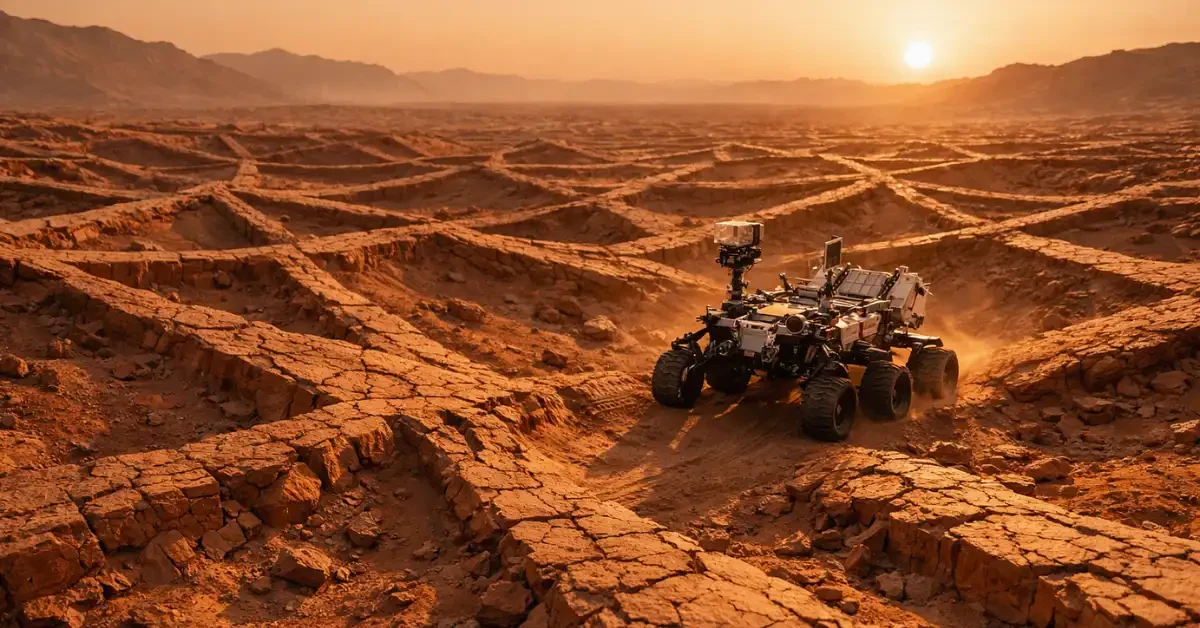
NASA’s Curiosity Mars rover has spent the past six months capturing unprecedented close-up images of intriguing geologic structures that resemble giant Martian spiderwebs . Known scientifically as boxwork, these sprawling formations suggest that ancient groundwater flowed across the Red Planet much later in its history than scientists originally expected . By studying these unique ridges, researchers are unearthing new clues about the planet’s watery past . This discovery is sparking fresh questions about exactly how long microbial life might have survived before Mars transformed into the cold, dry desert we see today .
What Are the Martian Spiderwebs?
When viewed from space by orbiting cameras, the sprawling boxwork formations look remarkably like giant spiderwebs draped across the Martian surface . Up close, these structures are actually a vast network of low ridges standing about three to six feet (one to two meters) tall . The ridges crisscross the landscape for miles, leaving sandy hollows or depressions trapped between them .
Scientists believe these distinct shapes formed billions of years ago when mineral-rich groundwater flowed through large fractures in the planet’s bedrock . As the water moved through these cracks, it left behind hardened minerals . These mineral deposits strengthened the fracture lines, turning them into sturdy ridges . Over countless millennia, harsh Martian winds slowly eroded the softer, unreinforced rock surrounding the fractures, hollowing out the sandy depressions and leaving the raised spiderweb patterns behind .
While similar boxwork ridges exist on Earth, they are vastly different in scale . Terrestrial boxwork formations are typically only a few centimeters tall . They are usually hidden away in caves or found in extremely dry, sandy environments . The sheer size and scale of the Martian spiderwebs make them a unique and highly valuable target for planetary scientists .
Navigating the Challenging Terrain
Getting a close look at these formations was no simple task for the Curiosity mission team . The rover, which is roughly the size of a standard SUV and weighs nearly a ton at 899 kilograms, had to carefully maneuver through a difficult landscape . Mission drivers had to send precise instructions to ensure the massive vehicle could safely roll across ridge tops that were barely wider than the rover itself .
Navigating the sandy hollows between the ridges also presented a constant risk . Ashley Stroupe, an operations systems engineer at NASA’s Jet Propulsion Laboratory, explained that driving on the ridges felt almost like cruising on a highway . However, dipping down into the hollows required extreme caution to prevent Curiosity’s wheels from slipping or getting stuck in the deep sand . Despite the obstacles, the team successfully found safe paths to collect the necessary data .
High Groundwater and Mysterious Nodules
The location of these Martian spiderwebs is just as important as their structure . Curiosity has been slowly climbing Mount Sharp, a massive mountain inside Gale Crater that stands three miles (five kilometers) tall . Finding boxwork formations this high up the mountain provides crucial information about the planet’s ancient water table .
Tina Seeger, a mission scientist from Rice University leading the boxwork investigation, noted that seeing these formations at such a high elevation suggests the groundwater table was once exceptionally high . Because of this, the water required to sustain potential microbial life could have lasted much longer than scientists initially assumed when looking only at orbital images .
As Curiosity explored the area, it also discovered bumpy, pea-sized textures known as nodules . These nodules are common indicators of past groundwater on Mars . However, their placement surprised researchers . Instead of sitting near the central fractures of the ridges, the nodules were clustered along the ridge walls and within the hollows . Seeger hypothesized that the ridges might have been cemented by minerals first, with later pulses of groundwater leaving the distinct nodules behind .
Drilling for Chemical Clues
To truly understand the Martian spiderwebs, Curiosity used its robotic arm to drill into the rock and collect pulverized samples . Last year, the rover gathered three separate samples from a ridgetop, a hollow, and a nearby transitional area . Inside the rover’s portable laboratory, X-ray analysis and a high-temperature oven revealed clay minerals in the ridges and carbonate minerals in the hollows .
Recently, the rover collected a fourth rock sample from the boxwork area . This sample was treated with a specialized wet chemistry technique . By mixing the rock powder with chemical reagents inside the rover’s oven, scientists hope to detect specific organic compounds . These carbon-based molecules are essential building blocks for life, and researchers are eagerly awaiting the results of this rare and complex analysis .
Curiosity is scheduled to leave the spiderweb formations behind sometime in March . As the rover continues its ascent up Mount Sharp, it will spend the coming year exploring a different rock layer enriched with salty sulfate minerals, searching for even more clues about the ancient changing climate of Mars .
