

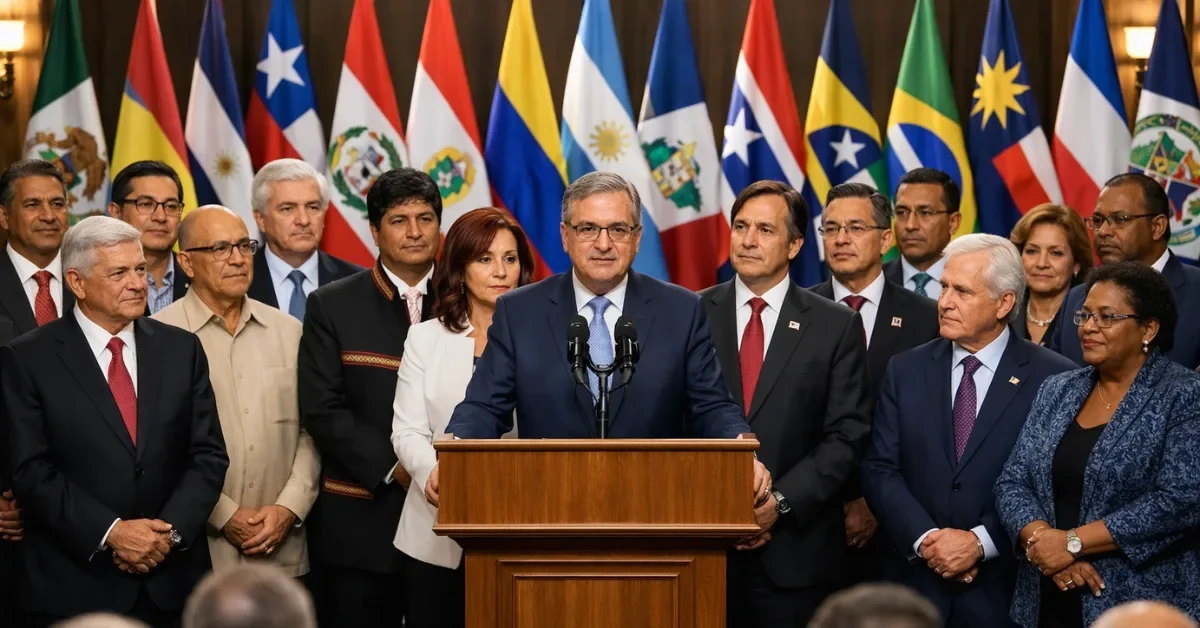
On Saturday, March 7, 2026, President Donald Trump hosted the inaugural Shield of the Americas summit at his golf club in Doral, Florida. The event gathered leaders from more than a dozen Latin American and Caribbean countries to unveil the “Americas Counter Cartel Coalition.” This new 17-nation military alliance is specifically designed to dismantle drug cartels and narcoterrorist networks operating across the Western Hemisphere.
The Shield of the Americas framework centers on deploying lethal military force to eradicate criminal organizations, improve border security, and counter the growing influence of foreign adversaries. During his opening remarks, Trump highlighted the immense potential of Latin America. However, he stressed that this potential can only be realized by defeating the criminal enterprises he described as a core security threat.
A Lethal Military Framework
At the summit, the president formally signed a proclamation to launch the new regional alliance. News reports present a discrepancy regarding the exact cabinet title of the official involved in this process. According to Homeland Security Today, the “Secretary of War” established the coalition through the proclamation. In contrast, DW reported that “Secretary of Defense” Pete Hegseth had recently led a related drug trafficking enforcement summit with Latin American counterparts at the United States Southern Command, also located in Doral.
The coalition’s primary objective is unyielding military action. Trump addressed the assembled heads of state by emphasizing that the core of their agreement is a strict commitment to utilizing lethal military force. He stated that the goal is to destroy sinister cartels and terrorist networks permanently. “We’ll get rid of them,” he told the leaders, adding, “We need your help.”
The president also pointed to the evolving dangers posed by these organizations. He noted that numerous cartels have developed highly advanced and sophisticated military operational capabilities, a situation he deemed completely unacceptable. Secretary of State Marco Rubio reinforced the aggressive posture of the alliance. He clarified that the Shield of the Americas will not act as a traditional summit where leaders simply discuss issues and issue annual documents, but rather as an active operational partnership.
Recent Military Operations
The summit follows a series of expanded United States military operations in Latin America and the Caribbean. On January 3, the U.S. executed a surprise military operation that resulted in the arrest and transport of Venezuelan President Nicolás Maduro and his wife. The administration justified the capture by classifying them as leaders of a drug crime syndicate that posed a severe threat to American security.
Military momentum continued into late February. Operating in cooperation with the Mexican government, United States forces killed Nemesio Oseguera, widely known as “El Mencho,” on February 22. Oseguera was identified as the leader of the largest drug cartel in Latin America. Shortly after this high-profile operation, the military launched “Operation Southern Spear” on March 3 to further eliminate regional criminal organizations.
The broader strategy behind these actions authorizes United States intervention in Latin America to achieve specific objectives. These goals include seizing strategic assets, combating organized crime, and halting migration, which remains one of the administration’s top domestic priorities.
Leadership and Geopolitical Context
The Doral gathering attracted several right-leaning allies, including Argentine President Javier Milei and El Salvador’s Nayib Bukele. Other nations represented included Bolivia, Chile, Costa Rica, the Dominican Republic, Ecuador, Guyana, Honduras, Paraguay, and Trinidad and Tobago. Notably, Honduras recently swore in a conservative president who secured electoral victory with Trump’s endorsement.
Conversely, left-leaning leaders from Brazil, Mexico, and Colombia were not expected to attend, reflecting their historically bristly relations with the current administration.
The summit also coincided with internal administrative shifts. Kristi Noem, the former Department of Homeland Security Secretary, was dismissed from her cabinet role and immediately appointed as the special envoy for the new coalition. The leadership change reportedly shifted the mood at the department. Stepping into her new role, Noem remarked that the initiative “will serve as a powerful example of what is possible in other regions of the world.”
While the primary focus remained on regional security, global issues were heavily featured. The coalition is intended to address concerns regarding Chinese influence in the Western Hemisphere, acting as a strategic precursor to Trump’s anticipated trip to Beijing for discussions with Chinese President Xi Jinping. Furthermore, reports indicate that the president issued warnings of imminent action against Cuba.
Trump also used the platform to provide an update on the ongoing United States and Israeli military conflict with Iran, which has recently caused significant movements in global energy markets. He informed the regional leaders that “tremendous progress” had been made in the Middle East. Describing the military action against Iran, he noted, “It’s been a pretty wild time, but it’s going very well.”
