

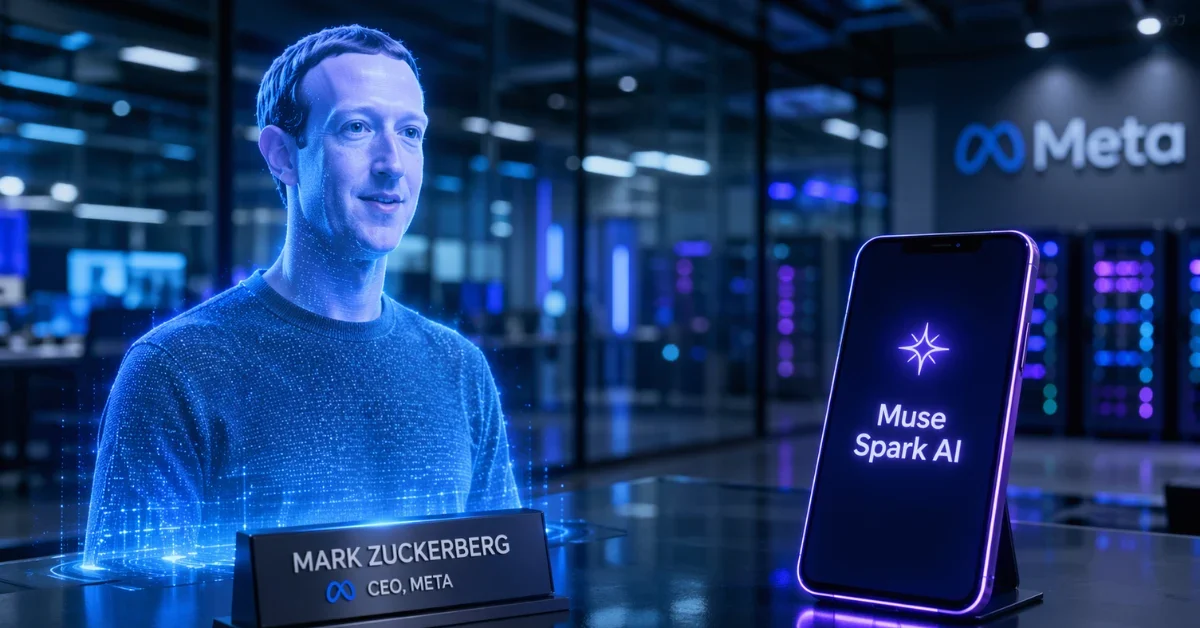
Meta is rapidly expanding its artificial intelligence capabilities with the launch of its new Muse Spark AI model and the development of a digital clone of CEO Mark Zuckerberg. These Meta AI advancements aim to reshape how employees interact with corporate leadership and how everyday users engage with virtual assistants. Through massive financial investments and a complete overhaul of its research divisions, the company is aggressively challenging industry rivals in the artificial intelligence sector.
Developing a Digital Clone of the CEO
In an effort to deepen connections within the company, Meta is reportedly building an artificial intelligence version of Mark Zuckerberg to interact with employees , . According to a report by the Financial Times, the company is prioritizing a photorealistic, 3D Meta AI character of the founder that can hold conversations, share thoughts, and provide feedback in real time , .
The system is being trained on Zuckerberg’s public statements, communication tone, mannerisms, and recent strategic thinking , . The ultimate goal is to make virtual interactions feel more personal, allowing staff to feel connected to the CEO even when he is not physically present , . Zuckerberg is personally involved in the project, reportedly spending five to ten hours a week coding and attending technical reviews to test the character , .
If this internal project proves successful, Meta may eventually allow influencers and content creators to build similar digital versions of themselves for fan interactions . However, creating these real-time avatars presents significant technical hurdles . The Financial Times noted that rendering photorealistic characters requires massive computing power, and maintaining fast, natural conversations without lag is difficult . To address audio capabilities, Meta recently acquired two voice technology companies, PlayAI and WaveForms .
This digital clone project is entirely separate from another internal tool known as the “CEO agent” , . According to a March report from The Wall Street Journal, the CEO agent is designed specifically to help Zuckerberg quickly retrieve information and make decisions without navigating multiple layers of staff , .
The Launch of the Muse Spark AI Model
Alongside its internal projects, Meta has publicly released Muse Spark, the inaugural large language model from its newly formed Meta Superintelligence Labs , . The division was created last year after Zuckerberg was reportedly dissatisfied with the progress of the company’s previous Llama models, which lagged behind competitors like OpenAI’s ChatGPT and Anthropic’s Claude .
To spearhead this overhaul, Meta poached Alexandr Wang, the former co-founder and CEO of Scale AI , . This hiring followed a massive investment in the data labeling company , . TechCrunch reported this investment as $14.3 billion for a 49% stake, while Business Insider reported a $14 billion investment , . Under Wang’s leadership, the team spent nine months rebuilding Meta’s infrastructure, architecture, and data pipelines from scratch to develop Muse Spark .
The new model introduces a “Contemplating mode,” which deploys multiple parallel agents simultaneously to solve complex problems and boost reasoning power , . For example, when planning a family vacation, one agent could draft the travel itinerary while another searches for kid-friendly activities . Muse Spark is also designed for visual reasoning, allowing users to calculate meal calories from a photo or visualize how a mug looks on a shelf , .
Furthermore, the model includes improved health-related responses developed in collaboration with 1,000 physicians, as well as a shopping feature that transforms creator and brand content across Meta platforms into product recommendations . However, Meta acknowledged that the model still has performance gaps in coding workflows, an area slated for continued investment . Following the announcement, reports on Meta’s market performance slightly differed. The Times of India reported a 7% boost in Meta’s stock, whereas Business Insider reported an 8% jump , .
App Store Success and User Privacy
The release of Muse Spark triggered an immediate surge in user interest . According to Sensor Tower estimates, daily web visitors for Meta AI reached an all-time high in the United States . The Meta AI iOS app experienced an 87% day-over-day increase in U.S. downloads, reaching approximately 46,000 downloads and jumping to the number six spot among free apps . The surge extended globally, with notable download increases in Canada, the United Kingdom, France, and Germany .
Despite the successful launch, the integration of advanced artificial intelligence into consumer products has raised privacy and safety questions , . Using Muse Spark requires logging in with an existing Facebook or Instagram account . While Meta has not explicitly stated that personal social media data trains the AI, the company traditionally utilizes public user data for training purposes . Additionally, Meta recently restricted teenager access to its artificial intelligence character features after regulators and child safety groups raised concerns about users creating inappropriate or sexualized digital personas .
Internal Push for Employee Adoption
As Meta pushes forward with consumer products, it is also mandating internal changes . The company is actively encouraging its employees to adopt new artificial intelligence tools, including custom-built automation agents and open-source software . Product managers are currently undergoing specific skill assessments related to the technology . While some employees worry these evaluations might foreshadow job cuts, Meta insists the exercises are strictly for training and development rather than layoffs .
