
By using this site, you agree to our Privacy Policy and Terms of Use.
Accept
VellaTimesVellaTimesVellaTimes
  • News
    NewsShow More
    Close-up of a silver espresso machine extracting a fresh shot of coffee into a glass cup in a softly lit cafe setting.
    Espresso Extraction Science: The Finer Grind Flaw
    May 18, 2026
    A smartphone resting on a wooden desk displaying an AI-powered Amazon search bar in a modern home office setting.
    Amazon Alexa for Shopping Replaces Rufus AI Assistant
    May 18, 2026
    Wide news-style image showing an OpenAI office scene with screens displaying audio waveforms and voice technology graphics
    OpenAI acquires Weights.gg to boost voice AI tools
    May 18, 2026
    Federal agents standing outside a modern university biology laboratory building at dusk during an active investigation.
    US Arrests Chinese Scientists for Smuggling Biological Materials
    May 18, 2026
    A dramatically lit modern corporate courtroom with futuristic technology elements, representing a high-stakes artificial intelligence legal trial.
    Elon Musk OpenAI Lawsuit Exposes Clashes Over AI Safety
    May 18, 2026
  • Technology
    TechnologyShow More
    Wide news-style image showing an OpenAI office scene with screens displaying audio waveforms and voice technology graphics
    OpenAI acquires Weights.gg to boost voice AI tools
    May 18, 2026
    A polished silicon wafer rests on a surface inside a modern semiconductor manufacturing facility.
    Samsung Strike Threatens Global AI Chip Production
    May 18, 2026
    A glowing computer screen displaying the text GPT-5.5 Instant in a modern, high-tech office environment with soft blue and purple lighting.
    GPT-5.5 Instant: OpenAI’s New Default ChatGPT Model
    May 10, 2026
    Wide view of a modern AI data center with server racks, glowing fiber-optic cables, and semiconductor hardware in the foreground.
    AI Infrastructure Spending Drives Nvidia, AMD Shares
    May 10, 2026
    A glowing computer monitor displaying lines of code and digital network graphics in a modern tech office setting.
    Airbnb AI Coding: 60% of New Software Now Generated by AI
    May 9, 2026
  • AI
    AIShow More
    A smartphone resting on a wooden desk displaying an AI-powered Amazon search bar in a modern home office setting.
    Amazon Alexa for Shopping Replaces Rufus AI Assistant
    May 18, 2026
    A dramatically lit modern corporate courtroom with futuristic technology elements, representing a high-stakes artificial intelligence legal trial.
    Elon Musk OpenAI Lawsuit Exposes Clashes Over AI Safety
    May 18, 2026
    A high-tech global map visualization showing glowing digital connections across different continents, representing the worldwide adoption of artificial intelligence.
    Global AI Adoption in 2026: Trends and Growing Divide
    May 10, 2026
    A modern smartphone displaying an artificial intelligence chat interface used for online shopping and product comparison.
    Alibaba Qwen AI Taobao Integration Launches Agentic Shopping
    May 10, 2026
    A split-screen illustration showing a high-tech modern office using advanced AI tools contrasted against an older, dimly lit workspace.
    Global AI Adoption Surges But Rich-Poor Divide Widens
    May 9, 2026
  • Science
    ScienceShow More
    Close-up of a silver espresso machine extracting a fresh shot of coffee into a glass cup in a softly lit cafe setting.
    Espresso Extraction Science: The Finer Grind Flaw
    May 18, 2026
    Federal agents standing outside a modern university biology laboratory building at dusk during an active investigation.
    US Arrests Chinese Scientists for Smuggling Biological Materials
    May 18, 2026
    Header image of a quantum communication lab setup with fiber-optic equipment, a telecom quantum dot device, and interferometer components used for long-distance quantum key distribution.
    Quantum Key Distribution Reaches 120 km With Quantum Dots
    May 10, 2026
    Abstract geometric representation of glowing quantum paraparticles interacting within a three-dimensional mathematical grid in deep blue and gold tones.
    Quantum Paraparticles Exist: New Math Challenges Physics
    May 10, 2026
    A large expedition cruise ship is navigating rough ocean waters under a cloudy sky.
    Global Authorities Respond to Andes Hantavirus Outbreak on MV Hondius Cruise Ship
    May 9, 2026
  • World
    WorldShow More
    Allu Arjun Commitment to Ethical Brand Partnerships
    Exploring Allu Arjun’s Commitment to Ethical Brand Partnerships
    December 18, 2023
    Orry aka Orhan Awatramani
    Orhan Awatramani ‘Orry’ Biography, Lifestyle and Rise to Fame
    December 8, 2023
    Alia Bhatt Latest Deepake Video Victim
    Alia Bhatt becomes latest victim of Deepfake Videos, Obscene Video goes Viral
    November 28, 2023
    Napoleon Movie Review
    Napoleon Movie Review: A Historical Epic by Ridley Scott Reviewed
    November 25, 2023
  • Bookmarks
Search
Category
  • News
  • Technology
  • AI
  • Science
  • World
Company
  • About Us
  • Contact Us
  • Fact Checking Policy
  • Terms & Conditions
  • Privacy Policy
  • Copyright Policy
Resources
  • Home
  • Web Stories
  • Bookmarks
  • Interests
  • Disclaimer
  • Sitemap
© 2022 VellaTimes • All Rights Reserved.
Reading: Exercise Protects the Brain via Liver Signal, Study Finds
Share
Notification Show More
Font ResizerAa
VellaTimesVellaTimes
Font ResizerAa
  • News
  • Technology
  • AI
  • Science
  • World
Search
  • Explore
    • News
    • Technology
    • AI
    • Science
    • World
  • Useful Links
    • About Us
    • Contact Us
    • Fact Checking Policy
    • Terms & Conditions
    • Privacy Policy
    • Copyright Policy
  • Home
  • Web Stories
  • Bookmarks
  • Interests
  • Disclaimer
  • Sitemap
© 2022 VellaTimes • All Rights Reserved.
News

Exercise Protects the Brain via Liver Signal, Study Finds

Nisha Pradhan
Last updated: 21/02/2026
Nisha Pradhan
Share
7 Min Read
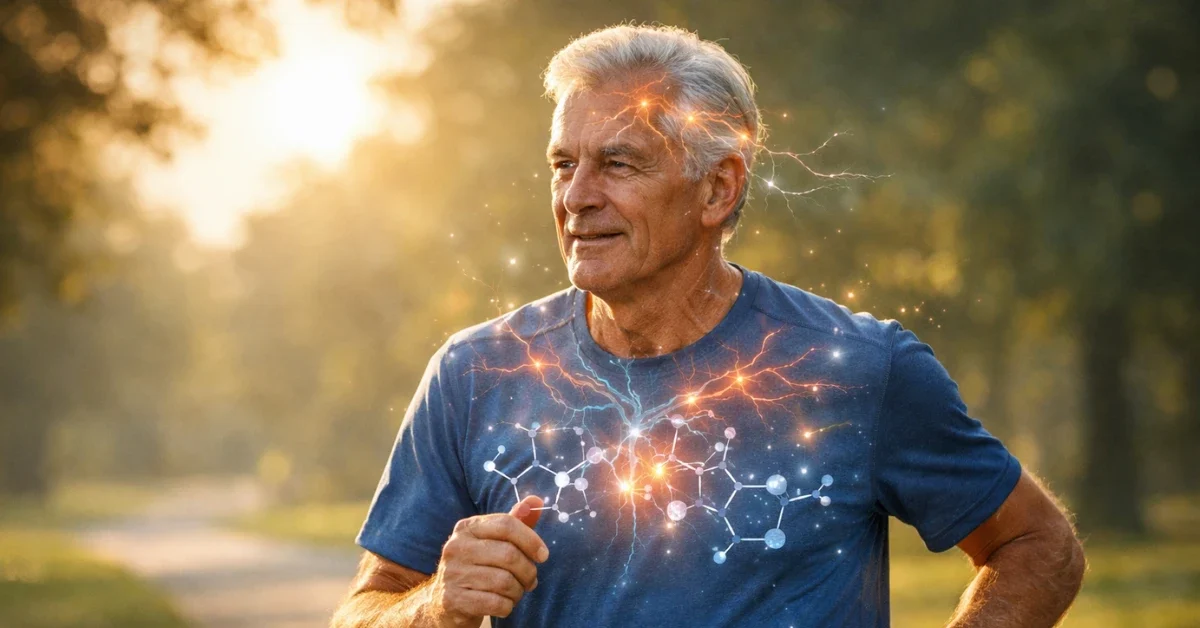
An older adult jogging along a sunlit park path with a faint scientific overlay of brain blood vessels, representing the liver-to-brain mechanism that links exercise to protection against brain aging and Alzheimer's disease.

Scientists at UC San Francisco have uncovered a long-sought biological pathway explaining how physical activity shields the aging brain from decline. A liver enzyme produced during exercise travels through the bloodstream to the brain’s blood vessels, where it clears out a harmful protein that weakens the brain’s protective barrier. Published in the journal Cell on February 18, 2026, the discovery could lead to new treatments for Alzheimer’s disease — including a drug that may replicate exercise’s brain benefits for people who cannot stay physically active.

Contents
The Brain’s Protective BarrierThe Liver-to-Brain ConnectionWhat the Experiments ShowedA Drug That Could Bottle the BenefitsHope for Alzheimer’s Treatment

For decades, doctors have recommended exercise as one of the best ways to maintain a sharp mind. Physical activity stimulates the growth of new nerve cells, enhances learning, and reduces brain inflammation. But the precise biological steps connecting a workout to a healthier brain have remained frustratingly unclear — until now.

The Brain’s Protective Barrier

The human brain is guarded by a dense network of tightly packed blood vessels called the blood-brain barrier. Acting like a security checkpoint, this structure filters out toxins and harmful substances circulating in the blood, protecting delicate brain tissue. With age, the barrier deteriorates and becomes permeable. Dangerous compounds leak in, sparking inflammation closely associated with cognitive decline and disorders like Alzheimer’s disease.

Six years ago, the UCSF research team took an important first step toward solving the mystery. They discovered that exercising mice produced elevated levels of an enzyme called GPLD1 in their livers, and that GPLD1 appeared to rejuvenate the brain. There was just one puzzle: the enzyme cannot cross the blood-brain barrier, so scientists were left wondering how it reached the brain in the first place.

The Liver-to-Brain Connection

The new study answers that question. The researchers found that GPLD1 works by targeting another protein, called TNAP. As mice age, TNAP accumulates on the cells forming the blood-brain barrier, weakening it and making it leaky. When mice exercise, their livers release GPLD1 into the bloodstream. The enzyme travels to the brain’s outer blood vessels and acts like molecular scissors — snipping the excess TNAP off the cell surfaces. With less TNAP present, the barrier seals up, inflammation subsides, and cognitive function improves.

“This discovery shows just how relevant the body is for understanding how the brain declines with age,” said Saul Villeda, PhD, associate director of the UCSF Bakar Aging Research Institute and senior author of the study.

What the Experiments Showed

To confirm TNAP’s role, the researchers conducted a series of targeted experiments in mice. When young mice were genetically engineered to carry excess TNAP in the blood-brain barrier, they developed memory problems resembling those of aging animals. This showed that high TNAP levels alone can drive cognitive decline.

When the team then used genetic tools to dial down TNAP levels in two-year-old mice — roughly equivalent to a 70-year-old human — the blood-brain barrier became less permeable, brain inflammation decreased, and the mice improved on memory tests. “We were able to tap into this mechanism late in life, for the mice, and it still worked,” said Gregor Bieri, PhD, a postdoctoral scholar in Villeda’s lab and co-first author of the study.

A Drug That Could Bottle the Benefits

Not every older adult or person with a physical limitation can exercise regularly. That reality gave the team a practical motivation: could a drug replicate what exercise does? They tested a compound called SBI-425, which blocks TNAP activity directly. Aged mice treated with SBI-425 showed similar improvements in memory and blood-brain barrier function as those given GPLD1 itself. Crucially, the drug does not enter brain tissue — it acts only on the outer vessel walls, which may reduce the risk of unintended side effects inside the brain.

Hope for Alzheimer’s Treatment

The findings extend to Alzheimer’s disease as well. Mice genetically engineered to develop Alzheimer’s-like brain plaques and behavioral problems showed a reduction in plaque density and improved behavior after being treated with either GPLD1 or the TNAP inhibitor.

Human tissue data added significant weight to these results. When scientists analyzed brain tissue samples from deceased individuals, they found that people who had Alzheimer’s disease carried higher levels of TNAP in their brain blood vessels compared to those without the condition. This correlation suggests the same mechanism observed in mice may also be at work in the human brain.

“We’re uncovering biology that Alzheimer’s research has largely overlooked,” Villeda said. “It may open new therapeutic possibilities beyond the traditional strategies that focus almost exclusively on the brain.”

While the findings are encouraging, human clinical trials will be necessary to confirm whether TNAP-targeted therapies are safe and effective in people. TNAP also plays roles elsewhere in the body — including bone mineralization — meaning any future drug would need to act precisely on the brain’s blood vessels without disturbing other systems. Still, this research offers a compelling new blueprint: the liver, long known mainly for its role in digestion, may be one of the brain’s most important allies in the battle against aging.

TAGGED: Alzheimer's disease, blood-brain barrier, brain aging, Cell journal, cognitive decline, exercise brain health, GPLD1 enzyme, TNAP protein, UCSF research
Share This Article
Facebook Twitter Whatsapp Whatsapp Telegram Copy Link
By Nisha Pradhan
I am a passionate content creator with a deep love for travel, music, and food. Using my unique blend of these interests, I genuinely enjoy crafting high-quality travel, lifestyle, and entertainment-related news content.
Leave a comment

Leave a Reply Cancel reply

Your email address will not be published. Required fields are marked *


Most Read

Microsoft Unveils AI Backdoor Scanner to Catch Sleeper Agents

February 7, 2026

Caitlin Kalinowski Resigns as OpenAI Robotics Head Over Pentagon Deal

March 9, 2026

Goldman Sachs Anthropic AI Agents Automate Banking

February 11, 2026

OpenAI Secures Pentagon AI Agreement Amid Anthropic Supply Chain Dispute

March 1, 2026

Google Gemini AI Updates: Android, Smart Home, and Workspace

March 7, 2026

CES 2026 AI: Robots, cars and physical AI take over

January 10, 2026

Related News

Close-up of a silver espresso machine extracting a fresh shot of coffee into a glass cup in a softly lit cafe setting.
News

Espresso Extraction Science: The Finer Grind Flaw

Nisha Pradhan Nisha Pradhan May 18, 2026
A smartphone resting on a wooden desk displaying an AI-powered Amazon search bar in a modern home office setting.
News

Amazon Alexa for Shopping Replaces Rufus AI Assistant

Sameer Katoch Sameer Katoch May 18, 2026
Wide news-style image showing an OpenAI office scene with screens displaying audio waveforms and voice technology graphics
News

OpenAI acquires Weights.gg to boost voice AI tools

Rakesh Paul Rakesh Paul May 18, 2026

About Us

VellaTimesVellaTimesVellaTimes

VellaTimes is a leading news portal that covers the latest trending news in technology, lifestyle, entertainment, automobiles, travel, and sports.

Explore

  • News
  • Technology
  • AI
  • Science
  • World

Useful Links

  • About Us
  • Contact Us
  • Fact Checking Policy
  • Terms & Conditions
  • Privacy Policy
  • Copyright Policy

Subscribe Us

Subscribe to our newsletter for the Latest News and Top Stories!

© 2022 VellaTimes • All Rights Reserved.
  • Home
  • Web Stories
  • Bookmarks
  • Interests
  • Disclaimer
  • Sitemap
adbanner
AdBlocker Detected
Our site is an advertising supported site. Please whitelist us to support our work.
Okay, I'll Whitelist