

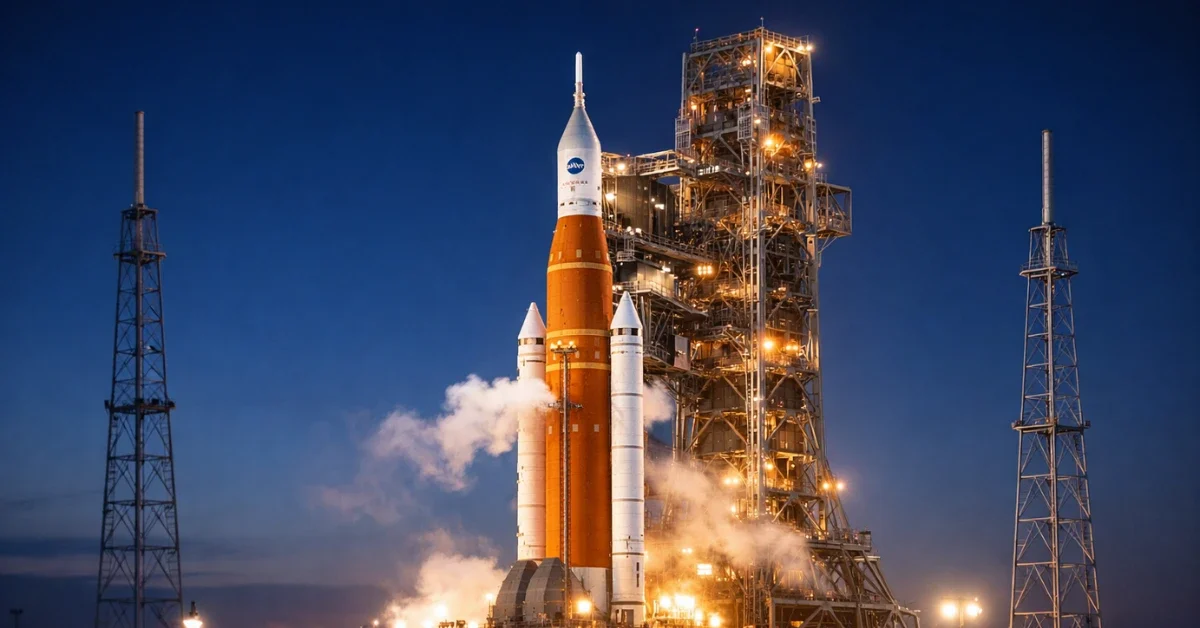
NASA has officially targeted Friday, March 6, as the earliest possible Artemis II launch date. This announcement comes after mission teams successfully completed a critical wet dress rehearsal at the Kennedy Space Center in Florida, overcoming previous fueling challenges. The historic 10-day mission will send four astronauts on a journey around the moon, marking the first crewed lunar flight in more than 50 years.
During a post-test news conference on February 20, agency officials confirmed the early March target. Lori Glaze, NASA’s Moon to Mars program manager, explained that the launch date remains tentative and depends on upcoming reviews. “There’s a lot of forward work that remains,” Glaze noted, pointing to post-test analysis, launch pad preparations, and a multi-day flight readiness review scheduled for late next week.
Overcoming Fuel Leaks in the Wet Dress Rehearsal
The comprehensive testing, which lasted approximately 50 hours, was the second attempt to fully fuel the 322-foot-tall Space Launch System rocket. A previous attempt on February 2 was halted early due to persistent hydrogen leaks and other technical hurdles. To resolve the issue, engineers isolated and replaced two fuel line seals at the base of the rocket’s core stage.
The fixes proved successful during the latest rehearsal. Artemis Launch Director Charlie Blackwell-Thompson reported that hydrogen gas concentrations remained well below allowable limits. While the mission could tolerate up to 16 percent of escaping hydrogen in the atmosphere, the recent test did not exceed a 1.6 percent concentration.
Throughout the rehearsal, engineers loaded more than 700,000 gallons—or about 2.6 million liters—of super-cold liquid hydrogen and liquid oxygen into the rocket’s tanks. Despite a momentary loss of ground communications that required a temporary switch to backup systems, and a brief pause caused by a booster avionics voltage anomaly, the teams successfully mitigated the issues.
Launch controllers successfully executed the terminal launch countdown twice. They ran the clock down to 33 seconds before the simulated launch time, paused for three minutes, recycled the countdown back to the 10-minute mark, and proceeded again down to 29 seconds.
“Our Space Launch System chief engineer, and my friend, John Blevins, often says, ‘You have to earn your right to fly,'” Blackwell-Thompson said. “And I felt like last night was a big step in us earning our right to fly.”
Astronaut Quarantine and Launch Pad Preparations
As engineers review the test data, the Artemis II crew is preparing for their upcoming flight. The four-person team includes NASA astronauts Reid Wiseman serving as commander, pilot Victor Glover, mission specialist Christina Koch, and Canadian Space Agency mission specialist Jeremy Hansen. This diverse crew features the first woman and the first Black man to participate in a lunar mission.
The astronauts observed portions of the wet dress rehearsal from the Launch Control Center. To preserve the flexibility of the March launch window, the crew will enter a roughly 14-day quarantine in Houston, Texas, starting February 20. This standard procedure limits their exposure to illness before heading into space. They are scheduled to travel to the Kennedy Space Center about five days prior to liftoff.
Meanwhile, significant work continues at Launch Complex 39B. Over the coming days, technicians will use cranes to erect temporary access platforms on the mobile launcher. These platforms will allow crews to reach the upper sections of the solid rocket boosters and the core stage intertank. From there, they will service and retest the flight termination system to ensure it meets Eastern Range safety requirements.
Performing this end-to-end safety testing directly at the launch pad prevents the need to roll the massive rocket back to the Vehicle Assembly Building. Additionally, the closeout crew will conduct further practice runs of their procedures. During the rehearsal, they simulated sealing the Orion spacecraft’s hatches and the launch abort system, though they lacked a full trainer system outside of the loading area to practice the entire procedure.
Paving the Way for Future Lunar Exploration
Generating 8.8 million pounds of thrust at liftoff, the massive rocket is one of the most powerful ever constructed. If the launch goes as planned and the mission successfully swings its crew around the moon before splashing down safely on Earth, it will provide crucial data for the future.
The mission serves as a vital stepping stone for the broader Artemis program, which aims to establish a long-term human presence on the lunar surface. Successfully testing these systems is essential for the planned Artemis III mission, which targets landing astronauts on the moon in 2028 and eventually preparing for crewed missions to Mars.
