

The highly anticipated Artemis II launch has officially sent a crew of astronauts out of Earth’s orbit and on their way to the Moon. Launching on April 2, 2026, the NASA mission marks a monumental milestone in space exploration. For the first time in more than 50 years, humans are making the rigorous journey back to the lunar vicinity. The spacecraft successfully executed the critical engine maneuvers required to break free from Earth’s gravitational hold, decisively slinging the crew toward their deep space destination.
This Artemis II launch represents a massive leap forward for NASA, serving as the first crewed lunar mission since the end of the Apollo program. The astronauts are embarking on a historic flight that will take them far beyond the familiar confines of low Earth orbit to fly around the Moon before returning safely home. Global attention is already focused heavily on the mission’s progress. Recognizing the cultural and historical weight of the event, tech giant Google rolled out a special Google Doodle to celebrate the momentous occasion and honor the resumption of human lunar exploration.
Early Technical Challenges in Deep Space
Despite the flawless departure from the launchpad and a successful exit from Earth’s orbit, the mission was not without its early uncomfortable moments. Just hours after the historic liftoff, the spacecraft suffered an embarrassing technical issue involving its onboard toilet. The malfunction forced the crew to navigate a messy situation right at the beginning of their monumental journey.
While the astronauts successfully entered their planned trajectory toward the Moon, dealing with plumbing malfunctions in the zero-gravity environment of space presented an immediate and unpleasant challenge. The unexpected toilet complication highlighted the unpredictable, and often unglamorous, realities of human spaceflight. It serves as a stark reminder that while the spacecraft utilizes highly advanced orbital mechanics and cutting-edge propulsion, mission planners must also account for basic human needs and complex life support systems.
A Spectacular View from a Window Seat
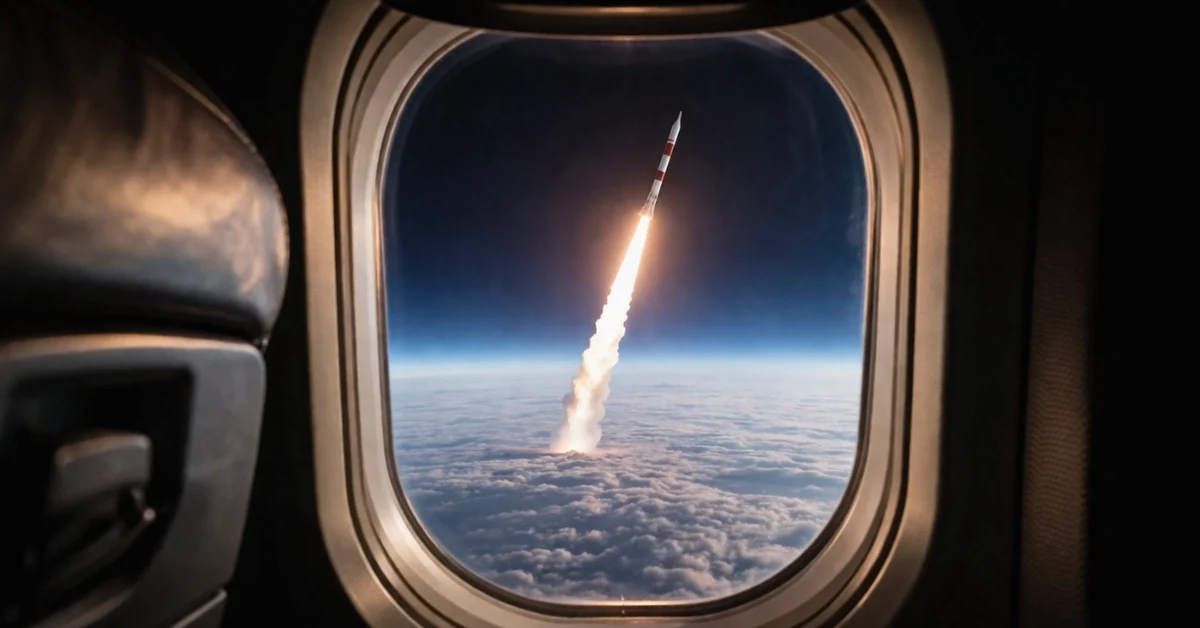
Down on Earth, the spectacular liftoff captivated millions of viewers tuning in through official broadcasts, but one bystander managed to capture a truly unique and serendipitous perspective. A passenger traveling aboard a commercial airplane happened to be looking out their window seat at the exact right moment to witness the rocket tearing through the sky.
The incredible video footage quickly gained widespread attention and went viral across digital platforms. Watching a massive lunar-bound rocket blast through the atmosphere from the high-altitude vantage point of a commercial airliner offered a breathtaking look at the sheer speed and power required to push a heavy spacecraft out of Earth’s atmosphere. The airplane passenger’s lucky timing provided the general public with an unforgettable, entirely organic visual of the historic departure.
The Journey Ahead and Mission Timeline
Now that the Artemis II crew has been officially slung out of Earth’s orbit, the next phase of the mission involves a multi-day transit across the vast emptiness of space. The spacecraft is set to travel hundreds of thousands of miles over several days before finally reaching the immediate proximity of the lunar surface.
Instead of touching down on the lunar soil, the astronauts will conduct a complex and highly calculated flyby maneuver. The mission plan dictates that the spacecraft will loop entirely around the Moon. By utilizing lunar gravity, the capsule will be able to slingshot itself out of the Moon’s orbit and enter a trajectory headed straight back toward Earth.
This critical test flight is designed to push all of the spacecraft’s life support, navigation, and propulsion systems to their absolute limits. As the spacecraft continues its journey over the coming days, teams on the ground will closely monitor the crew’s progress, the health of the vessel, and any ongoing system issues. The successful completion of this flight around the Moon will pave the way for the next major era of space exploration, ultimately setting the stage for future missions where humans will once again walk on the lunar surface.
