

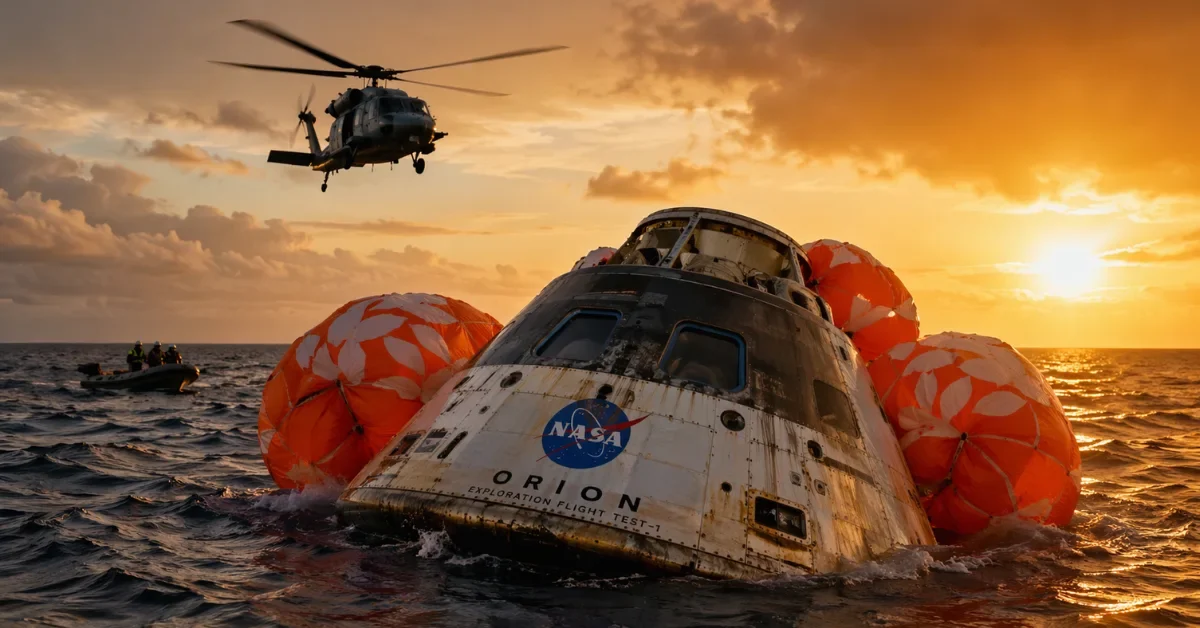
The Artemis II mission successfully concluded as four astronauts splashed down safely in the Pacific Ocean off the coast of San Diego on Friday, April 10, 2026. After an intense and historic 10-day journey around the moon, the safe return of the NASA Orion spacecraft marks humanity’s first crewed lunar flight in over half a century and officially sets the stage for ambitious future lunar surface bases.
NASA astronauts Reid Wiseman, Victor Glover, Christina Koch, and Canadian Space Agency astronaut Jeremy Hansen traveled farther from Earth than any previous humans in history . The Artemis II mission flew 252,756 miles from home at its peak, breaking the long-standing 1970 Apollo 13 distance record, and ultimately covered a total of 694,481 miles before safely returning to Earth . Upon their arrival, NASA Administrator Jared Isaacman expressed gratitude to President Donald Trump and Congress for supporting the mandate that made this monumental flight possible .
Breaking Records and Testing Spacecraft Limits
Launching on April 1 from Florida’s Kennedy Space Center atop the massive 8.8-million-pound-thrust Space Launch System rocket, the crew affectionately named their spacecraft Integrity . Throughout the outbound journey, the astronauts rigorously tested Orion’s critical life support and manual piloting systems . The mission included a highly anticipated close lunar flyby on April 6, where the spacecraft passed just 4,067 miles above the moon’s rugged surface .
During this flyby, the crew experienced 40 minutes of total communication blackout while navigating the moon’s far side . Despite the solitude, they captured over 7,000 images, documenting a unique solar eclipse where the moon completely blocked the sun from Orion’s vantage point . The imagery also included earthrises, ancient lava flows, and meteoroid impact flashes . The crew also proposed names for two lunar craters, dedicating one to Commander Wiseman’s late wife .
Technical assessments were a major operational focus of the test flight . The spacecraft utilized a new reentry trajectory to protect its heat shield, which had suffered unexpected chipping across more than 100 spots during the uncrewed 2022 Artemis I test . According to Isaacman, early evaluations indicated no unexpected conditions during reentry . However, the crew did encounter multiple problems with their space toilet and dealt with a worsening helium leak in the European-built propulsion system, which will require a significant redesign for future flights .
Public Engagement and Medical Evaluations
Following the 5:07 p.m. PDT splashdown, combined military and NASA teams transported the crew via helicopter to the USS John P. Murtha for initial medical checks . By Saturday, the astronauts had returned to the Johnson Space Center in Houston . Alongside testing hardware, the crew participated in scientific experiments like the AVATAR investigation, studying how microgravity and deep-space radiation affect human tissue for long-duration spaceflight .
The Artemis II mission captured massive public attention, becoming NASA’s most-viewed live broadcast on YouTube with over 27 million viewers tuning in for the lunar flyby . Reflecting on the journey back in Houston, Hansen noted the crew’s deep connection to the public, stating that the astronauts serve as a mirror reflecting humanity back at itself .
Shifting Focus to Artemis III and Lunar Bases
With the crew safely home, NASA is pivoting sharply from its previous architectural plans . The space agency has officially scrapped the Gateway lunar-orbiting space station concept . Instead, leadership is focusing exclusively on establishing a permanent operational base on the moon’s surface to prepare for eventual Mars missions . Isaacman emphasized that learning and testing critical technologies will be far more effective on the lunar surface rather than looking down from orbit .
The immediate next step in the program is Artemis III, currently scheduled for a 2027 launch . Unlike Artemis II, this mission will remain in near-Earth orbit to carefully test docking procedures between the Orion capsule and commercial lunar landers currently being developed by SpaceX and Blue Origin . Despite a recent NASA audit highlighting schedule delays and technical challenges for both private companies, the space agency remains steadfast on the 2027 timeline and plans to announce the crew soon .
Looking further ahead, NASA intends to launch Artemis IV in early 2028 . This mission will carry astronauts to lunar orbit, with two crew members taking a lander down to the moon’s south pole for a week of intensive scientific research . Beginning with Artemis V, the agency aims to increase the frequency of missions to achieve a lunar landing every six months, solidifying a sustained human presence on the moon .
