

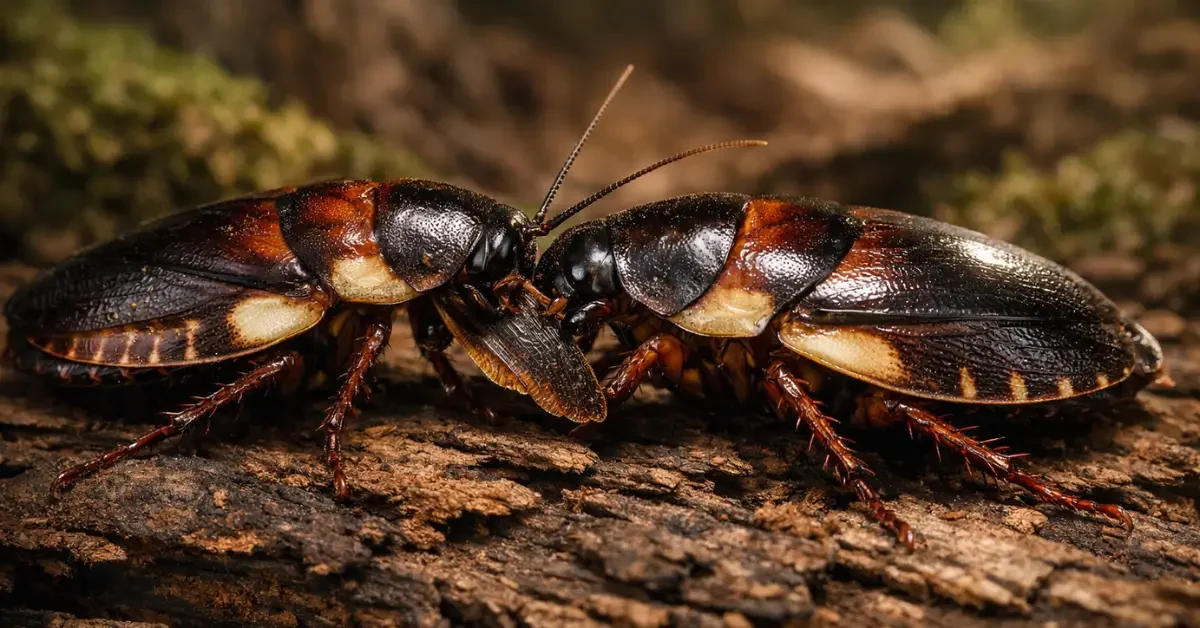
Most people associate cockroaches with pest control, not pair bonding. But scientists have just documented something remarkable: a wood-feeding cockroach species forms lifelong, monogamous partnerships — and seals that bond by eating each other’s wings. A study published March 4 in Royal Society Open Science delivers the first behavioral evidence that pair bonding, a trait long considered exclusive to vertebrates, also occurs in invertebrates.
A Wing-Eating Ritual That Bonds for Life
The species at the center of this discovery is Salganea taiwanensis, a wood-feeding cockroach capable of living up to five years. Unlike the vast majority of insects, this cockroach is strictly monogamous. A male and female pair up, build a shared nest inside rotting wood, and raise their young together for the rest of their lives.
To make that commitment permanent, both partners take turns gnawing each other’s wings off — before, during, or after mating. Once the wings are gone, neither cockroach can fly again. The ritual is irreversible by design. It strips away each partner’s primary means of escape, making it biologically impractical for either one to abandon the relationship.
Haruka Osaki, a behavioral ecologist at the Museum of Nature and Human Activities in Hyōgo, Japan, led the research alongside co-authors Kensei Kikuchi and Nathan Lo. The team paired cockroaches in a controlled lab setting, gave each couple a nest, and then introduced outside intruders — both male and female — to observe how the bonded pairs would respond.
Fierce Defenders of Each Other
The difference between pre-ritual and post-ritual pairs was striking.
Among the eight pairs that had not yet gone through the wing-eating ritual, only a single male chose to fight an intruding male. After the ritual took place, however, the dynamic changed completely. Both partners charged any stranger who entered their nest — regardless of whether the intruder was the same sex or the opposite sex. The cockroaches rammed outsiders with force. And when only one partner led the attack, the other showed clear support by waggling its abdomen or digging nearby in the nest.
Crucially, the paired roaches never attacked or attempted to replace their own mate — even when a potential alternative was introduced. This is not simple co-parenting or territorial defense. The cockroaches were actively choosing each other while rejecting everyone else. “Studies like ours show that they can form stable and selective partnerships,” Osaki said. Even a cockroach, it turns out, can commit.
First Pair Bond Confirmed in Invertebrates
Pair bonding — defined as an exclusive relationship between two adults of the same species, involving the selective exclusion of rivals — has been well documented in vertebrates, from prairie voles to wolves. But it had never been confirmed in invertebrates, despite the enormous diversity of social systems found in insects, spiders, and crustaceans.
The behavior of S. taiwanensis changes that. The cockroaches’ mutual wing-eating followed by selective aggression toward outsiders, combined with the fact that they never attacked or replaced each other, fulfills the defining scientific criterion of pair bonding. The findings provide the first behavioral evidence for pair bonding within mating pairs in invertebrates and open a new model for studying the cognitive ecology of mating in the animal kingdom.
Lars Chittka, a behavioral ecologist at Queen Mary University of London who was not part of the research team, described the wing-eating ritual as a kind of built-in biological lock. “It’s a built-in ‘stay-and-invest’ signal for both parties, exactly the sort of irreversible step that often stabilizes cooperation in pair-living species,” he said. He also called the study’s findings “arguably the crispest demonstration of a ‘bond like'” pairing ever observed in an insect.
Why Eat the Wings at All?
Researchers are still working out exactly why this ritual evolved, but two leading explanations have emerged. One is practical: the nests that S. taiwanensis builds are carved inside rotting wood, where wings could easily get trapped in tight spaces. Removing them may make navigating the home simpler and safer for both partners.
The other explanation, raised by Chittka, is chemical. The act of consuming a partner’s wings may expose each cockroach to compounds that help it learn and memorize the other’s unique biological identity — turning the ritual into both a physical and a sensory bonding event.
Either way, the outcome is the same. Two wingless insects, locked together in a shared nest, with no good reason — biological or practical — to go their separate ways. For Salganea taiwanensis, love bites are not a metaphor. They are the foundation that holds the partnership together for life.
