

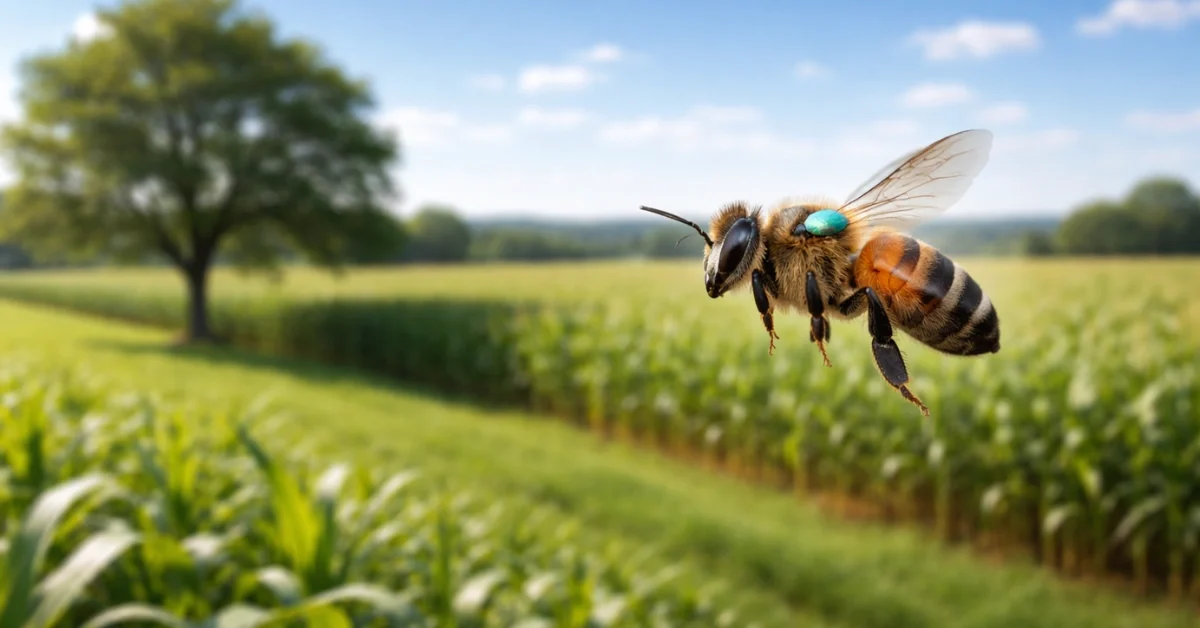
Honey bees may appear to wander aimlessly as they search for nectar, but new research shows their flight paths are incredibly deliberate . A recent study conducted by the University of Freiburg has uncovered surprising new details about honey bee navigation precision . Using advanced drone technology, scientists discovered that individual insects map out unique routes and follow them with remarkable accuracy .
Led by neurobiologist Prof. Dr. Andrew Straw, the research team found that honey bees do not simply fly in a general direction toward a food source . Instead, every bee establishes an individualized, highly accurate route that functions as its own dedicated airway . This discovery fundamentally changes how scientists understand insect cognition and highlights a level of navigation precision that was previously unknown .
Advanced Drone Technology Tracks Insect Flight
To capture these detailed flight patterns, the researchers utilized a custom multicopter drone equipped with a specialized “Fast Lock-On” tracking system . Standard radar systems previously struggled to capture high-resolution, three-dimensional data in outdoor environments . The new drone system solved this problem by actively following the insects over long distances .
The team attached tiny, highly reflective markers to the backs of experienced forager bees . As the bees flew outdoors, the drone’s cameras detected the reflected light from these markers . A high-speed computer processed this visual data in milliseconds, allowing the drone to calculate the insect’s exact three-dimensional position and stay locked onto its target .
The Obstacle Course and Flight Patterns
The experiment took place in an agricultural region near the Kaiserstuhl in Germany . Researchers trained the bees to fly between their hive and a food source located roughly 400 feet away . The direct route between these two points was intentionally blocked by a large tree, a hedgerow, and a tall cornfield, forcing the insects to maneuver around these natural obstacles .
During the study, the scientists successfully recorded 255 complete flights from 26 different bees . The data showed the insects traveling a 453-foot distance in roughly 25 seconds, which translates to speeds between 18 and 20 feet per second . While outbound and return flights shared similar speeds and durations, the outbound trips were slightly lower in altitude and less straight .
Navigational Personality and Visual Landmarks
The drone footage revealed that the insects do not share a single, uniform route . Instead, they chose different paths to bypass the tree, with some flying over the hedge, others skirting wide of it, and most returning via the tree path . Once a bee selected its preferred route, it repeated that exact path on future trips . According to Prof. Dr. Straw, the individuals repeated their routes so precisely that it seemed as if every bee possessed its own distinct navigational personality .
Environmental landmarks played a critical role in maintaining this exactness . The highest level of precision occurred near distinct landscape features, such as the large tree . In these areas, the insects passed within just 1.6 feet of their established routes . Conversely, when flying over the visually repetitive and featureless cornfield, their flight paths showed the greatest amount of variability . This indicates that bees use strong visual landmarks to anchor their navigation, while their uncertainty increases in monotonous environments .
To compensate for visually uniform areas, scientists believe the bees rely heavily on an internal mechanism known as path integration . This system acts like a compass and step counter, allowing the bee to keep track of its traveled distance and general direction even without clear visual cues . Once a familiar landmark reappears in their field of view, the insects quickly correct their course and tighten their flight paths back to their highly specific personal routes .
The researchers also noticed different strategies during the inbound flights back to the hive . Some bees flew directly toward the hive location before navigating around the tree just before reaching it . Others targeted a specific opening between the vegetation from the very beginning of their return trip . This suggests that individual bees can choose between relying on global cues, like sky polarization, or depending strictly on learned visual landmarks .
Redefining the Waggle Dance
These findings, published in the journal Current Biology, also challenge long-held assumptions about the honey bee waggle dance . For decades, scientists knew that bees use this physical dance to communicate the location of food to their hive mates . However, the directional information provided in the waggle dance is known to be slightly inaccurate, often deviating by about 30 degrees for targets located roughly 328 feet away .
Previously, biologists assumed this inaccuracy meant the bees had a coarse spatial memory . The University of Freiburg study proves otherwise, showing that an individual bee’s actual flight path deviates by an average of only three degrees . The bees navigate much more accurately to familiar destinations than their dance communication suggests . Researchers now conclude that the imprecision of the waggle dance stems from the physical limitations of communicating complex spatial directions inside a dark hive, rather than a lack of cognitive ability .
Ultimately, the research demonstrates that honey bees use a sophisticated combination of internal calculations and visual memory to traverse their environment . By memorizing obstacles and crafting reliable, repeatable strategies, these tiny insects navigate complex landscapes far more precisely than scientists previously understood .
