

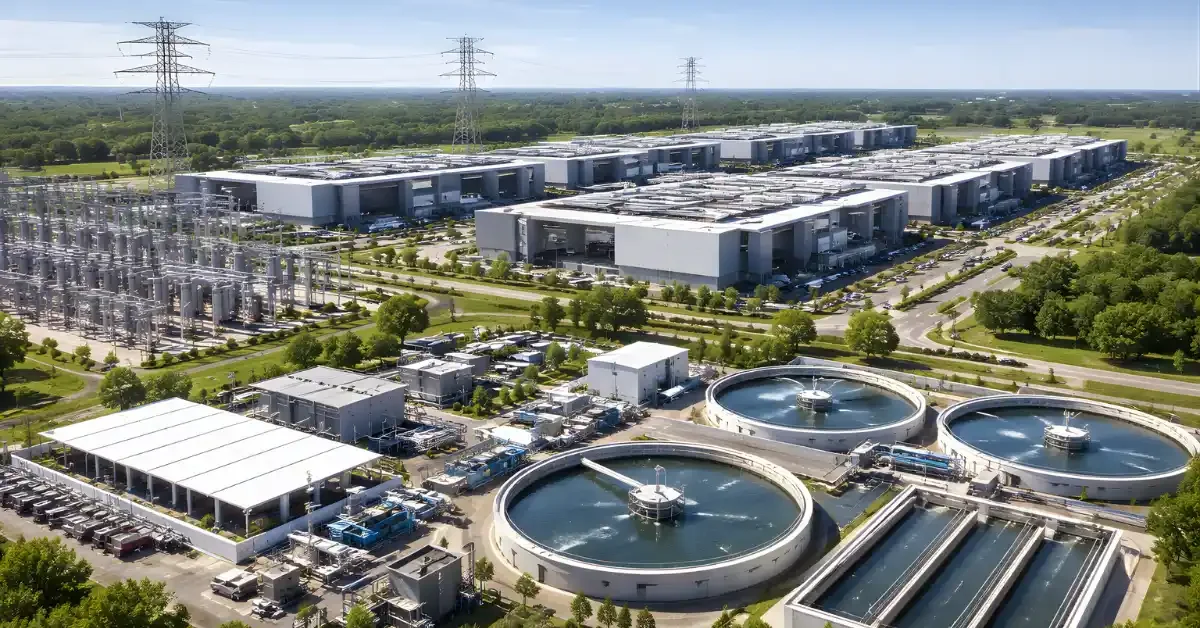
Microsoft has announced a new “Community-First AI Infrastructure” strategy aimed at addressing local concerns about how resource-intensive AI data centers can affect electricity prices and water supplies in the communities where they operate.
The plan, outlined by Microsoft vice chair and president Brad Smith, focuses on a promise that Microsoft will “pay its way” so its data centers do not drive up local power bills, while also reducing water impacts and investing in local communities.
Concerns have been growing in parts of the U.S. as data centers expand to meet demand for AI computing, with residents and local leaders raising alarms about higher utility rates and pressure on water systems.
Promise on electricity costs
Microsoft’s strategy includes a commitment to pay utility rates “high enough to cover” the company’s power costs for data center operations, according to multiple reports describing the plan.
One key idea is that electricity rates should reflect not only the energy used by Microsoft facilities, but also the cost of supporting infrastructure needed to deliver that power, such as power delivery systems.
In areas where current power lines and substations cannot meet Microsoft’s needs, the company says it will pay for upgrades rather than shifting those costs to residents.
The move comes as communities push back against resource-heavy projects, and as estimates cited in coverage of the announcement say U.S. data center electricity demand could more than triple by 2035.
Planning with local utilities
Microsoft also says it will give utilities clearer forecasts about its future electricity needs to help them plan grid improvements.
The company plans to provide utilities with AI tools meant to support planning work and improve the resilience of the power grid, according to details shared about the initiative.
Microsoft’s overall message is that data center buildouts will move forward more smoothly when communities believe the benefits outweigh the costs, and Smith has argued that local support depends on addressing power bills and water concerns directly.
Water reduction and replenishment
On water, Microsoft has said it will minimize water use and “replenish more water” than it consumes, framing the goal as strengthening local water systems rather than burdening them.
Microsoft also said it will begin publishing water-use information for each U.S. data center region, along with progress on replenishment.
One report describing the program says Microsoft aims to cut its data centers’ “water use intensity” by 40% through the end of the decade, including by increasing opportunities to use air cooling instead of liquid cooling.
Microsoft is also testing a data center design using a closed-loop liquid cooling system that recycles coolant instead of evaporating it, and the company has already deployed this system in several states, including Wisconsin and Georgia.
In areas where reservoirs are strained, Microsoft says it will finance new public works intended to reduce its reliance on potable water.
Local projects and a past example
Smith pointed to work in Quincy, Washington—described as an arid region where groundwater supplies were already under pressure—as an example of what the company wants to replicate.
According to Smith’s description cited in coverage, Microsoft partnered with the city to build the Quincy Water Reuse Utility, which treats and recirculates data center cooling water to avoid drawing from the community’s potable water.
The company’s water and electricity commitments are meant to address the kinds of concerns that have fueled local backlash around data center development in multiple U.S. communities.
Jobs, taxes, and training commitments
Beyond utilities and water, Microsoft says it wants its data center expansion to contribute more to local economies, including job opportunities and skills development.
One report says Microsoft will not seek property tax breaks for data centers going forward, positioning that as part of a broader effort to increase its contribution to local communities.
Microsoft also plans to provide AI tools and training to small businesses through local chambers of commerce, and to launch additional upskilling programs tied to data center construction, maintenance, and operations roles.
The company says it will expand its Datacenter Academy program in partnership with local community colleges and vocational schools to train people for data center operations and related careers.
In a separate description of the initiative, Microsoft’s strategy is framed as a five-point plan that also includes commitments to expand the local tax base that supports public services and invest in local AI training programs and nonprofit organizations.
Public and industry reactions
U.S. President Donald Trump praised the idea that big technology companies should “pay their own way” for the power their data centers consume, and said his administration was working with major American tech companies so Americans do not “pick up the tab” through higher utility bills.
Microsoft said it did not provide financial details when asked, according to reporting that noted the company declined to share specific figures for the initiative.
Some industry observers quoted in coverage argued that the objectives are not entirely new, with one analyst saying Microsoft is articulating what it has already been doing as part of a goodwill effort.
Another expert commentary described Microsoft’s approach as reinforcing a community-centered model that embeds stakeholder engagement and long-term societal impact into data center development, while also raising questions about possible downstream costs for customers.
