

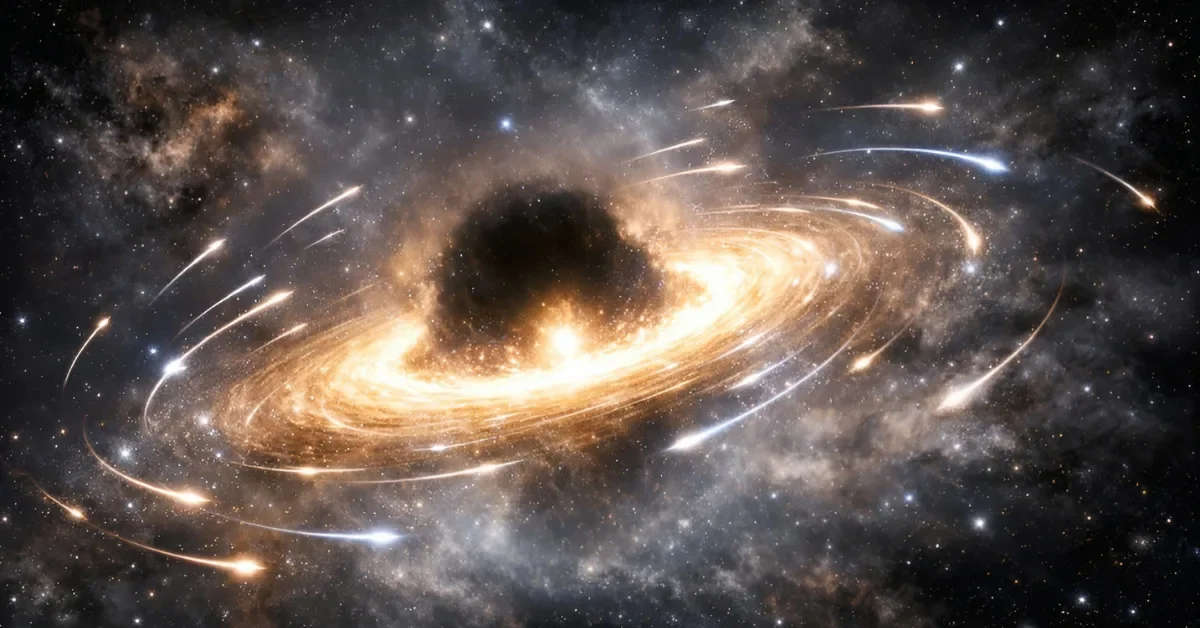
A groundbreaking new study challenges one of astronomy’s most established theories: that a supermassive black hole lies at the center of the Milky Way. Instead, an international team of researchers proposes that the gravitational behemoth governing our galaxy’s core may actually be a dense clump of dark matter. This controversial yet mathematically robust hypothesis suggests that a specific type of invisible particle could explain the behavior of stars and gas throughout the galaxy, offering a unified alternative to the traditional black hole model.
The research, published in the Monthly Notices of the Royal Astronomical Society, argues that the mysterious object known as Sagittarius A* (Sgr A*) is not a singularity but rather a massive, compact core made of fermions. These light subatomic particles, which make up the vast majority of the universe’s mass, could be packed so tightly that they exert a gravitational pull indistinguishable from a black hole in many observations. If confirmed, this theory would fundamentally reshape our understanding of the Milky Way, suggesting that the galaxy’s heart and its surrounding halo are actually two parts of a single, continuous structure.
Rethinking the Galactic Center
For decades, the prevailing consensus has been that Sgr A* is a supermassive black hole, a conclusion drawn largely from the behavior of nearby celestial objects. Astronomers have long observed a group of stars known as S-stars, which whip around the galactic center at tremendous speeds—up to several thousand kilometers per second. Similarly, mysterious dust-shrouded objects called G-sources have been tracked moving in ways that imply a massive, invisible anchor.
However, the new study posits that a dense core of fermionic dark matter could produce the exact same gravitational effects. According to the researchers, this core would be sufficiently compact and massive to dictate the frenetic orbits of the S-stars and G-sources, effectively mimicking the pull of a traditional black hole. Unlike a black hole, which collapses into a singularity, this dark matter core would remain a physical, non-singular structure, held up by the quantum mechanics of the particles themselves.
A Unified Cosmic Structure
The most compelling aspect of this new model is its ability to explain phenomena across the entire galaxy, not just at the center. The researchers propose that the Milky Way is not composed of separate dark matter components but is instead permeated by a single, continuous field of fermions. In this scenario, the dark matter transitions smoothly from a super-dense core into a vast, diffuse halo that stretches to the galaxy’s outer edges.
This “fermionic” model addresses discrepancies that have long puzzled scientists. Traditional models often rely on separate explanations for the central mass and the outer halo. By treating them as manifestations of the same substance, the new theory offers a more elegant, unified framework. The core is simply the region where the dark matter is most concentrated, while the halo represents its more tenuous outer reaches.
Evidence from Gaia and the Outer Halo
Crucial support for this hypothesis comes from the latest data released by the European Space Agency’s Gaia mission (Gaia DR3). This mission has provided the most detailed map to date of the Milky Way’s rotation curve, showing how fast stars and gas orbit at various distances from the center. The data revealed a “Keplerian decline,” a specific type of slowdown in the galaxy’s rotation at its outer fringes.
The research team found that their fermionic model predicts this exact behavior. While traditional “Cold Dark Matter” theories suggest halos that spread out with extended tails, the fermionic model predicts a tighter, more compact halo structure. When combined with the known mass of the galaxy’s visible disk and bulge, this compact halo perfectly fits the observed rotation curve. This successful bridge between the small-scale dynamics of the galactic center and the large-scale rotation of the halo strengthens the case for dark matter as the primary driver of galactic mechanics.
Mimicking the Black Hole Shadow
One of the biggest hurdles for any theory challenging the black hole paradigm is the famous image captured by the Event Horizon Telescope (EHT). This image shows a dark central shadow surrounded by a bright ring of light, a feature widely interpreted as the silhouette of a black hole’s event horizon. However, the study’s authors argue that their dark matter core can replicate this visual signature without requiring a black hole.
Building on previous research, the team demonstrated that a dense core of fermions would bend light so intensely that it would create a shadow-like feature almost identical to the one imaged by the EHT. When illuminated by a surrounding accretion disk of hot gas, the dark matter core would trap light and create a central darkness ringed by brightness. This finding suggests that the “shadow” is not definitive proof of a singularity but could instead be the signature of an exotic, super-dense particle cluster.
Future Tests and Observations
While the current data cannot decisively rule out a black hole, the dark matter model offers clear predictions that can be tested with upcoming technology. The researchers point to future observations with the GRAVITY interferometer, located on the Very Large Telescope in Chile, as a decisive testing ground. This instrument will be able to track stellar orbits with even greater precision, potentially revealing subtle differences between the gravitational field of a black hole and that of a dark matter core.
The ultimate test may lie in the search for “photon rings.” In General Relativity, a black hole produces specific, sharp rings of light caused by photons orbiting the event horizon. The fermionic dark matter model does not predict these rings. If future high-resolution imaging fails to find these distinct photon rings, it would provide strong evidence that the heart of our galaxy is indeed a giant clump of dark matter, forcing a rewrite of astrophysics textbooks.
