
By using this site, you agree to our Privacy Policy and Terms of Use.
Accept
VellaTimesVellaTimesVellaTimes
  • News
    NewsShow More
    Close-up of a silver espresso machine extracting a fresh shot of coffee into a glass cup in a softly lit cafe setting.
    Espresso Extraction Science: The Finer Grind Flaw
    May 18, 2026
    A smartphone resting on a wooden desk displaying an AI-powered Amazon search bar in a modern home office setting.
    Amazon Alexa for Shopping Replaces Rufus AI Assistant
    May 18, 2026
    Wide news-style image showing an OpenAI office scene with screens displaying audio waveforms and voice technology graphics
    OpenAI acquires Weights.gg to boost voice AI tools
    May 18, 2026
    Federal agents standing outside a modern university biology laboratory building at dusk during an active investigation.
    US Arrests Chinese Scientists for Smuggling Biological Materials
    May 18, 2026
    A dramatically lit modern corporate courtroom with futuristic technology elements, representing a high-stakes artificial intelligence legal trial.
    Elon Musk OpenAI Lawsuit Exposes Clashes Over AI Safety
    May 18, 2026
  • Technology
    TechnologyShow More
    Wide news-style image showing an OpenAI office scene with screens displaying audio waveforms and voice technology graphics
    OpenAI acquires Weights.gg to boost voice AI tools
    May 18, 2026
    A polished silicon wafer rests on a surface inside a modern semiconductor manufacturing facility.
    Samsung Strike Threatens Global AI Chip Production
    May 18, 2026
    A glowing computer screen displaying the text GPT-5.5 Instant in a modern, high-tech office environment with soft blue and purple lighting.
    GPT-5.5 Instant: OpenAI’s New Default ChatGPT Model
    May 10, 2026
    Wide view of a modern AI data center with server racks, glowing fiber-optic cables, and semiconductor hardware in the foreground.
    AI Infrastructure Spending Drives Nvidia, AMD Shares
    May 10, 2026
    A glowing computer monitor displaying lines of code and digital network graphics in a modern tech office setting.
    Airbnb AI Coding: 60% of New Software Now Generated by AI
    May 9, 2026
  • AI
    AIShow More
    A smartphone resting on a wooden desk displaying an AI-powered Amazon search bar in a modern home office setting.
    Amazon Alexa for Shopping Replaces Rufus AI Assistant
    May 18, 2026
    A dramatically lit modern corporate courtroom with futuristic technology elements, representing a high-stakes artificial intelligence legal trial.
    Elon Musk OpenAI Lawsuit Exposes Clashes Over AI Safety
    May 18, 2026
    A high-tech global map visualization showing glowing digital connections across different continents, representing the worldwide adoption of artificial intelligence.
    Global AI Adoption in 2026: Trends and Growing Divide
    May 10, 2026
    A modern smartphone displaying an artificial intelligence chat interface used for online shopping and product comparison.
    Alibaba Qwen AI Taobao Integration Launches Agentic Shopping
    May 10, 2026
    A split-screen illustration showing a high-tech modern office using advanced AI tools contrasted against an older, dimly lit workspace.
    Global AI Adoption Surges But Rich-Poor Divide Widens
    May 9, 2026
  • Science
    ScienceShow More
    Close-up of a silver espresso machine extracting a fresh shot of coffee into a glass cup in a softly lit cafe setting.
    Espresso Extraction Science: The Finer Grind Flaw
    May 18, 2026
    Federal agents standing outside a modern university biology laboratory building at dusk during an active investigation.
    US Arrests Chinese Scientists for Smuggling Biological Materials
    May 18, 2026
    Header image of a quantum communication lab setup with fiber-optic equipment, a telecom quantum dot device, and interferometer components used for long-distance quantum key distribution.
    Quantum Key Distribution Reaches 120 km With Quantum Dots
    May 10, 2026
    Abstract geometric representation of glowing quantum paraparticles interacting within a three-dimensional mathematical grid in deep blue and gold tones.
    Quantum Paraparticles Exist: New Math Challenges Physics
    May 10, 2026
    A large expedition cruise ship is navigating rough ocean waters under a cloudy sky.
    Global Authorities Respond to Andes Hantavirus Outbreak on MV Hondius Cruise Ship
    May 9, 2026
  • World
    WorldShow More
    Allu Arjun Commitment to Ethical Brand Partnerships
    Exploring Allu Arjun’s Commitment to Ethical Brand Partnerships
    December 18, 2023
    Orry aka Orhan Awatramani
    Orhan Awatramani ‘Orry’ Biography, Lifestyle and Rise to Fame
    December 8, 2023
    Alia Bhatt Latest Deepake Video Victim
    Alia Bhatt becomes latest victim of Deepfake Videos, Obscene Video goes Viral
    November 28, 2023
    Napoleon Movie Review
    Napoleon Movie Review: A Historical Epic by Ridley Scott Reviewed
    November 25, 2023
  • Bookmarks
Search
Category
  • News
  • Technology
  • AI
  • Science
  • World
Company
  • About Us
  • Contact Us
  • Fact Checking Policy
  • Terms & Conditions
  • Privacy Policy
  • Copyright Policy
Resources
  • Home
  • Web Stories
  • Bookmarks
  • Interests
  • Disclaimer
  • Sitemap
© 2022 VellaTimes • All Rights Reserved.
Reading: New Study Suggests Dark Matter, Not Black Hole, Powers Milky Way’s Heart
Share
Notification Show More
Font ResizerAa
VellaTimesVellaTimes
Font ResizerAa
  • News
  • Technology
  • AI
  • Science
  • World
Search
  • Explore
    • News
    • Technology
    • AI
    • Science
    • World
  • Useful Links
    • About Us
    • Contact Us
    • Fact Checking Policy
    • Terms & Conditions
    • Privacy Policy
    • Copyright Policy
  • Home
  • Web Stories
  • Bookmarks
  • Interests
  • Disclaimer
  • Sitemap
© 2022 VellaTimes • All Rights Reserved.
News

New Study Suggests Dark Matter, Not Black Hole, Powers Milky Way’s Heart

Nisha Pradhan
Last updated: 06/02/2026
Nisha Pradhan
Share
8 Min Read
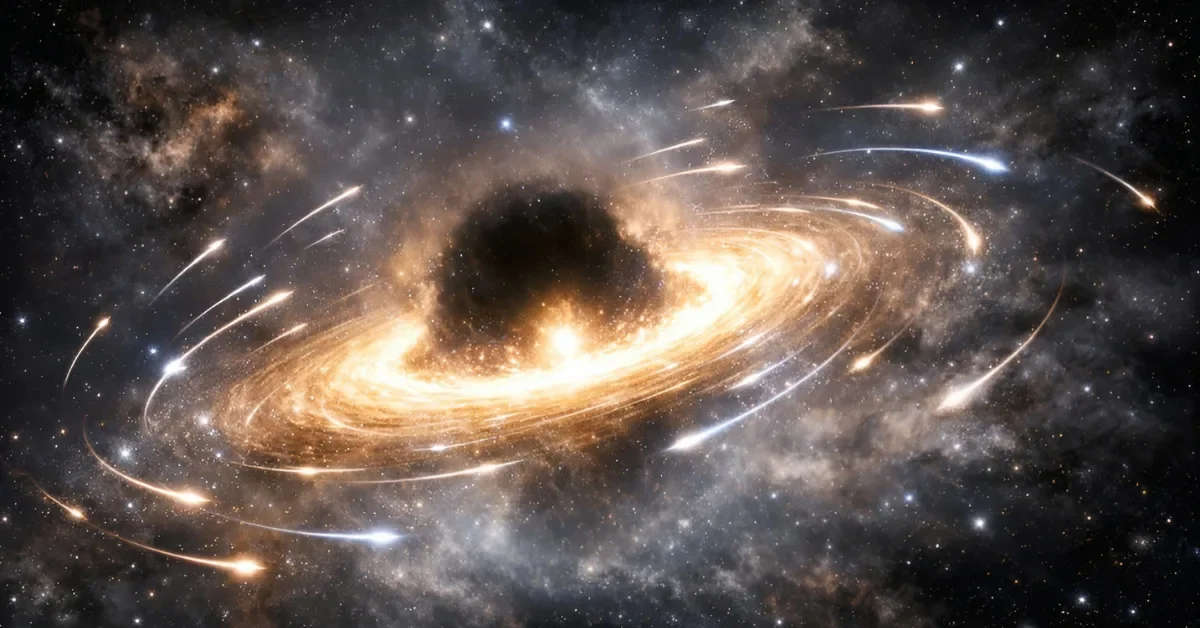
Artistic rendering of the Milky Way's center showing a dense dark matter core surrounded by orbiting stars and a diffuse halo, illustrating the new fermionic dark matter theory.

A groundbreaking new study challenges one of astronomy’s most established theories: that a supermassive black hole lies at the center of the Milky Way. Instead, an international team of researchers proposes that the gravitational behemoth governing our galaxy’s core may actually be a dense clump of dark matter. This controversial yet mathematically robust hypothesis suggests that a specific type of invisible particle could explain the behavior of stars and gas throughout the galaxy, offering a unified alternative to the traditional black hole model.

Contents
Rethinking the Galactic CenterA Unified Cosmic StructureEvidence from Gaia and the Outer HaloMimicking the Black Hole ShadowFuture Tests and Observations

The research, published in the Monthly Notices of the Royal Astronomical Society, argues that the mysterious object known as Sagittarius A* (Sgr A*) is not a singularity but rather a massive, compact core made of fermions. These light subatomic particles, which make up the vast majority of the universe’s mass, could be packed so tightly that they exert a gravitational pull indistinguishable from a black hole in many observations. If confirmed, this theory would fundamentally reshape our understanding of the Milky Way, suggesting that the galaxy’s heart and its surrounding halo are actually two parts of a single, continuous structure.

Rethinking the Galactic Center

For decades, the prevailing consensus has been that Sgr A* is a supermassive black hole, a conclusion drawn largely from the behavior of nearby celestial objects. Astronomers have long observed a group of stars known as S-stars, which whip around the galactic center at tremendous speeds—up to several thousand kilometers per second. Similarly, mysterious dust-shrouded objects called G-sources have been tracked moving in ways that imply a massive, invisible anchor.

However, the new study posits that a dense core of fermionic dark matter could produce the exact same gravitational effects. According to the researchers, this core would be sufficiently compact and massive to dictate the frenetic orbits of the S-stars and G-sources, effectively mimicking the pull of a traditional black hole. Unlike a black hole, which collapses into a singularity, this dark matter core would remain a physical, non-singular structure, held up by the quantum mechanics of the particles themselves.

A Unified Cosmic Structure

The most compelling aspect of this new model is its ability to explain phenomena across the entire galaxy, not just at the center. The researchers propose that the Milky Way is not composed of separate dark matter components but is instead permeated by a single, continuous field of fermions. In this scenario, the dark matter transitions smoothly from a super-dense core into a vast, diffuse halo that stretches to the galaxy’s outer edges.

This “fermionic” model addresses discrepancies that have long puzzled scientists. Traditional models often rely on separate explanations for the central mass and the outer halo. By treating them as manifestations of the same substance, the new theory offers a more elegant, unified framework. The core is simply the region where the dark matter is most concentrated, while the halo represents its more tenuous outer reaches.

Evidence from Gaia and the Outer Halo

Crucial support for this hypothesis comes from the latest data released by the European Space Agency’s Gaia mission (Gaia DR3). This mission has provided the most detailed map to date of the Milky Way’s rotation curve, showing how fast stars and gas orbit at various distances from the center. The data revealed a “Keplerian decline,” a specific type of slowdown in the galaxy’s rotation at its outer fringes.

The research team found that their fermionic model predicts this exact behavior. While traditional “Cold Dark Matter” theories suggest halos that spread out with extended tails, the fermionic model predicts a tighter, more compact halo structure. When combined with the known mass of the galaxy’s visible disk and bulge, this compact halo perfectly fits the observed rotation curve. This successful bridge between the small-scale dynamics of the galactic center and the large-scale rotation of the halo strengthens the case for dark matter as the primary driver of galactic mechanics.

Mimicking the Black Hole Shadow

One of the biggest hurdles for any theory challenging the black hole paradigm is the famous image captured by the Event Horizon Telescope (EHT). This image shows a dark central shadow surrounded by a bright ring of light, a feature widely interpreted as the silhouette of a black hole’s event horizon. However, the study’s authors argue that their dark matter core can replicate this visual signature without requiring a black hole.

Building on previous research, the team demonstrated that a dense core of fermions would bend light so intensely that it would create a shadow-like feature almost identical to the one imaged by the EHT. When illuminated by a surrounding accretion disk of hot gas, the dark matter core would trap light and create a central darkness ringed by brightness. This finding suggests that the “shadow” is not definitive proof of a singularity but could instead be the signature of an exotic, super-dense particle cluster.

Future Tests and Observations

While the current data cannot decisively rule out a black hole, the dark matter model offers clear predictions that can be tested with upcoming technology. The researchers point to future observations with the GRAVITY interferometer, located on the Very Large Telescope in Chile, as a decisive testing ground. This instrument will be able to track stellar orbits with even greater precision, potentially revealing subtle differences between the gravitational field of a black hole and that of a dark matter core.

The ultimate test may lie in the search for “photon rings.” In General Relativity, a black hole produces specific, sharp rings of light caused by photons orbiting the event horizon. The fermionic dark matter model does not predict these rings. If future high-resolution imaging fails to find these distinct photon rings, it would provide strong evidence that the heart of our galaxy is indeed a giant clump of dark matter, forcing a rewrite of astrophysics textbooks.

TAGGED: astronomy, astrophysics, Black Hole, dark matter, Fermions, Gaia Mission, Milky Way, Sagittarius A*, Scientific Research, Space News
Share This Article
Facebook Twitter Whatsapp Whatsapp Telegram Copy Link
By Nisha Pradhan
I am a passionate content creator with a deep love for travel, music, and food. Using my unique blend of these interests, I genuinely enjoy crafting high-quality travel, lifestyle, and entertainment-related news content.
Leave a comment

Leave a Reply Cancel reply

Your email address will not be published. Required fields are marked *


Most Read

Neutron Star Collision Found in Tiny Distant Galaxy

March 14, 2026

Samsung Galaxy A55 Unveiled: A Powerful Game-Changer in Mid-Range Smartphones

December 17, 2023

Scientists Observe Positronium Wave Behavior in Lab

May 1, 2026

Universal thermal performance curve governs all life

March 14, 2026

Ocean Methane Discoveries Reveal Hidden Ecosystems

April 17, 2026

Samsung record Q4 profit jumps as AI chips tighten supply

January 29, 2026

Related News

Close-up of a silver espresso machine extracting a fresh shot of coffee into a glass cup in a softly lit cafe setting.
News

Espresso Extraction Science: The Finer Grind Flaw

Nisha Pradhan Nisha Pradhan May 18, 2026
A smartphone resting on a wooden desk displaying an AI-powered Amazon search bar in a modern home office setting.
News

Amazon Alexa for Shopping Replaces Rufus AI Assistant

Sameer Katoch Sameer Katoch May 18, 2026
Wide news-style image showing an OpenAI office scene with screens displaying audio waveforms and voice technology graphics
News

OpenAI acquires Weights.gg to boost voice AI tools

Rakesh Paul Rakesh Paul May 18, 2026

About Us

VellaTimesVellaTimesVellaTimes

VellaTimes is a leading news portal that covers the latest trending news in technology, lifestyle, entertainment, automobiles, travel, and sports.

Explore

  • News
  • Technology
  • AI
  • Science
  • World

Useful Links

  • About Us
  • Contact Us
  • Fact Checking Policy
  • Terms & Conditions
  • Privacy Policy
  • Copyright Policy

Subscribe Us

Subscribe to our newsletter for the Latest News and Top Stories!

© 2022 VellaTimes • All Rights Reserved.
  • Home
  • Web Stories
  • Bookmarks
  • Interests
  • Disclaimer
  • Sitemap
adbanner
AdBlocker Detected
Our site is an advertising supported site. Please whitelist us to support our work.
Okay, I'll Whitelist